Investment volume in 2025 around 35 percent above previous year | Take-up rises to 1.29 million sqm in the second half of the year | Manufacturing real estate remains the strongest market segment | Yields and rents largely stable
Overall, the market for light industrial real estate in Germany developed more robustly in 2025 than in the previous year. Although the investment market lost some pace again in the second half of the year after the dynamic start to the year, the transaction volume rose significantly by 35.4 percent to around EUR 1.61 billion for the year as a whole. These are the key findings of the current market report of the LIGHT INDUSTRIAL INITIATIVE.
In the second half of 2025, the investment volume was around EUR 720.6 million, below the level of EUR 893.2 million in the first half of the year. At the same time, the weak comparative period of the previous year was clearly exceeded. The market continues to be strongly influenced by individual transactions, while portfolio deals play only a subordinate role.
Production real estate remains the dominant asset class
The market activity was once again driven primarily by production properties. With around EUR 280 million, or 39 percent of the half-year volume, they represented the property category with the highest turnover. Business parks accounted for around EUR 213.7 million, warehouse properties for EUR 226.9 million.
Regionally, investment activity continued to be concentrated on established business and industrial locations. The South region was once again in first place with EUR 225.3 million or 31.3 percent of the transaction volume. This was followed by the Rhine-Ruhr conurbation with 157.9 million euros and Munich and the surrounding area with 105.2 million euros. Locations where industrial value creation, good infrastructure and resilient user demand come together remain particularly in demand.
On the buyer side, asset and fund managers as well as private equity companies remained the most active group of players. They invested EUR 279.8 million in the second half of the year, accounting for 38.8 percent of the total transaction volume. Institutional and professional market players thus continued to determine market activity.
Yields stabilize
Yields moved largely sideways in the second half of 2025. Business parks had a prime yield of 6.3 percent, warehouse properties 5.4 percent and production properties remained unchanged at 7.2 percent. Pricing in the market has thus stabilised to a large extent, while at the same time valuation remains highly dependent on property quality, location and flexibility of use.
Take-up developed positively in the second half of the year. At around 1.29 million sqm, it was both above the first half of the year (1.16 million sqm) and significantly higher than in the same period of the previous year. For the year as a whole, however, take-up remained below the level of 2024, which was characterised by an exceptionally strong first half of the year.
Production real estate drives demand for space
Demand continued to be concentrated primarily on production properties. At the same time, the market is selective: many companies continue to make location decisions cautiously and with a view to the difficult economic environment. At the same time, individual large-volume deals – including from the defence-related industrial sector – provided additional demand impetus.
Rents remained stable overall. An exception is Flex Spaces, whose prime rent rose slightly to 18.20 euros/sqm. Absolute top properties with outstanding location characteristics now reach up to 21.00 euros/sqm. Production space as well as office and social space, on the other hand, remained at the level of the first half of the year.
Project pipeline remains well filled
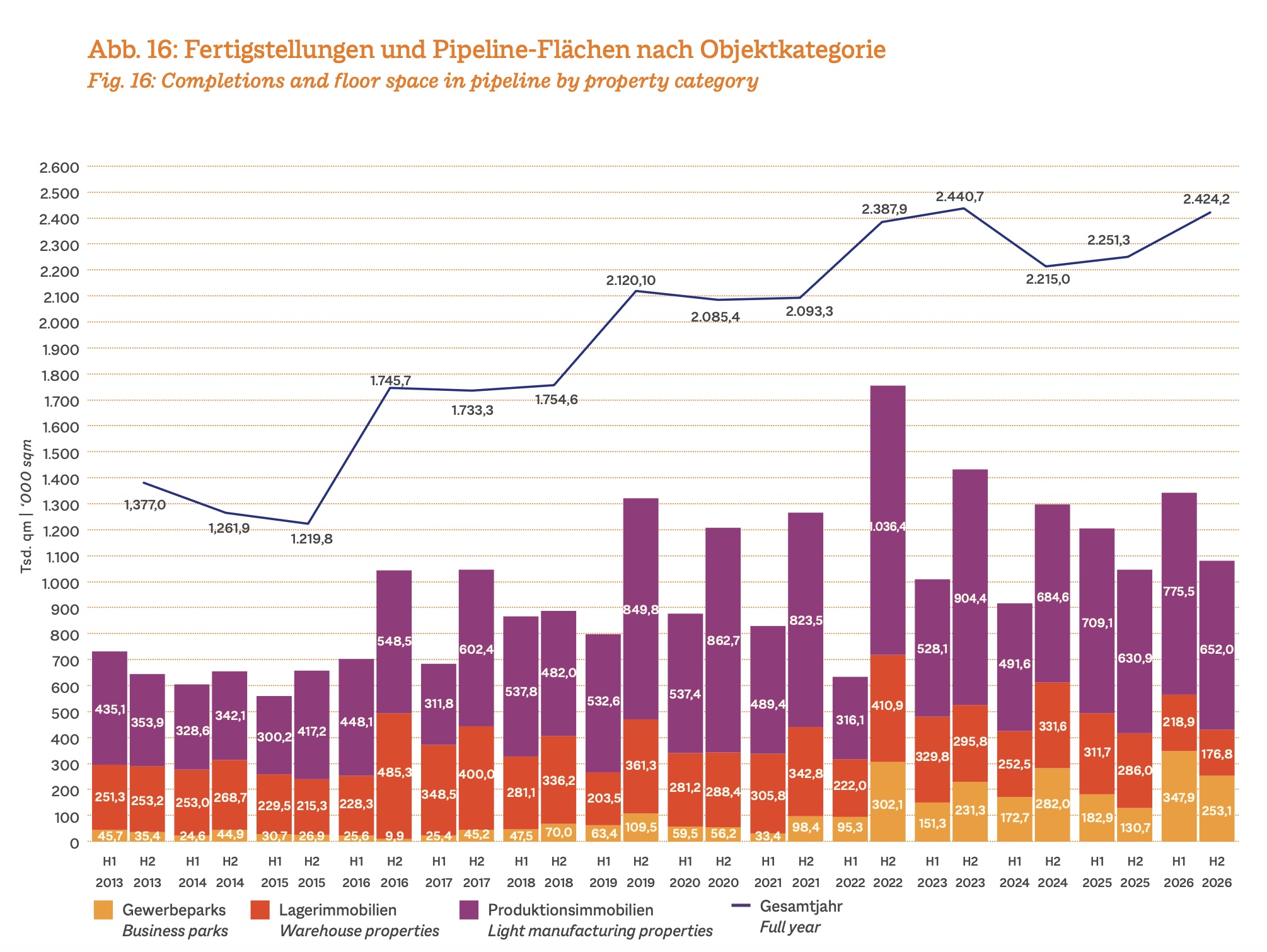
The completion volume in the second half of 2025 was around 1.05 million sqm, 12.9 percent below the first half of the year. For the year as a whole, however, a slight increase in completions of 1.6 percent was recorded compared to 2024.
For 2026, the project pipeline points to a further increase in completions. However, construction delays, financing difficulties and changed market conditions remain uncertainties for further development.