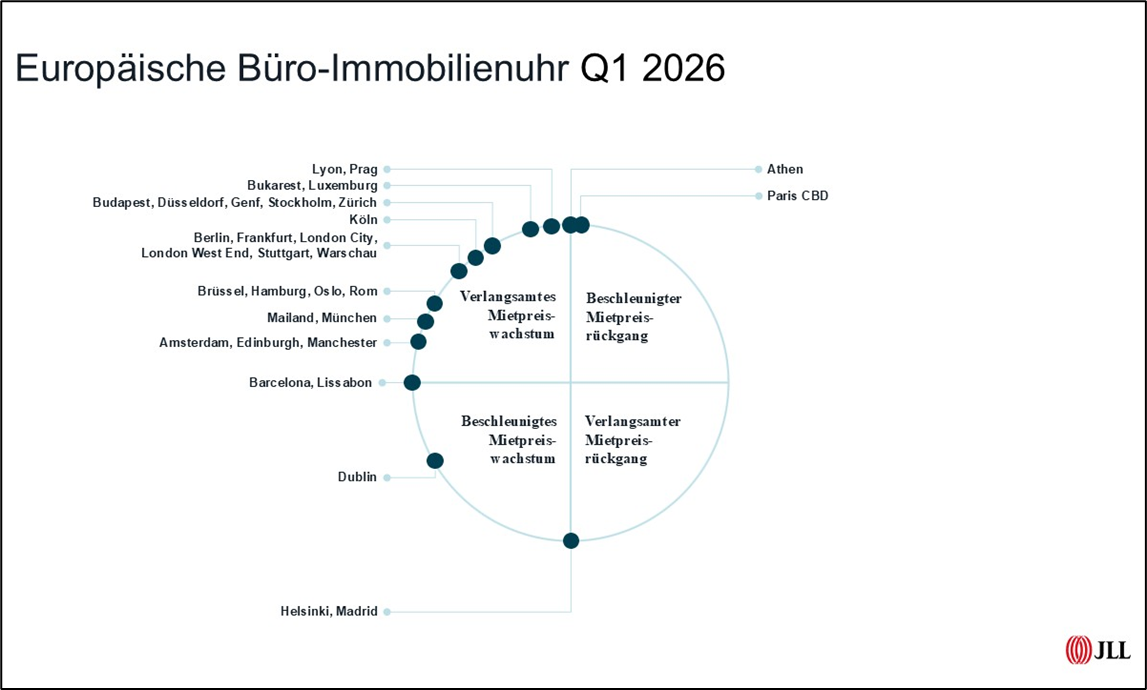
JLL EMEA office real estate clock in the first quarter of 2026
The first quarter of 2026 started on a bullish note in Europe – subdued inflation, stable or falling interest rates, and clearer government budgets. However, the escalating conflicts in the Middle East caused considerable uncertainty. The longer the conflict and the associated supply chain disruptions – such as the closure of the Strait of Hormuz – continue, the greater and more lasting the economic and inflationary impact on Europe will be. If the conflict ends promptly, the damage can be limited and temporary.
Recent data show moderate economic growth, with the eurozone growing by 0.3 percent in the fourth quarter of 2025 and similar subdued growth is expected in the first quarter of 2026, although the conflict led to a decline in March. Economic indicators weakened, as shown by the decline in the purchasing managers’ index in March in the eurozone and the UK. “Central banks paused monetary policy in the face of uncertainty, suggesting that rate hikes are more likely than cuts if the conflict lasts longer,” says Hela Hinrichs, Senior Director EMEA Research & Strategy JLL. Inflation was still falling at the beginning of the year, but all forecasts now expect an increase. The most important variable for Europe’s outlook remains the duration and consequences of the ongoing conflict.
Prime office rents: polarisation is increasing in Europe’s most important markets
European prime office rents continued to rise in the first quarter of 2026, rising 5.6 percent year-on-year and 0.7 percent quarter-on-quarter, beating the ten-year average. This growth is driven by a focus on quality, as companies increasingly seek modern, sustainable centrally located office space to meet current company and employee expectations. “However, demand is meeting a structural shortage of suitable new buildings and high-quality renovated space, which intensifies competition for the best offices and drives up prime rents,” explains Hinrichs.
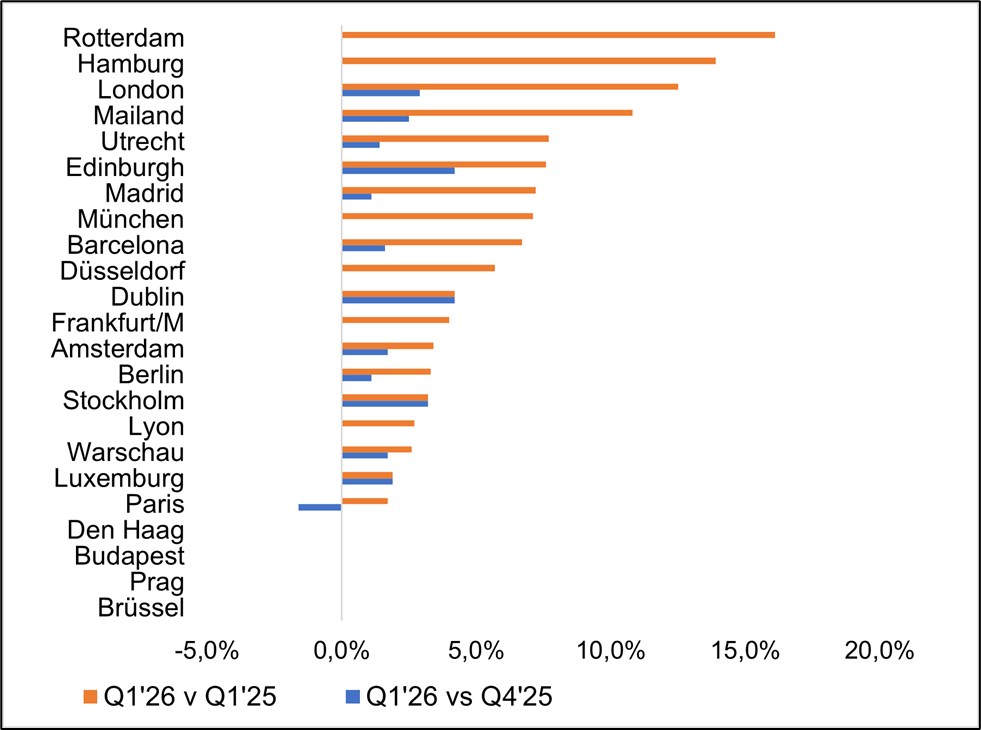
As a result, there is growing polarization in Europe’s office markets, with rental price differentials between prime and secondary properties widening. Notable year-on-year increases in prime rents were recorded in Rotterdam (16.1 per cent), Hamburg (13.9 per cent) and London (12.5 per cent), with strong quarterly increases in Edinburgh and Dublin (both 4.2 per cent). Paris was the only index market to decline quarter-on-quarter, as rents there have reached an affordability limit.
Take-up in the most important markets declines
European office space take-up reached 1.85 million m² in the first quarter of 2026, a decline of 14 per cent year-on-year. The main reason for this is weaker activity in key markets such as Paris, Frankfurt, Amsterdam and Southern Europe.
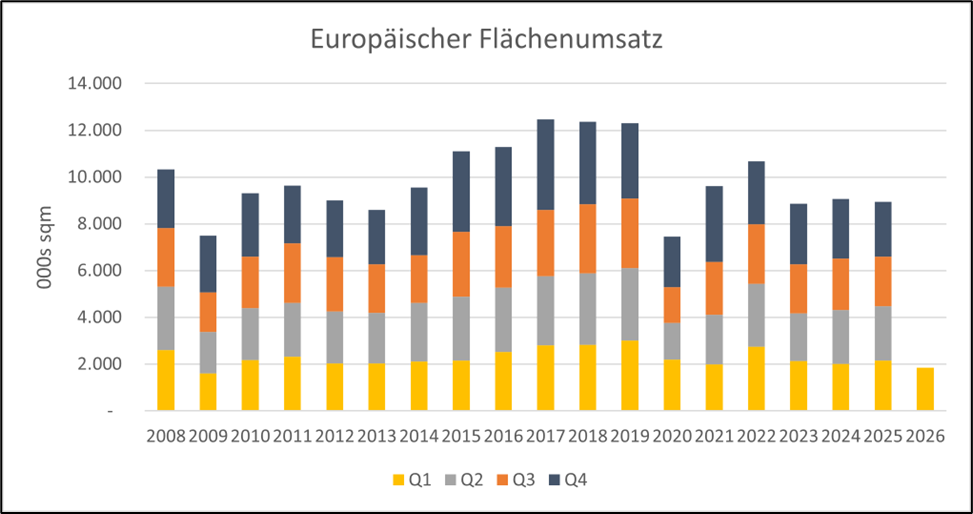
Nine markets recorded increased demand, led by the small markets of Rotterdam and Utrecht, which again recorded office space lettings of more than 10,000 m² in the 1st quarter and increased by a three-digit percentage. However, Berlin was also able to report a 43 percent increase in office space lettings after a weak result in the previous year. In contrast, 14 markets had to accept declines, including Frankfurt (minus 62 percent) and Brussels (minus 49 percent).
London remained robust, reaching more than 200,000 sqm of take-up, an increase of 14 per cent compared to Q1 2025, with demand growing in both the City and West End, driven mainly by professional services and AI-oriented users in the technology, media and telecommunications industries.
In Paris, take-up fell by 15 per cent to 368,000 m², mainly due to a decline in large transactions. In addition, numerous smaller leases were registered, with central districts performing worse compared to cheaper sub-markets and the suburbs.
Vacancy rate rises more slowly due to a lack of modern space
The vacancy rate in Europe’s office market rose to 9.4 percent at the end of the first quarter of 2026, an increase of 40 basis points year-on-year, but the supply of new space remains limited. This limits the risk of a further significant increase in vacancy in 2026. Twelve index markets recorded higher vacancy rates, led by Edinburgh (up 70 basis points to 7.4 percent), Warsaw (up 50 basis points to 9.5 percent) and Munich (up 40 basis points to 8.9 percent), while eleven markets, including Utrecht (down 130 basis points to 4.1 percent), Amsterdam (down 100 basis points to 8.8 percent) and Madrid (down 50 basis points to 8.6 percent) saw declines.
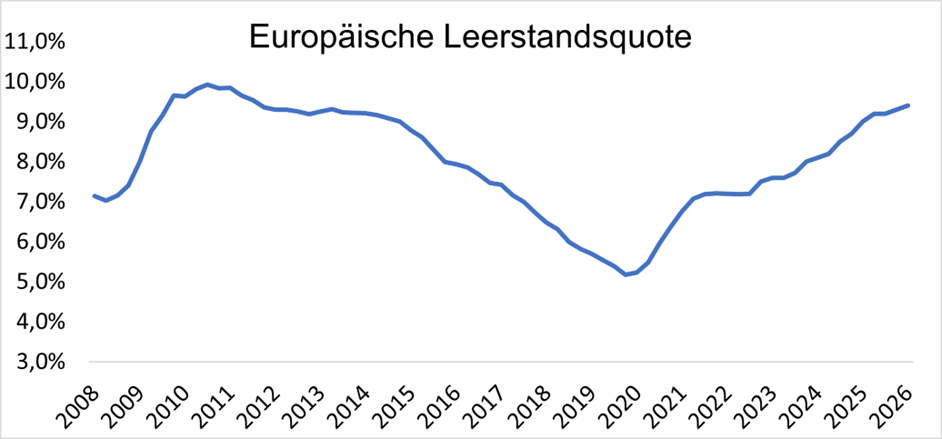
The vacancy rate in London fell slightly to 8.8 percent due to a shortage of new and refurbished office buildings, which favored rental growth and pre-letting activity. The office vacancy rate in Paris, on the other hand, has continued to rise slightly to 11.4 percent
Although the vacancy rate in Germany has risen slightly, a high pre-letting rate and a shrinking development pipeline point to future shortages of high-quality office space.
“The amount of land under construction fell to a nine-year low, with speculative projects accounting for only about half. A not inconsiderable part of the space under construction is now accounted for by comprehensive renovation projects and reflects the interest of investors in upgrading outdated and outdated office properties,” says Hinrichs.