By 2030, many data centers will be built in Germany beyond the metropolises
The German data center market is growing noticeably beyond the major metropolises. Although Frankfurt will maintain its leading position in the medium term, hundreds of megawatts (MW) of computing power will also be generated in rural areas by 2030. This is shown by the current JLL report “The New Geography of the Data Center Market in Germany”, which analyzes the development of the market in the coming years and the position of the German market in an international comparison.
Frankfurt leads, Berlin and new locations are catching up
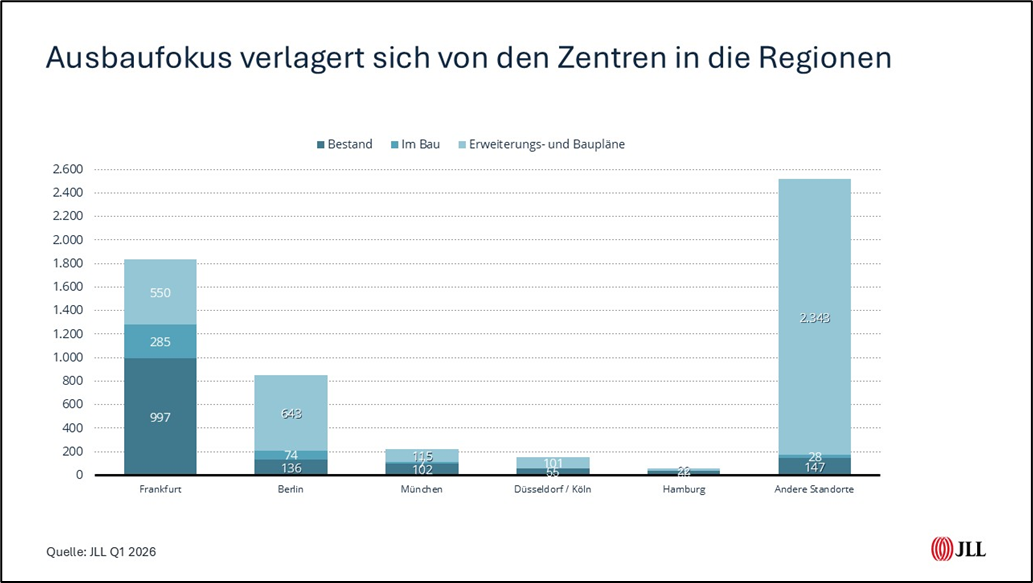
With 997 MW of installed IT capacity and a vacancy rate of only four percent, Frankfurt remains the largest European top market for data centers. “The Main metropolis recorded a record in 2025 with 135 MW of newly added capacity. But the city is reaching its limits when it comes to energy infrastructure: “Waiting times for grid connections of larger plants can currently be more than ten years,” points out the author of the study, Stanislav Kreuzer, Senior Director EMEA Research Data Hub Operations.
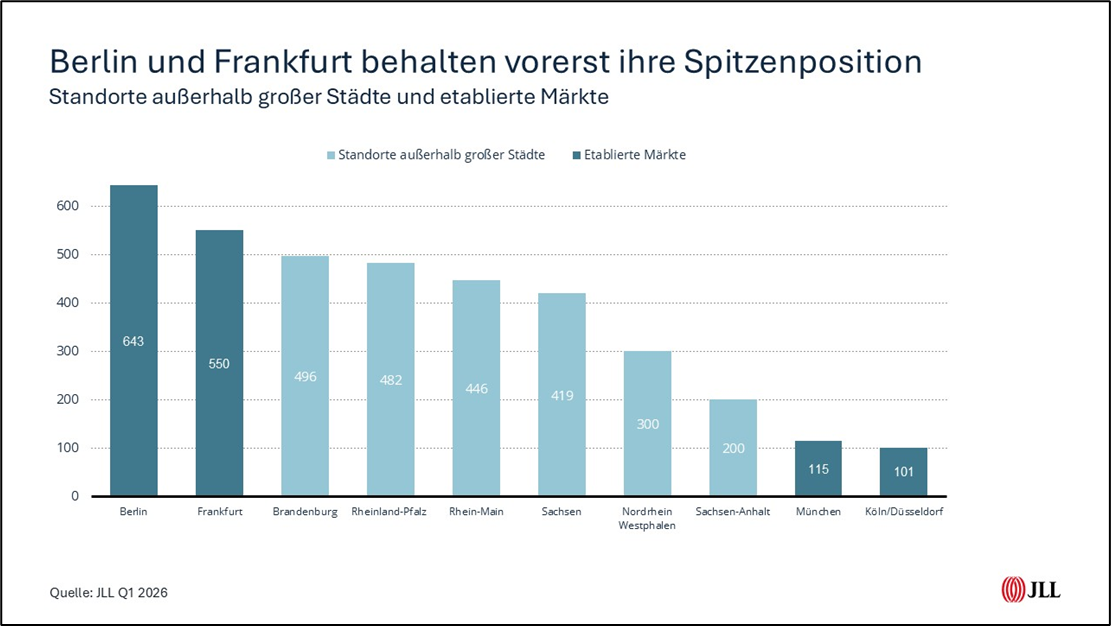
Meanwhile, Berlin is developing the strongest growth. With 136 MW currently in stock and a pipeline of 74 MW under construction and 643 MW planned, IT capacity is expected to increase to up to 853 MW by 2030 – an increase of six times. Munich is following with 102 MW of stock and 122 MW of planned capacity, while Cologne/Düsseldorf, with 55 MW of stock and 100 MW of planned capacity, will benefit from major projects such as Microsoft’s investment in the Rhenish mining area.
The rise of decentralized locations is also remarkable: In North Rhine-Westphalia, Blackstone is planning a data center with up to 200 MW of computing power in Hamm, Westphalia, for around four billion euros. The Schwarz Group is building a plant in Brandenburg (Lübbenau/Spreewald) with a connected load of 200 MW at a cost of eleven billion euros. In Saxony, the “Green Power Park” in Rackwitz is being planned with a connected load of up to 500 MW.
Germany is ahead in a European comparison
With a total of 529 data centers, Germany ranks first in Europe. The German data center market is currently estimated at $7.7 billion and is expected to grow to $12.84 billion by 2030. As part of this, IT capacity is to increase from the current 1.3 GW to up to 4.85 GW.
“However, the European landscape is shifting: The share of the established FLAP-D markets (Frankfurt, London, Amsterdam, Paris, Dublin) in the overall European data center capacity could fall from 62 to 51 percent by 2035,” Kreuzer observes. Nordic countries and Spain are becoming more attractive due to shorter grid connection times, cheaper renewable energies and greater land availability. The electricity demand of data centers in Denmark, Norway and Sweden is expected to increase fivefold by 2030.
Artificial intelligence requires more and more computing power
Artificial intelligence is currently the strongest growth driver. According to Bitkom, the share of AI applications in installed data center capacity in Germany is expected to increase from the current 15 percent to 40 percent by 2030. The cloud migration of the economy forms another solid basis: companies want to move more than half of their IT applications to the cloud by 2030.
A third decisive factor is digital sovereignty. US hyperscalers control two-thirds of the European cloud market. The elimination of American cloud providers would create a supply gap of around 1,200 MW for Germany. The German government’s data center strategy, adopted in March 2026, aims to at least double capacities and quadruple AI capacities by 2030.
Energy as a key factor
Energy supply is becoming the biggest challenge. Data centers are transforming from passive consumers to active players in the energy system. Battery Energy Storage Systems (BESS) enable so-called “peak shaving” and contribute to grid stabilization. Operators invest in their own photovoltaic and wind power plants or build their own power plants, such as CyrusOne in Frankfurt-Sossenheim with a 61 MW gas-fired power plant.
“The German data center market is at a turning point. Geographical diversification is a direct response to capacity constraints and underlines the need for innovative solutions in energy and sustainability,” concludes Stanislav Kreuzer .