

Recent stress in private credit exposed the cost of opaque collateral and concentrated risk but was largely confined to corporate lending rather than private credit as a whole. Real estate debt is underpinned by tangible, repriced collateral, inflation-linked income, and low equity correlation. With ~EUR 617bn of European CRE loans maturing in 2026-2028 and Basel IV driving bank retrenchment, it offers a core fixed-income allocation.
A Moment of Reckoning for Private Credit
Private credit has faced several challenges recently. Redemption requests at several semi-liquid direct-lending vehicles, questions over the accuracy of reported net asset values, and a sharp re-rating of software credits as AI reset the sector’s earnings outlook have together forced a harder look at what sits inside these portfolios.
Two failures crystallized the concern. In September 2025, the subprime auto lender Tricolor Holdings filed for Chapter 7 after it emerged that the same loan collateral had been pledged across multiple warehouse lines. Days later, the auto-parts supplier First Brands Group filed for Chapter 11 with liabilities in excess of USD 11bn, including roughly USD 2.3bn of factoring obligations the company itself flagged as fraudulent – invoices fabricated, inflated, or sold to several lenders at once. Both cases were idiosyncratic frauds rather than evidence of broad credit deterioration, but they did real damage to confidence, and the Federal Reserve’s November 2025 Financial Stability Report pointed directly at the opacity of private-credit exposures and the growing interlinkage between banks and non-bank lenders.
The distinction that most commentary has missed is that these problems are concentrated in corporate direct lending, not in private credit as a category. According to Oaktree, direct lending has grown from roughly USD 150bn to around USD 2tn in two decades and now dominates the headlines, but it is only one part of a market that also includes asset-based finance, infrastructure debt and commercial real estate debt – each with different collateral, different risk drivers and different behavior through a cycle. Treating them as one allocation is the error.
Where real estate debt is genuinely different
Private credit is not a single asset class. Its strategies differ materially in collateral, covenant protection, inflation linkage and valuation transparency – positioning real estate debt at a favorable point in the risk-return spectrum relative to both corporate direct lending and public market alternatives. The case for real estate debt does not rest on it being immune to cycles. It rests on four structural features that change the shape of the downside.
Collateral you can value independently.
Real estate debt is secured against physical assets, such as residential, logistics, and office buildings, appraised independently and corroborated by observable transactions. The valuation anxiety now unsettling direct-lending investors is, at root, a question of whether marks on enterprise value and projected cash flows can be trusted. That question is far harder to ask of a building with a registered title and comparable evidence behind its value.
A loan written against an already-repriced basis.
This is the most important point and the one most often understated. According to Generali Real Estate, European real estate values fell by roughly 16% between mid-2022 and mid-2024, and the bulk of that correction was driven by the rate shock, not by deteriorating property income – net operating income continued to grow through the repricing. A loan originated today therefore attaches to a value that has already absorbed the shock, with the borrower’s equity sitting below it on that reset basis. That is a fundamentally different position from much of the 2019-2021 direct-lending book, which was underwritten against peak-cycle valuations and high entry multiples. The protection is real – but only if the lender underwrites to current value and conservative leverage, rather than betting on a recovery to refill the cushion.
Security and seniority that survive enforcement.
A first-ranked mortgage over an identified asset, documented in a single whole-loan agreement, gives the lender control and a recovery path tied to something with a market. We would stress the first-rank feature in particular: recovery is anchored to a tangible asset that can be sold, not to a going-concern value that can evaporate. It is also the structural answer to the fraud that brought down Tricolor and First Brands – a registered charge over a specific property is far harder to pledge twice than a pool of receivables.
Inflation linkage and lower sector concentration.
Many European leases carry explicit indexation, passing inflation through to rents and supporting both collateral values and borrower cash flow – a useful feature now that energy-driven price pressure has reappeared. Corporate borrowers face the opposite: inflation erodes margins and debt-service capacity. And where direct lending has concentrated heavily in software and technology, precisely the sectors AI is now repricing, real estate debt is spread across property types and jurisdictions, which limits correlated loss.
Why it earns a place in the portfolio
The allocation argument follows from the income, not from a back-test. Real estate debt returns are driven by contractual interest on senior, secured positions – a different engine from the earnings-and-multiple cycle that moves public equity and corporate credit. That is the structural reason its returns show low correlation to listed markets, and why it held its role in 2022, when equities and bonds fell together and the conventional fixed-income hedge failed.
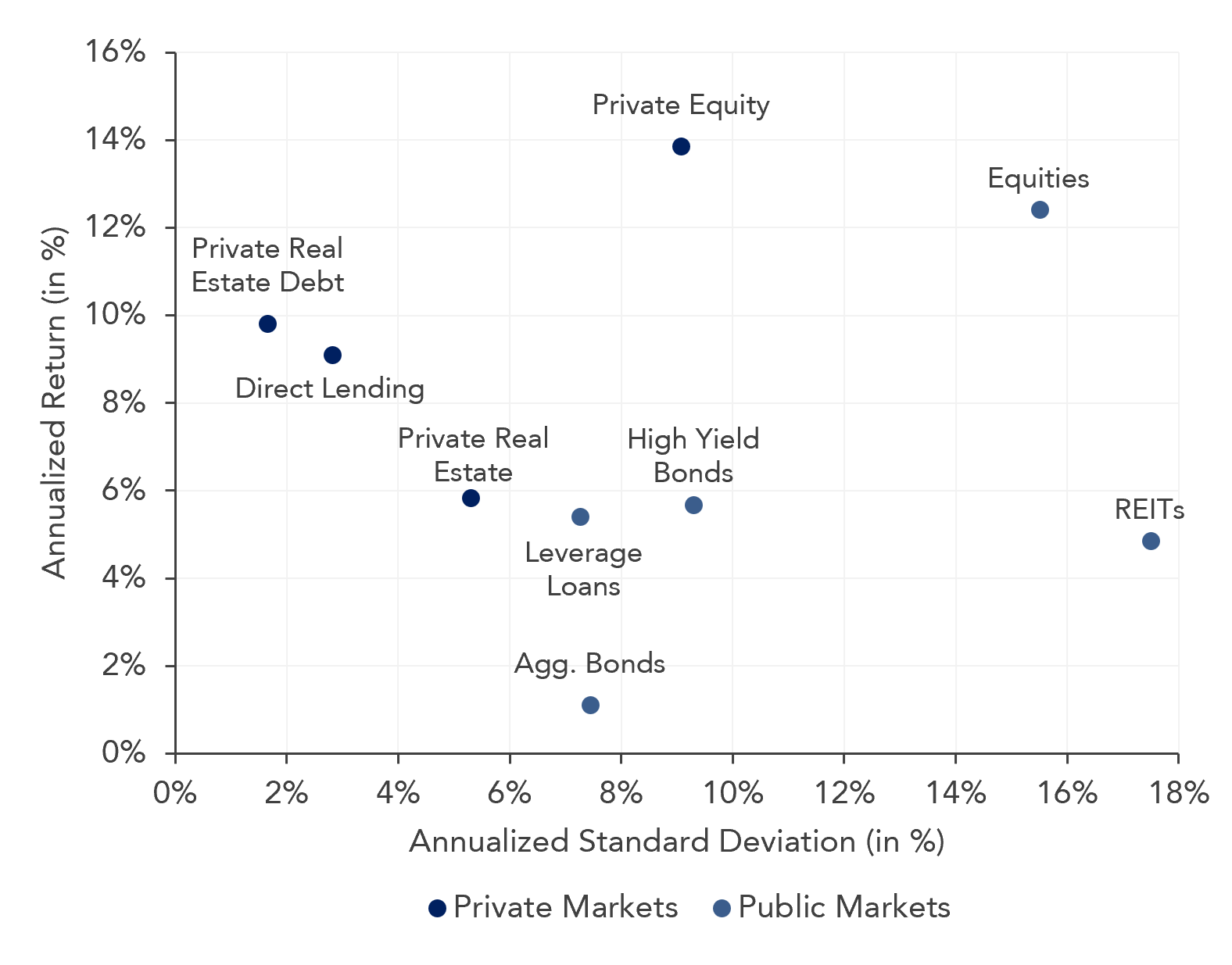
The long-run record bears this out. Over the ten years to September 2025, private real estate debt has occupied the most efficient corner of the risk-return spectrum – delivering returns comparable to far riskier public and private strategies, but at substantially lower volatility and with materially shallower drawdowns than equities, REITs or listed infrastructure (Figure 1). For an allocator, the point is not that real estate debt outperforms in every environment; it is that it adds a genuinely different return stream rather than another version of the credit risk already in the book.
The European structural opportunity
For European investors, the case is reinforced by the shape of the lending market itself. Banks still provide around 84% of European CRE financing – against 54% in the UK and roughly 40% in the US – over an estimated EUR 2.3tn of outstanding loans, so even a modest shift in market share moves a great deal of capital (Figure 2). The more telling figure is the other side of that split: dedicated alternative lenders hold barely 1% of the European market, versus around 14% in the US. Basel IV and CRR III are widening the gap, raising the capital cost of higher-leverage and development exposures and pushing banks toward the narrowest, most prime segments – leaving precisely the complex, transitional and development financings that non-bank capital is built to take.
At the same time, roughly EUR 617bn of European CRE loans mature between 2026 and 2028, with market estimates putting around EUR 74bn – about 12% – at risk of a funding gap. The stress is concentrated in 2016-2021 vintages written against compressed spreads and optimistic exit assumptions, and it is most acute in France and Germany, where bank dependence is highest and non-bank infrastructure least developed. This is a durable expansion of the addressable market for lenders with pan-European reach, local origination and the ability to structure for complex situations – not a one-off cyclical window.

The risks, stated plainly
None of this makes real estate debt riskless, and the credibility of the case depends on saying so. All lending carries default and impairment risk, values can fall further in a prolonged rate or recession scenario, private debt is illiquid and extension risk is real in a market where borrowers are already choosing to extend rather than refinance. The repricing protection described above is conditional, not automatic – it exists only where the lender underwrites to today’s value, holds conservative leverage and takes genuine first-ranked security, and where the enforcement regime supports recovery, which varies by jurisdiction.
The yields on offer exist precisely because investors are paid to bear credit, valuation and illiquidity risk. Disciplined underwriting, hard collateral and experienced local execution are the prerequisites for the structural advantages to hold – they are not a substitute for them.
Conclusion
The scrutiny of private credit is healthy, because it is forcing investors past the label to the mechanism – the collateral, the seniority, the basis the loan is written against. On those terms, real estate debt stands apart from the corporate direct-lending strategies driving the current headlines: a repriced basis, first-ranked security over a tangible asset, contractual inflation-linked income and low correlation to listed markets. For European institutional portfolios, taken together with a bank retrenchment and refinancing wall that is structural rather than cyclical, that is the case for treating real estate debt as a core fixed-income allocation rather than a peripheral one.