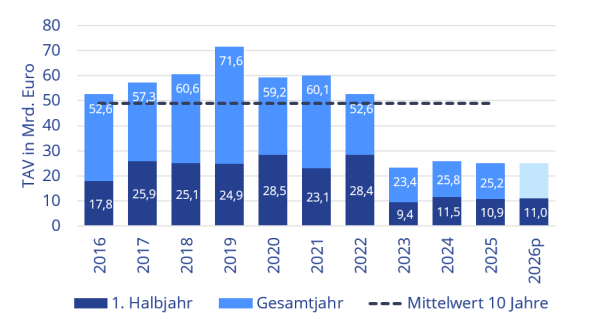
The market revival that has just started is experiencing a damper before it has begun. According to Colliers, real estate worth 15.1 billion euros was traded in Germany in the first half of 2026. This means that the transaction volume on the investment market (residential and commercial) was only 1 percent below the previous year’s figure. The institutional residential segment of ten residential units or more accounted for just under 4.2 billion euros, 3 percent less than in the same period last year. At EUR 11.0 billion, commercial real estate achieved almost exactly the half-year figure from the previous year. While the strong first quarter supported the half-year results, market activity cooled noticeably between April and June.
In the commercial segment, the transaction volume in the second quarter was around 40 percent below the level at the beginning of the year. At the same time, the number of contracts fell by a quarter, which also reduced the average ticket size to less than 20 million euros.
Effects of the Iran war have reached the real estate market as expected
Michael R. Baumann, Head of Capital Markets Germany at Colliers, said: “As expected, the moderate market recovery has stalled after the start of the Iran war. After four quarters with a transaction volume of more than six billion euros each, three-month sales between April and June fell back to a good 4.2 billion euros for the first time.” The increased reluctance to invest is reflected, among other things, in long-awaited lighthouse transactions that have been postponed or even cancelled. The most prominent example is the Frankfurt Opera Tower, the sale of which had been hoped to bring back large-volume core transactions. It would have been the largest single agreement in Europe since 2022.
The number of major deals above 100 million euros also remained manageable in the second quarter with fewer than ten transactions. The largest known transaction of the quarter and the third-largest of the first half of the year was the acquisition of two German properties in a German-Dutch logistics portfolio by the Singapore fund Frasers Logistics & Commercial for around EUR 275 million. Portfolio sales accounted for a total market share of 26 percent, well below the long-term comparison of values between 35 and 40 percent. While four portfolio transactions exceeded the EUR 200 million mark at the start of the year, smaller real estate packages with only a few properties dominated between April and June.
Individual deals in the order of more than 100 million euros remain rare due to the long marketing and review processes, but continue to be concluded. This is evidenced, among other things, by the sale of the Munich office building at Prinzregentenplatz 7-9 for 167 million euros. CONREN Land acquired the property on behalf of a European family office from Union Investment’s open-ended real estate fund UniImmo:Deutschland. The top 7 markets, which accounted for more than half of the transaction volume over many years, continue to be disproportionately affected by the current market situation with a market share of 36 percent.
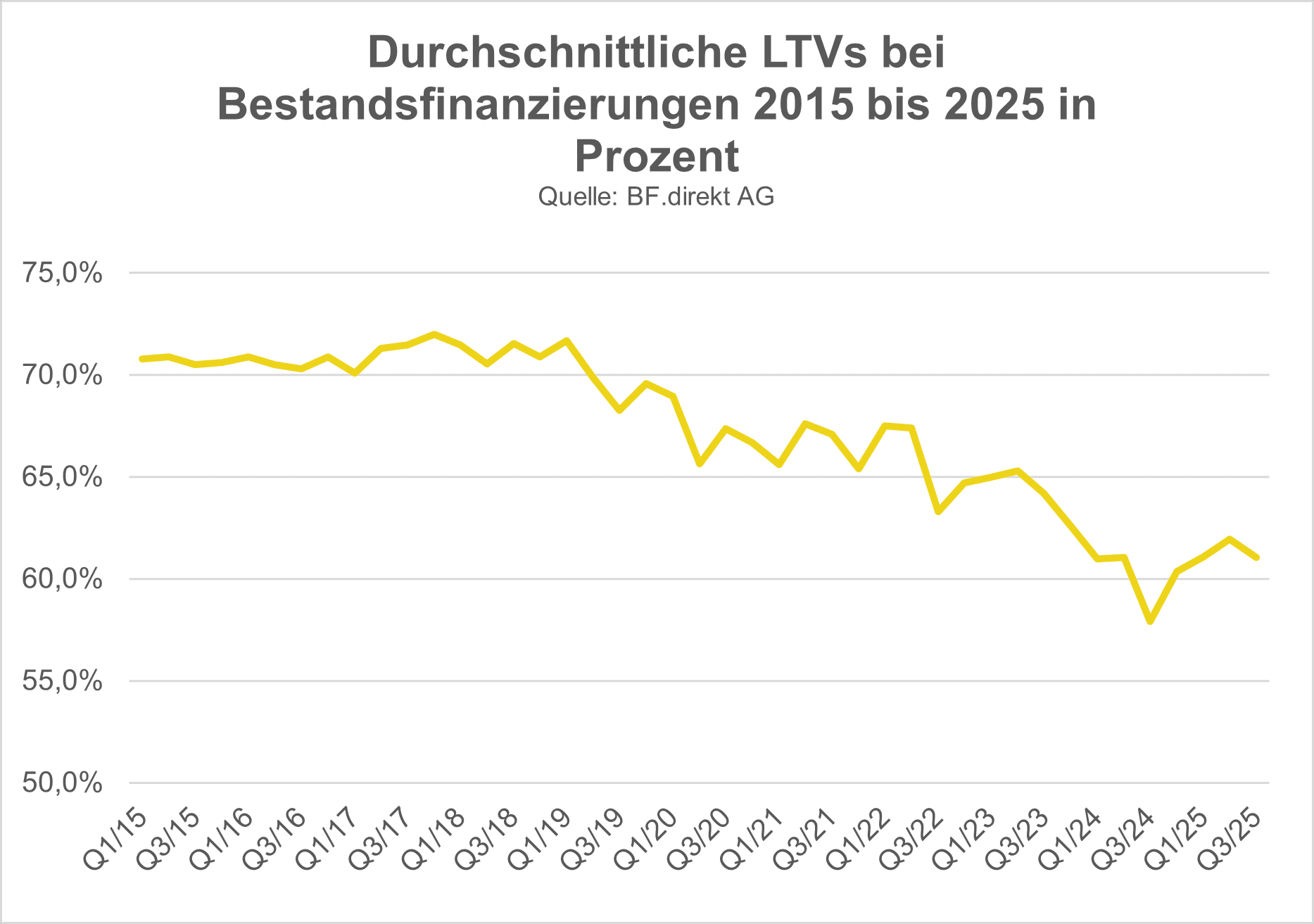
Baumann explains: “Sheer size continues to be seen as a risk factor among the currently remaining players. With increasing property volumes, risk premiums for financing increase disproportionately, credit checks are stricter and financing commitments are withheld – as the example of the Frankfurt Opera Tower shows.”
Francesca Boucard, Head of Market Intelligence & Foresight at Colliers, looks at the macroeconomic drivers: “We have to be prepared for the fundamental conditions on the financial and capital markets to remain challenging for the foreseeable future. The ECB’s interest rate hike in June was foreseeable in view of the persistently high inflation. It remains to be seen whether further interest rate steps will follow in this volatile environment. A normalization of energy costs and international trade flows is also likely to take time.”
Real estate-related capital market interest rates have already risen significantly since March. Ten-year German government bonds are trading around the three percent mark again. “In view of extensive government investment programs and permanently higher defense spending, we are experiencing a noticeable fiscal expansion. This macroeconomic scenario suggests that long-term capital market interest rates will rise rather than fall in the future,” Boucard analyses. For ongoing purchase price negotiations, which are still based on interest rate assumptions from the beginning of the year, this often means a revaluation. At the same time, real estate investments are in stronger competition with lower-risk government bonds, which have become more attractive again.
Rising prime yield can already be observed
The increased price sensitivity of investors is now evident in all liquid types of use. Baumann observes: “We are seeing rising yields again across all situation and risk classes – after a prolonged phase of price consolidation, even in the top segment.” For example, slight yield spreads of 10 basis points could be seen in the top 7 office centres, and even up to 25 basis points for logistics properties in the eight top German destinations. Even in the food-anchored specialist retail segment, it is becoming increasingly difficult to enforce the price expectations from the beginning of the year, despite continued high demand and an attractive product.
Expansion of the offer and price adjustment as an opportunity
The increasing selling pressure on large portfolio holders is likely to favour further price adjustments. Open-ended mutual funds in particular are affected by depreciation and loss of attractiveness compared to higher-yielding government bonds. In June, net outflows reached record levels. Suspended share redemptions and the first fund liquidations are already the result.
Baumann also sees opportunities in this: “With the growing supply, especially in the core-plus and value-add segments, in combination with price discounts, there is also a possible driver for higher market activity, which is not necessarily evident from the increase in volumes. For active, risk-averse buyer groups who are primarily looking around in the small to medium-sized market segment and want to leverage value in the long term, the window for opportunities will remain open for a while.”
Since the beginning of the year, these buyer groups have mainly included asset managers who invest on behalf of family offices and private investors (24 percent market share). This is followed by open-ended real estate and special funds as well as corporates and owner-occupiers (15 percent each). Private investors and family offices reach 14 percent.
Outlook: Expectations adapt to geopolitical reality
Boucard summarizes the outlook for the year as a whole: “Although the market recovery is paused, a relapse into shock after the outbreak of the Ukraine war is not expected. The far-reaching reorientation of investors after the end of the zero interest rate phase has largely been completed. However, a sustained strengthening of investor confidence is inevitably linked to a settlement of the Iran conflict and the containment of its global economic consequences. Due to the usual transaction durations, we assume that the third quarter will still proceed with the handbrake on. We are adjusting our forecast for the full year accordingly and now expect a transaction volume at the previous year’s level of around EUR 25 billion.”
Comparison of German Investment Centres (as of Q2)
| Key figure | Germany | Berlin | Dusseldorf | Frankfurt | Hamburg | Cologne | Munich | Stuttgart |
|---|---|---|---|---|---|---|---|---|
| Commercial transaction volume in € million (2026) | 10.954 | 757 | 800 | 286 | 757 | 270 | 1.059 | 40 |
| Commercial transaction volume in € million (2025) | 10.914 | 1.140 | 330 | 139 | 788 | 300 | 985 | 60 |
| Change compared to previous year | 0 % | -34 % | 142 % | 105 % | -4 % | -10 % | 7 % | -34 % |
| Largest group of investors | Asset managers (asset/fund managers) – 24% | Corporates / owner-occupiers – 30% | Asset managers (asset/fund managers) – 54% | Corporates / owner-occupiers – 42% | Asset managers (asset/fund managers) – 40% | Asset managers (asset/fund managers) – 29% | Private investors / family offices – 43% | Private investors / family offices – 87% |
| Largest group of sellers | Project developer – 21% | Asset managers (asset/fund managers) – 44% | Project Developer – 39% | Asset managers (asset/fund managers) – 69% | Project developer – 31% | Asset managers (asset/fund managers) – 32% | Public sector – 23% | Private investors / family offices – 61% |
| Main type of use | Office – 27% | Office – 45% | Office – 54% | Office – 75% | Office – 42% | Office – 61% | Office – 41% | Office – 76% |
| Prime yield office | – | 5,00 % | 5,10 % | 5,05 % | 4,70 % | 4,85 % | 4,40 % | 4,90 % |
| Prime yield retail | – | 5,00 % | 5,00 % | 4,85 % | 4,50 % | 5,00 % | 4,10 % | 4,90 % |
| Prime yield logistics | 5,00 % | – | – | – | – | – | – | – |
Source: Colliers
Commercial transaction volume (TAV) in Germany