The investment transaction volume in Germany amounted to 16.2 billion euros in the first half of 2026, 13 percent higher than in the same period last year. Of this, just under 13 billion euros were accounted for by commercial real estate, a good fifth more than in the first half of 2025. The market thus continued its gradual recovery. At the same time, transaction activity remained selective and concentrated on high-quality individual transactions as well as liquid core markets. The momentum in the second quarter was somewhat lower than at the beginning of the year. Geopolitical uncertainties mean that individual processes are completed later and new transactions are initiated more cautiously at times. However, this did little to change the fundamental market recovery. These are the results of a recent analysis by the global real estate service provider CBRE.
“The gradual recovery continues. We are seeing more activity in the market, more sales processes and more product overall than we did a year ago. At the same time, the investment market remains very selective. Investors continue to focus on high-quality real estate in liquid markets and make their decisions in a very disciplined manner,” says Marcus Lemli, Head of Capital Markets Germany at CBRE in Germany. “A key driver of this development is the growing product range. This is due to various developments – from upcoming refinancing and the continued rise in interest rates to outflows of funds from open-ended real estate mutual funds and requests for capital repayments by institutional investors from special funds. This increases the selling pressure and ensures additional market activity.”
“The real estate fundamentals remain intact and support the German investment market. At the same time, pricing is now much more advanced than it was a year ago. Germany therefore remains a strategically important target market for international investors. Interest is increasing again, even though many investors continue to be very selective and domestic capital continues to dominate market activity,” says Dr. Jan Linsin, Head of Research Germany at CBRE in Germany.
“Pricing is much further along today than it was a year ago. Buyers and sellers have gradually adjusted their expectations to market conditions. This will reduce the bid-ask spread and allow transactions to be implemented more frequently again. At the same time, prime yields in the liquid core markets remain largely stable. Outside the prime segment, however, the market is more differentiated according to location, property quality and risk profile. Overall, we are seeing more resilient price levels today than we did just a few quarters ago. At the same time, there are signs of a slight increase in prime yields in some asset classes in the second half of the year,” says Sandro Höselbarth, Head of Valuation & Advisory Services Germany at CBRE in Germany.
Office is clearly coming to life
With an investment volume of 3.45 billion euros, office properties increased by 66 percent compared to the same period last year, thus recording the most significant upturn among the major asset classes. The segment benefited in particular from high-quality individual transactions. Industrial and logistics properties also developed dynamically and made a significant contribution to the growth of the commercial investment market. In contrast, the retail trade recorded a decline. Residential real estate declined slightly, but remained the strongest asset class on the German investment market. Development plots achieved the strongest relative growth and make it clear that investors are once again selectively willing to take on higher risks.
Top 7 markets drive recovery
The seven largest German investment locations, which benefit from their high liquidity and market transparency, continued to gain in importance in the first half of the year. Within the top 7 locations, however, a differentiated picture emerged. Düsseldorf developed particularly dynamically due to a number of major deals. Cologne, Hamburg and Frankfurt also recorded a noticeable upturn, while Berlin and Munich, on the other hand, were below the previous year’s level.
Individual transactions shape market activity
The transaction structure remained clearly characterized by individual transactions, which increased significantly compared to the same period last year, while portfolio transactions declined slightly. This continues the trend towards more granular investment strategies. At the same time, large-volume transactions regained importance. Both the number and the relative share of deals above EUR 100 million increased. Around a third of these transactions were in Berlin, Düsseldorf, Hamburg and Munich. In the office segment in particular, large-volume individual transactions dominated, while portfolios were predominantly traded in the care and healthcare properties, logistics and multi-family housing segments. Despite the higher number of large deals, the average deal size fell to just over 20 million euros, mainly due to the simultaneous increase in the number of small and medium-sized individual transactions.
There was also a change in investment strategies. The share of core products declined slightly in favor of increased core-plus investments. Opportunistic strategies also gained momentum, whereas the value-add segment performed somewhat weaker. Overall, the market is thus moving from a predominantly defensive orientation to a more differentiated risk positioning.
On the buyer side, real estate companies, the public sector and asset and fund managers were the most active market participants. On the seller side, project developers, real estate stock corporations and REITs dominated. As a result, well-capitalised investors increasingly took advantage of market opportunities, while on the supply side, liquidity-driven owners in particular brought additional properties to the market. Although international investors increased their activities, market activity continued to be predominantly driven by domestic capital, whose share continued to increase compared to the same period last year.
Outlook for the rest of the year
“We expect the gradual recovery to continue in the second half of the year, especially as the pipeline is well filled. For the year as a whole, a transaction volume of a good 35 billion euros is emerging. Although review and decision-making processes remain challenging and take longer, this also leads to more informed investment decisions and greater predictability of transactions. The market remains selective – with a clear focus on high-quality real estate, liquid core markets and sustainable cash flows,” says Lemli.
Investment transaction volume in Germany (total commercial and residential real estate, excluding pro rata acquisitions of company shares)
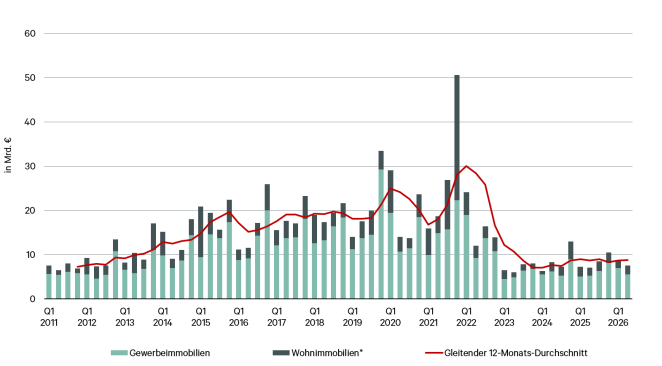
* Residential properties with 50 and more residential units
Source: CBRE Research