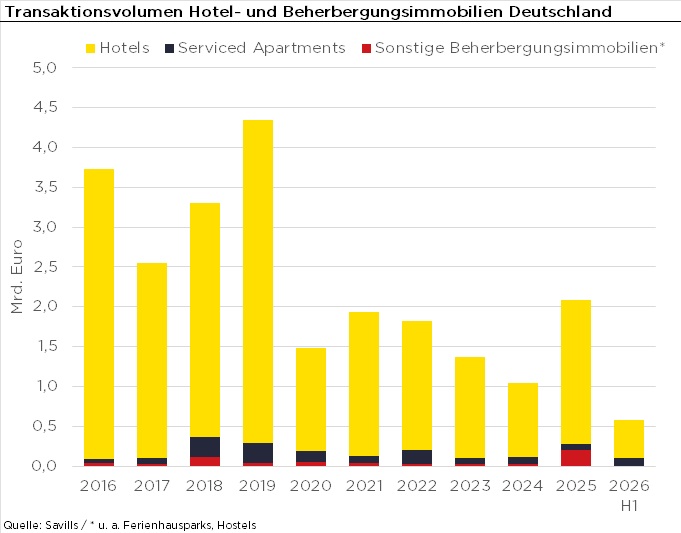
In the 1st half of 2026, the transaction volume with hotel and accommodation properties amounted to just under 572 million euros, according to Savills, which is a 45% decline compared to the same period last year. At EUR 360 million, the 2nd quarter was significantly stronger than in the first quarter and was only slightly below the quarterly average of the past three years (EUR 376 million). In addition to the sales of pure hotel and accommodation properties, some hotels also changed hands in the 1st half of the year as part of mixed-use quarters. These include hotels in the Deiker Höfe in Düsseldorf, the Lokhöfe in Rosenheim and the Postquadrat in Mannheim. However, Savills does not attribute these transactions to the hotel transaction volume, but to the mixed properties category.
Sales of classic hotel properties dominated market activity in the 1st half of the year. They generated sales of a good 469 million euros or 82% of the total volume. Serviced apartments achieved a transaction volume of almost EUR 100 million, thus already exceeding the respective full-year results for the years 2023 to 2025 by the middle of the year.
Tina Haller, Director Capital Markets and Head of Hotels Germany at Savills in Germany, comments on the market as follows: “The German hotel investment market continued to be subdued in the first half of 2026 due to the challenging market environment. While concerns about further operator insolvencies continue, restructuring, new market participants and international expansion strategies are simultaneously bringing high momentum at operator level. The fact that new operators have already been found for more than 120 hotels in the Revo Group is a key signal in the market and underlines the high attractiveness of high-performance hotel locations even in challenging situations. This has a positive effect on the confidence of real estate investors.
We are observing that international owner-occupiers in particular are increasingly examining acquisition opportunities in Germany. Core locations remain in demand among buyers, while investors from the long-stay segment are increasingly focusing on classic hotels and conversion projects. The heterogeneous buyer landscape and the parallel expansion of new and often technology-driven operator concepts offer investors and owners the opportunity to reposition existing hotel properties. Accordingly, sales processes are becoming increasingly flexible in the current market environment. In addition to traditional investors, new buyer groups are increasingly being addressed in a targeted manner and possible property adjustments – up to and including changes of use – are being examined at an early stage.”