The Frankfurt office market is facing a prolonged phase of rising rents – especially in the Central Business District (CBD). This is shown by a recent analysis by Newmark. The current difference between construction costs and rent levels is likely to narrow in the coming years. With noticeable consequences for tenants in the premium segment.
Rents are rising, but construction costs are much faster
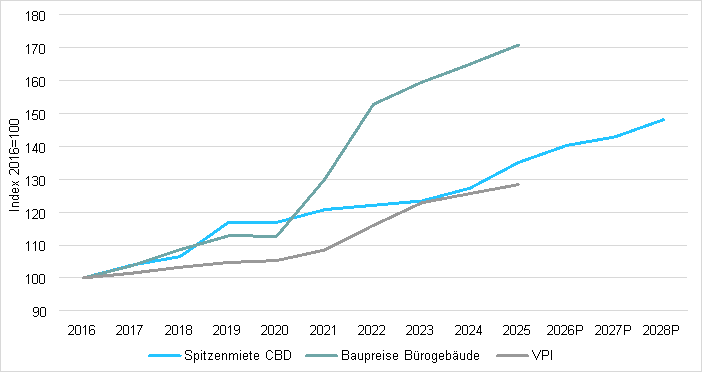
Since 2016, the prime rent in Frankfurt’s CBD has risen from 38.50 euros to 52.00 euros per square metre. This corresponds to an increase of around 35 percent. The median of all registered leases also increased from EUR 25.00 to EUR 32.00 (+28%) in the same period. For 2026, Newmark expects a prime rent of 54.00 euros, while individual transactions have already exceeded the 70 euro threshold. Further increases are forecast for 2027.
However, construction costs increased much more strongly. Until 2020, construction cost development and rent growth were still largely parallel: The construction cost index for office buildings rose by around 16 percent between 2016 and 2020, while prime rents rose by 17 percent. With the Corona pandemic, the dynamics between construction costs and rental prices changed fundamentally. Supply chain bottlenecks, a surge in inflation of up to 6.9 percent in 2022, rising labor costs in the construction industry, and stricter regulatory and ESG requirements drove construction costs up by around 52 percent between 2020 and 2025. Prime rents rose by only 16 percent in the same period.
Since 2016, construction costs and prime rents have thus diverged significantly: construction costs rose by 71 percent, prime rents by only 35 percent. The difference is thus around 36 percentage points. Under these conditions, economically viable project developments can increasingly only be realised in the premium segment, where the achievable rents justify the high development costs.
“The gap between construction costs and rents that has arisen will gradually close in the CBD in the coming years. For prime space in Frankfurt’s CBD, we see significant rent increases over the next three years. This is the logical consequence of a supply side that is coming under increasing pressure from high construction costs and stricter ESG requirements,” says Lukas Kasperczyk, Head of Office Leasing Frankfurt at Newmark.
Structural scarcity due to ESG requirements
In addition to the pressure on construction costs, the growing importance of ESG criteria is exacerbating the supply situation in the premium segment. Properties without sufficient sustainability certification are increasingly losing their attractiveness for international and creditworthy users and run the risk of becoming so-called “stranded assets”. This selection process increases the structural shortage of ESG-compliant space in the CBD and improves the bargaining position of owners of certified buildings.
For occupiers, the increasing shortage of high-quality, ESG-compliant office space has long-term implications for space strategy and cost planning. Newmark therefore recommends that users conclude leases early and contractually secure extension and expansion options. In addition, the current analysis of recent years shows that graduated rents of 2.5 percent would have been significantly cheaper for tenants than the adjustment to the consumer price index. The supply of high-quality CBD space is likely to continue to decline structurally.
“Tenants who hesitate today will face significantly higher rental costs tomorrow,” Kasperczyk adds. “The window for favorable conditions is closing. Long-term rising prime rents and a structurally tight CBD supply speak in favor of securing the best space now – at conditions that are still negotiable today.”
Newmark sees the Frankfurt market as part of a Europe-wide development towards high-quality office space in core urban locations. The company is consistently expanding its presence in Germany and has teams in Berlin, Düsseldorf, Frankfurt, Hamburg and Munich.