After a solid first half of the year, numerous transactions are still in the pipeline
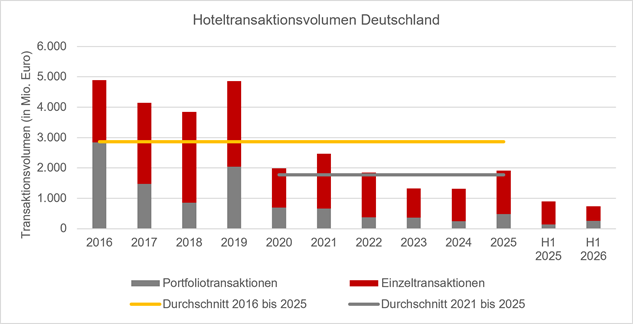
In the first half of 2026, the German hotel investment market achieved a transaction volume[1] of around 741 million euros. This is around 18 percent below the first half of 2025 (around 901 million euros). However, this was exceptionally strong and had almost doubled the volume from the previous half of 2024 of around 460 million euros.
In total, the market closed 28 deals in the past six months, including five portfolio deals. The first half of the year was significantly influenced by the sale of the Penta portfolio, which is one of the highest-volume portfolio transactions of the year to date with a transaction volume of around EUR 275 million. The average transaction size of around EUR 27 million remained stable, albeit low.
Stefan Giesemann, Managing Director of JLL Hotels & Hospitality Group: “The German hotel investment market has made a dynamic start to 2026. The Iran conflict and temporary uncertainty on the operator side took some wind out of the sails in the second quarter, but the fundamental interest in the asset class remains unbroken. Last year, the transaction volume in the first half of the year was still largely driven by three outstanding individual transactions – the Motel One Upper West, the Mandarin Oriental in Munich and the Steigenberger at the Chancellery in Berlin – which we are missing this year. Nevertheless, based on excellent fundamentals, hotels remain one of the most liquid and sought-after asset classes in Germany.” According to Giesemann, the continuing international investor demand, which accounts for more than half of the transaction volume, is particularly pleasing – a clear signal of Germany’s structural attractiveness as a hotel investment location.
Prime yields are moving stably sideways, as the ECB’s interest rate hike in June was already priced into investors’ expectations. “We are also currently seeing an attractive range of investment opportunities, both in the value-add and core segments, which forms the basis for continued strong demand. For the second half of the year, we expect robust market activity and consider a full-year volume at the level of 2025, i.e. around the two billion euro mark, to be realistic,” adds Giesemann.
Dominik Rüger, Senior Director Debt & Structured Finance JLL EMEA, sheds light on the financing environment for hotel properties: “Liquidity in the German hotel financing market has improved significantly over the past 18 months. Both German and international senior banks and debt funds are active in the market and contribute to this positive environment. The operational recovery of the hotel sector after the pandemic has strengthened the confidence of lenders in the long term. Senior financing is currently typically available at loan-to-value ratios of 55 to 65 percent, depending on location and property quality. Financing conditions have stabilised, with margins falling slightly compared to 2024 and 2025. This underlines the growing attractiveness of the asset class also from a financing perspective and creates a solid basis for transactions in the second half of the year.”
The most significant individual transactions in the first half of 2026 included:
-
the acquisition of the luxury resort “Der Öschberghof” in the Black Forest by the Zech Group, in which JLL acted as exclusive agent,
-
the sale of the Excelsior Hotel Munich by Geisel Privathotels to BlackRock for around 60 million euros,
-
the acquisition of the Excelsior Hotel Berlin by the Israeli owner-operator Brown Hotels for around 50 million euros.
On the portfolio side, the aforementioned transaction of the Penta Hotel portfolio – a European hotel portfolio with a German focus – dominated. Aroundtown sold six German hotel properties to Ogilvy Capital. “This is a clear signal of the continuing interest of international investors in structured hotel portfolios with a German focus,” says Giesemann.
The most active group of buyers in the first half of 2026 was once again very high net worth individuals (HNWIs) and family offices, accounting for around 37 percent of the total transaction volume (around 272 million euros). This was followed by institutional investors with 35 percent (around 262 million euros) and hotel operators with around twelve percent (around 94 million euros). Private equity investors contributed about ten percent (around 75 million euros). Foreign investors accounted for more than half of the transaction volume (around 410 million euros) in the first half of 2026 and thus remain a mainstay of the German hotel investment market.
So far this year, value-added-oriented strategies have dominated market activity: value-add and opportunistic transactions together reached around EUR 433 million – equivalent to around 60 percent of the total volume. Core investments contributed around 259 million euros to about 36 percent, while core-plus transactions accounted for the remaining share. The preponderance of value-add and opportunistic products shows that investors are specifically looking for repositioning potential. At the same time, the ongoing demand for core signals continued healthy institutional interest.
Heidi Schmidtke, Managing Director of JLL Hotels & Hospitality Group, says: “In the first half of 2026, the hotel operator market was strongly influenced by the insolvency of Revo Hospitality Group, one of the largest multi-brand hotel operating companies with hotels in Europe and especially Germany. As a result, it can already be said that the group has been split up and new operating companies have entered the German hotel market in addition to already known ones.”
And Schmidtke adds: “However, since not all takeovers have been completed yet, the effects are likely to be seen in the second half of the year. Otherwise, the trend towards conversions continues to be confirmed, while new construction projects continue to be the exception. Notable entries of new groups into the German hotel market in the first half of 2026 include Taj Hotels with the reopening of the former Grand Hotel Hessischer Hof, as well as The Dean Hotels with their debut in Berlin-Charlottenburg as a result of the takeover of the former Max Brown Hotel Ku’damm.”
[1] The Hotels & Hospitality Group of JLL Germany takes into account individual transactions with an investment volume of at least five million euros as well as portfolio transactions with properties exclusively in Germany. Also included are German hotels that are sold as part of cross-border portfolio sales.