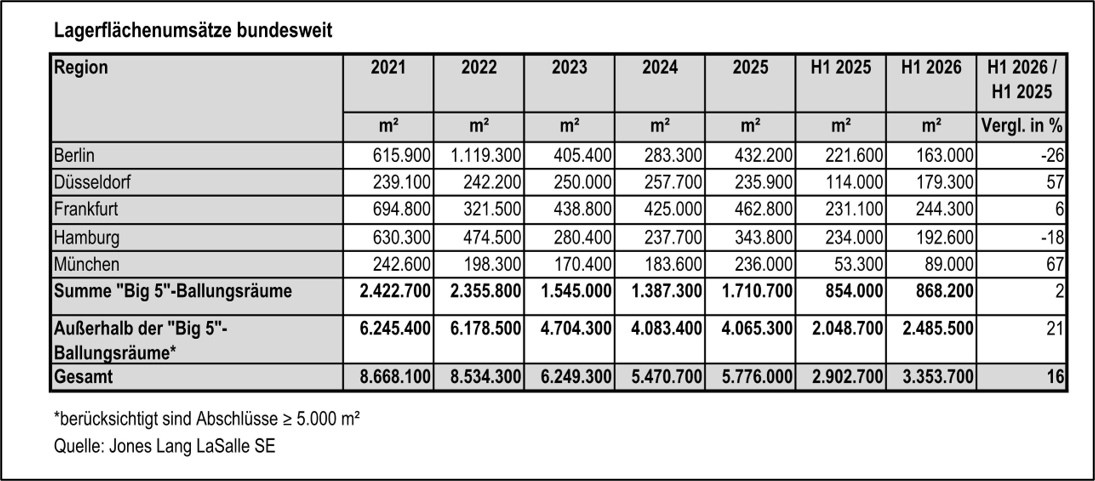
Demand for warehouse and logistics space increased noticeably in the first half of 2026. The letting market recorded take-up of around 3.35 million m² for owner-occupiers and lettings. The result thus exceeded the previous year’s figure of 2.90 million m² by a significant 16 per cent and was only slightly below the comparable five- and ten-year averages (three per cent and one per cent respectively). “The number of contracts concluded in a year-on-year comparison with 341 corresponded to the previous year’s level. However, the first half of the year undercut the average of the past five years of 375 contracts by nine percent,” Sebastian Bögel, Head of Industrial & Logistics Agency JLL Germany, sums up.
While revenue from rentals increased by 31 percent compared to the previous year, the share of owner-occupiers in total sales fell by 25 percent. At around 593,000 m², they contributed only 18 per cent to the result for the first half of the year.
Different sales dynamics in the five metropolises
The five conurbations of Berlin, Düsseldorf, Frankfurt, Hamburg and Munich generated sales of around 868,200 m² in the first six months, slightly exceeding the previous year’s result by two percent. However, they missed the five-year comparative value by eleven percent.
The region with the highest take-up was Frankfurt with 244,300 m², an increase of six per cent in a twelve-month comparison. The Hamburg region follows at a distance with 192,600 m² (minus 18 percent). Third place is occupied by Düsseldorf with 179,300 m² and a significant increase of 57 percent in a twelve-month comparison. Berlin achieved 163,000 m² (minus 26 per cent) and Munich recorded the largest growth of 67 per cent, but from a low level it achieved the lowest take-up among the five strongholds at 89,000 m².
Companies from the transport, traffic and warehousing sectors proved to be the most active user group, with take-up of 357,400 m², which corresponds to 41 per cent of total take-up and represents an increase of around 35 per cent compared to the first half of 2025. In contrast, retail companies recorded a decline of 36 percent with 156,800 m² and industrial companies with 223,000 m² a minus of 16 percent.
The largest deals are spread across the regions of Hamburg, Berlin and Frankfurt
The two largest lettings were already registered in the first quarter: a well-known online retailer rented more than 50,000 m² in Hamburg-Allermöhe and the Chinese logistics service provider JD Logistics around 40,000 m² in Ludwigsfelde near Berlin. In the second quarter, the third-largest deal was the lease of around 32,000 m² by Siemens AG in Offenbach (Frankfurt region).
At the same time, less new supply is coming onto the market: From January to June, around 187,000 m² of new warehouse space was completed in the five metropolises, almost 35 percent less than in the first half of 2025; compared to the five-year average, the decline is as much as 49 percent. At the time of completion, only around 63,000 m² (34 per cent of the space) was still available, 48 per cent had been let and the remaining space had been allocated to owner-occupiers.
“This low availability exacerbates the already tense situation: In many top five regions, there is a shortage of modern space available at short notice,” says Bögel. By mid-year, around 665,000 m² were under construction, 56 percent of which was still unlet. The highest construction activity was recorded in the Berlin region with around 278,000 m². In the Frankfurt region, the smallest areas are under construction at around 60,000 m².
Prime rents stable in the five strongholds at mid-year
In the second quarter, prime rents for warehouse space of 5,000 m² or more remained unchanged in all five main regions, after a slight increase in Munich and Frankfurt in the first quarter. Munich leads with 11.00 euros/m², followed by Berlin with 10.50 euros/m² and Düsseldorf with 9.00 euros/m². In Hamburg and Frankfurt, 8.50 euros/m² are achieved each.
Outside the five main regions, logistics companies dominate the demand for space
Significant growth was recorded in the markets outside the five conurbations*. At 2.49 million m², around 21 per cent more square metres were taken up in the first half of 2026 than in the same period last year, when the stores reached 2.05 million m². About 22 percent of total sales were accounted for by owner-occupiers.
Companies in the transport, traffic and warehousing sectors once again increased significantly year-on-year: they achieved 370,600 m² more than in the previous year, thus dominating the demand for space in the first half of 2026. With 1.19 million m², this sector accounted for around 48 per cent of take-up, almost half of take-up. These include the four largest leases: The contract logistics company Ceva Logistics leases around 90,000 m² each in Frankfurt (Oder) and in Lich near Giessen. Maersk Logistik signed a contract for almost 69,000 m² in a speculatively built new building in Herleshausen in northern Hesse and ID Logistics secured around 67,000 m² in Alsdorf near Aachen
Retail companies also grew disproportionately by 48 per cent year-on-year and were thus responsible for 23 per cent or 575,000 m² of total take-up in the middle of the year. Demand from industrial companies, on the other hand, fell by 23 percent to 522,000 m².
Chinese occupiers dominate take-up in the Ruhr region
With around 303,400 m² and an increase of 48 per cent in a twelve-month comparison, the Ruhr region is at the top of the list of regions outside the five metropolises. The region benefited more than any other from the sustained demand from Chinese companies, which generated sales of around 126,000 m² in the first six months – around 42 percent of total take-up in the Ruhr region.
Significant year-on-year growth was also recorded in the regions of Hanover/Braunschweig with 233,400 m² and Cologne with 141,600 m², each of which more than quadrupled its previous year’s results.