Newmark has published a new market analysis that examines the state of the German office real estate investment market. While transactions are selective, the report concludes that a bottom is still a long way off.
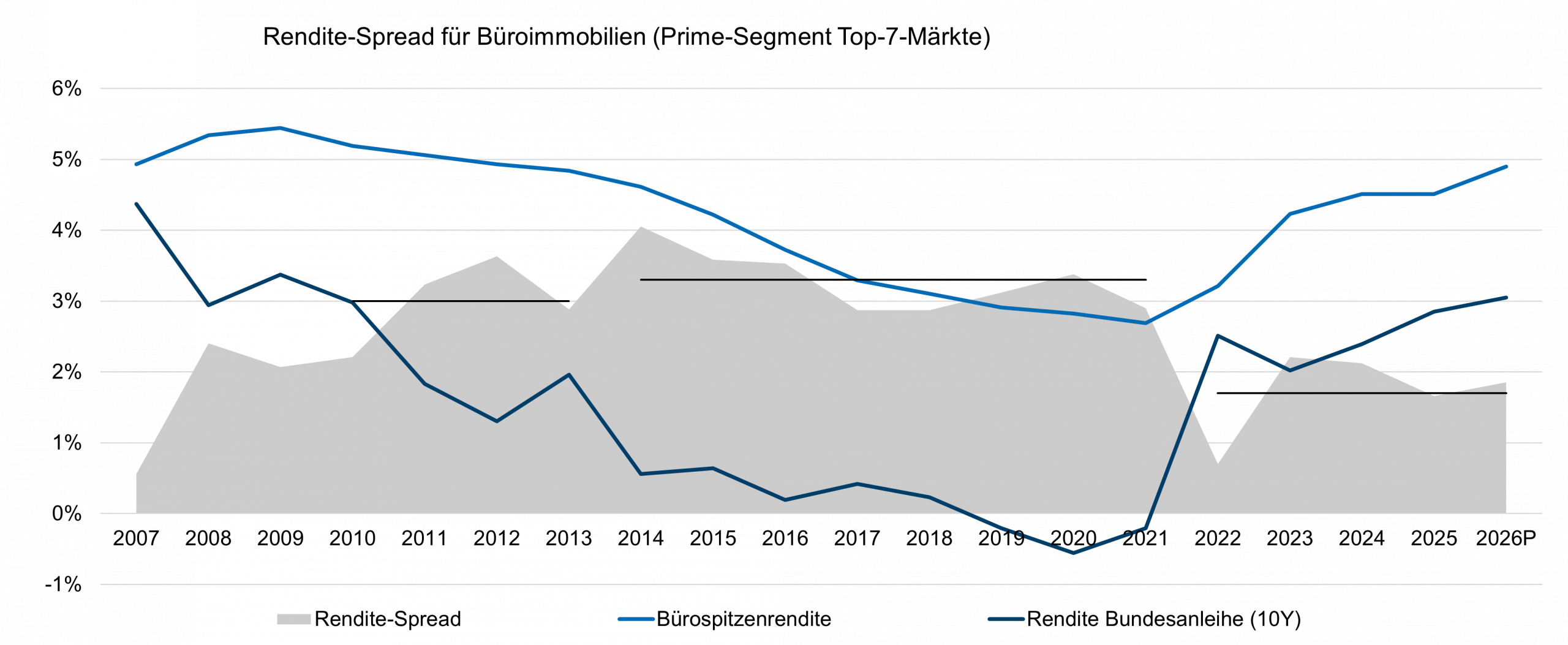
The market analysis “Fundraising & Liquidity – The Spread is the Problem” shows that a yield spread that is too low from an investor’s point of view – the difference between real estate yields and government bonds or interest on debt capital – blocks the chain of effects of capital, liquidity and transactions. Without clearer price signals and improved risk premia to support capital raising, liquidity remains constrained and reliable benchmarks have yet to re-emerge.
For prime office properties in Germany’s top 7 markets, the yield spread at the end of the second quarter of 2026 was around 185 basis points (bps), after an even lower 150 bps in the previous quarter. Historically, however, a noticeable revival in transaction volume only began at significantly higher levels. Newmark therefore expects investment activity in 2026 to be slightly lower than in the previous year. A broader rebound can only be expected when spread dynamics improve and capital returns to the market for core and core+ strategies.
“The market is waiting for resilient returns,” says Marcus Lütgering, Country Head Germany at Newmark. “As long as the risk-reward ratio is not convincing for many investors, capital will remain on the sidelines.”
Liquidity is selective and fundraising predominates for high-risk strategies
After the sharp slump in 2022 and 2023, activity on the office investment market in Germany remains subdued. In 2025, the office transaction volume of 7.3 billion euros was around 60 percent below the five-year average and four percent below the previous year. Although the share of international investors has recently increased and the result for the first half of 2026 was 5% higher than the previous year’s figure, Newmark expects a slight decline for office investments for the full year 2026.
Liquidity continues to be concentrated in a few segments. Prime assets in prime locations are particularly attractive for private investors and family offices with strong equity. Institutional core investors, on the other hand, hardly appear as buyers. Although fundraising has been showing initial signs of recovery since 2025, these are predominantly driven by opportunistic and value-add strategies.
“Transactions need liquidity, liquidity is created through fundraising, and fundraising requires a sufficiently high yield spread,” explains Helge Zahrnt, Head of Research at Newmark. “This chain of effects is currently interrupted. While we are seeing selective market activity, the start of a new, broad-based cycle has been a long time coming.”
Yield spread is the central lever for market activity
The analysis shows that changes in the risk premium have a delayed but measurable effect. Statistically, an increase of ten basis points is accompanied by an increase in the volume of office transactions of around two percent in the following year. Various factors could lead to a widening of the spread. However, changes in rental prices, sales prices or financing costs have different realistic potential and depend on the respective prime or secondary market segment. A spread well in the range of 275 basis points would have a noticeably positive impact on the market.
Macroeconomic environment remains a factor of uncertainty
In addition, the economic environment is having a dampening effect on the real estate market. Germany’s economic output fell in 2023 and 2024 and increased by only 0.2 percent in 2025. For 2026, only slight, recently revised, growth is expected. This is supported by fiscal stimulus, but at the same time is associated with high risks, for example from geopolitical developments and a low level of forecast reliability. The weak economy is weighing on rental markets and thus having a dampening effect on investment decisions.
In an international comparison, markets such as London or Paris are further along in the cycle, as they devalued earlier and more consistently. Opportunities exist above all for investors with a clear strategy, low dependence on the capital market and a focus on liquid asset classes such as residential, logistics and high-quality office properties in prime locations.
“Many investors are watching the market very closely,” says Marcus Lütgering. “The entry into the next cycle will not be triggered by optimism, but by comprehensible prices, stable cash flows and sustainable returns.
If market players are not willing to take the final steps to adapt, there will be no momentum. Then 2026 will be a year of selective deals instead of a broad market launch.”
You can view the full market analysis here: Fundraising & Liquidity – The Spread Is the Problem