With her energy policy, Federal Minister of Economics Katherina Reiche promises security of supply, predictability and cost efficiency – combined with the guiding principle of “more market and less permanent funding”. An analysis by the International Economic Forum for Renewable Energies (IWR) comes to a different conclusion: In the end, the planned realignment of energy policy will not lead to falling electricity costs, but to higher electricity costs for industry and consumers.
Controlling power of the actors: How Katherina Reiche is realigning the electricity system portfolio
The capacity market, the amendment to the Renewable Energy Sources Act (EEG) and the grid connection package intervene in the electricity system in very different places with the planned changes, but the decisive effect only arises through their combination. As a result, Reiche shifts the control of the German electricity system more strongly from the competitive electricity market to regulated monopoly companies and state-organized capacity mechanisms. The change in the distribution of risk between the technologies is a consequence of this realignment.
Network operators act as regulated monopoly companies and are not in classic competition. According to a recent ESD analysis, the 18 largest distribution system operators achieved a market share-weighted average return on equity of 30.1 percent in 2024. In the future, they will be able to have a greater influence on which turbines are connected to the grid, when and under what conditions. Operators of secured capacity receive remuneration for the provision of power via the state-organised capacity market in addition to possible electricity market revenues. Renewable energies, on the other hand, are to be exposed to the market more closely and their expansion is to be more closely aligned with the available grid capacities.
“This is not a future-oriented energy policy, but a shift in the management of the energy transition towards actors and revenue models that are significantly less under the cost pressure of a competitive electricity market – with far-reaching consequences,” says Dr. Norbert Allnoch, Managing Director of IWR.
Specifically, operators of secured power plant capacity are to be additionally remunerated for the provision of capacity via the capacity market. In the case of new wind turbines, on the other hand, the grid connection package is intended to shift the risk of grid bottlenecks more strongly to the operators: The planned redispatch reservation allows grid connection without the financial compensation in the event of subsequent curtailments. In addition, there are changes to the wind energy reference yield model and a greater limitation of PV feed-in capacity.
According to the plans, new small PV rooftop systems will no longer receive a minimum EEG remuneration and will have to market the solar power themselves. This increases the barriers to market entry and marketing, especially for private operators, which, according to the IWR, favours a stronger concentration on traditional market players. Battery storage systems will continue to be burdened with construction cost subsidies when connected to the grid.
Why more gas-fired power plants drive up electricity prices, not lower them
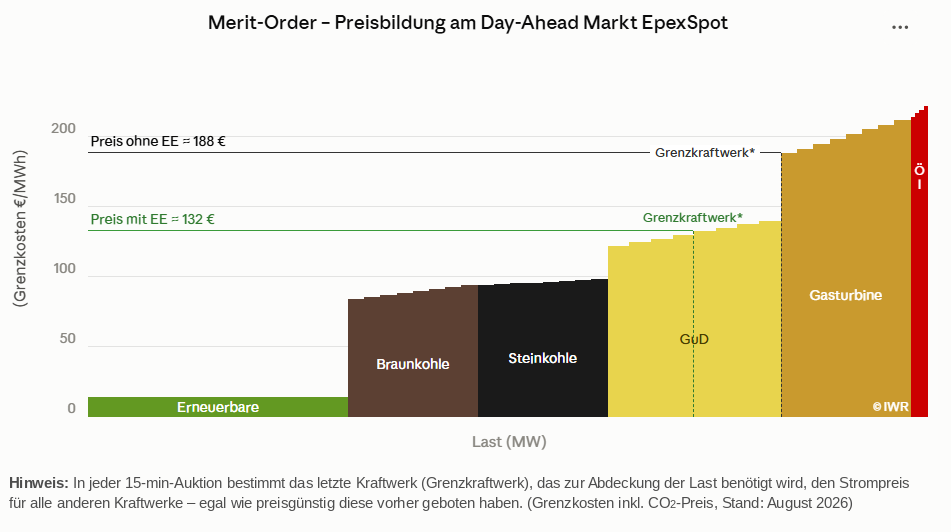
A common misconception among the public: More gas-fired power plants would increase supply and lower prices. The opposite is the case. On the electricity exchange, the merit order principle applies. Power plants are lined up according to their bids. The last power plant that is still considered in the auction determines the price for all other power plants, no matter how low they have previously bid.
More renewables will push more expensive power plants out of the market and thus lower the price for everyone. If their expansion is slowed down, gas-fired power plants will more often remain the price-setting marginal power plant – and with them the gas price, which is currently high: The European gas price (TTF) was around 62.50 euros per megawatt hour (6.25 ct/kWh) in mid-August 2026. In a gas-fired power plant with 50 percent efficiency, the gas costs alone for generating one kWh of electricity amount to 12.5 cents.
The effect is exacerbated by the coal phase-out running in parallel: If electricity from lignite and hard coal-fired power plants is replaced by more expensive gas-based power generation instead of renewables and storage, marginal costs rise. If gas-fired power plants become more of a price-determining power plant as a result, this will lead to higher electricity prices on the stock exchange.
From the IWR’s point of view, this is a central contradiction of current energy policy: If the expansion of renewable energies is slowed down at the same time, the price-lowering displacement effect of wind and solar power will be slowed down. Storage systems can prolong this reduction effect by shifting cheap electricity from hours of high renewable generation to hours of higher demand, thus reducing the use of expensive gas-fired power plants.
“None of the planned new regulations from the grid package and the EEG amendment will ensure lower electricity prices for industry and consumers, quite the opposite,” said Allnoch.
The IWR also considers the unspecific expectation of a return to permanently low gas prices to be of little help – it is more wishful thinking than a viable energy policy perspective. “Some dream of cheap Russian gas as soon as the Ukraine war is over. But even China, despite its close partnership with Russia, has been negotiating hard for years about prices and conditions for additional gas supplies. The hope that Germany can simply return to the gas prices of the time before 2022 is not a reliable basis for the long-term orientation of our electricity system,” said Allnoch.
New capacity market levy instead of short-term electricity price relief
In addition to the effects on the exchange price of electricity, the capacity market incurs additional costs. From 2031, according to previous plans, its financing is to be carried out via a new levy. For capacity promotion in 2031, the Federal Ministry of Economics estimates costs of 1 to 3 billion euros, which are to be borne by electricity consumers.
Reiche himself does not hold out the prospect of short-term electricity price reductions. “We will not see noticeable relief until the 2030s,” explained Federal Minister for Economic Affairs and Energy Reiche at the beginning of August.
IWR: Electricity system portfolio geared towards future viability and lower electricity prices
From the IWR’s point of view, energy policy should align the electricity system portfolio with the combination of renewable generation, storage, grids, flexible demand and secured power that leads to the lowest possible electricity prices. The IWR sees the combination of renewable energies and storage systems as the standard of large tenders as an opportunity to further develop the electricity system in a sustainable way.
The network infrastructure is also changing. According to current plans, central north-south power connections are to be completed in the next two years by 2028 with Ultranet, A-Nord, SuedLink and SuedOstLink. They will soon increase transport options between the renewable generation hotspots in the north and the consumption centres in the west and south, thus reducing grid bottlenecks and the need for redispatch.
Allnoch: “The task of politics is to actively align the electricity system portfolio for future viability – similar to responsible portfolio management, which weighs up different opportunities and risks against each other. This includes high-performance grids and secured power as well as renewables, storage systems and flexible consumers. However, it is not only decisive where investments are directed, but also who controls the system and what electricity prices are associated with this for industry and consumers.”