Berlin and Munich are driving take-up, while vacancies and prime rents in the top 5 markets are rising at the same time.
The five largest German office stores achieved take-up of around 1.16 million square metres in the first half of 2026, which corresponds to a decline of one per cent compared to the same period last year. This is shown by the current Market Monitor H1 2026 on Newmark’s office market, which is published for the first time. The almost stable overall result is due to widely differing local developments in the five markets of Berlin, Düsseldorf, Frankfurt, Hamburg and Munich.
“Berlin and Munich are benefiting from large leases and growing significantly, while other markets are still looking for new momentum,” says Helge Zahrnt MRICS, Head of Research Germany at Newmark.
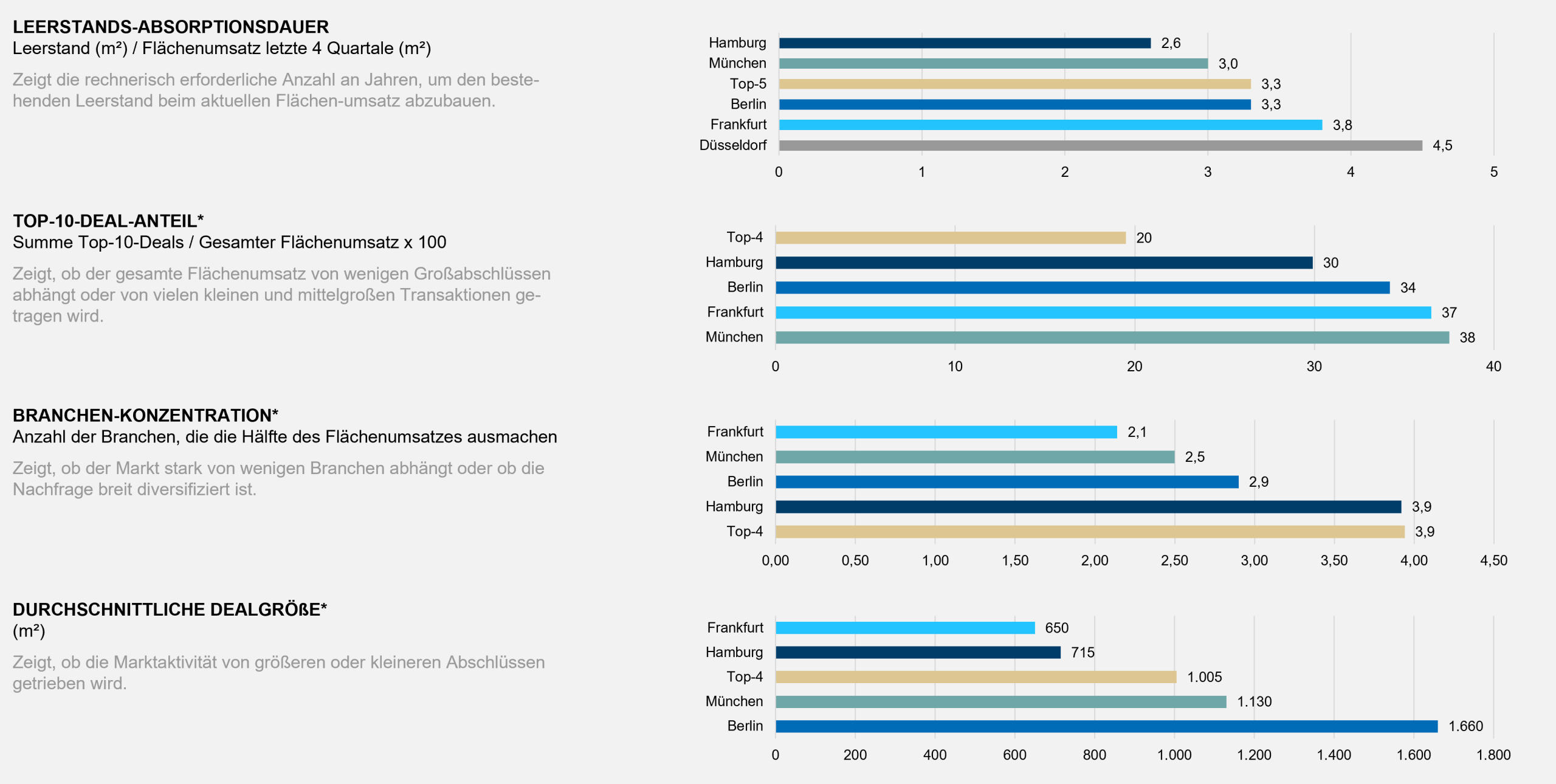
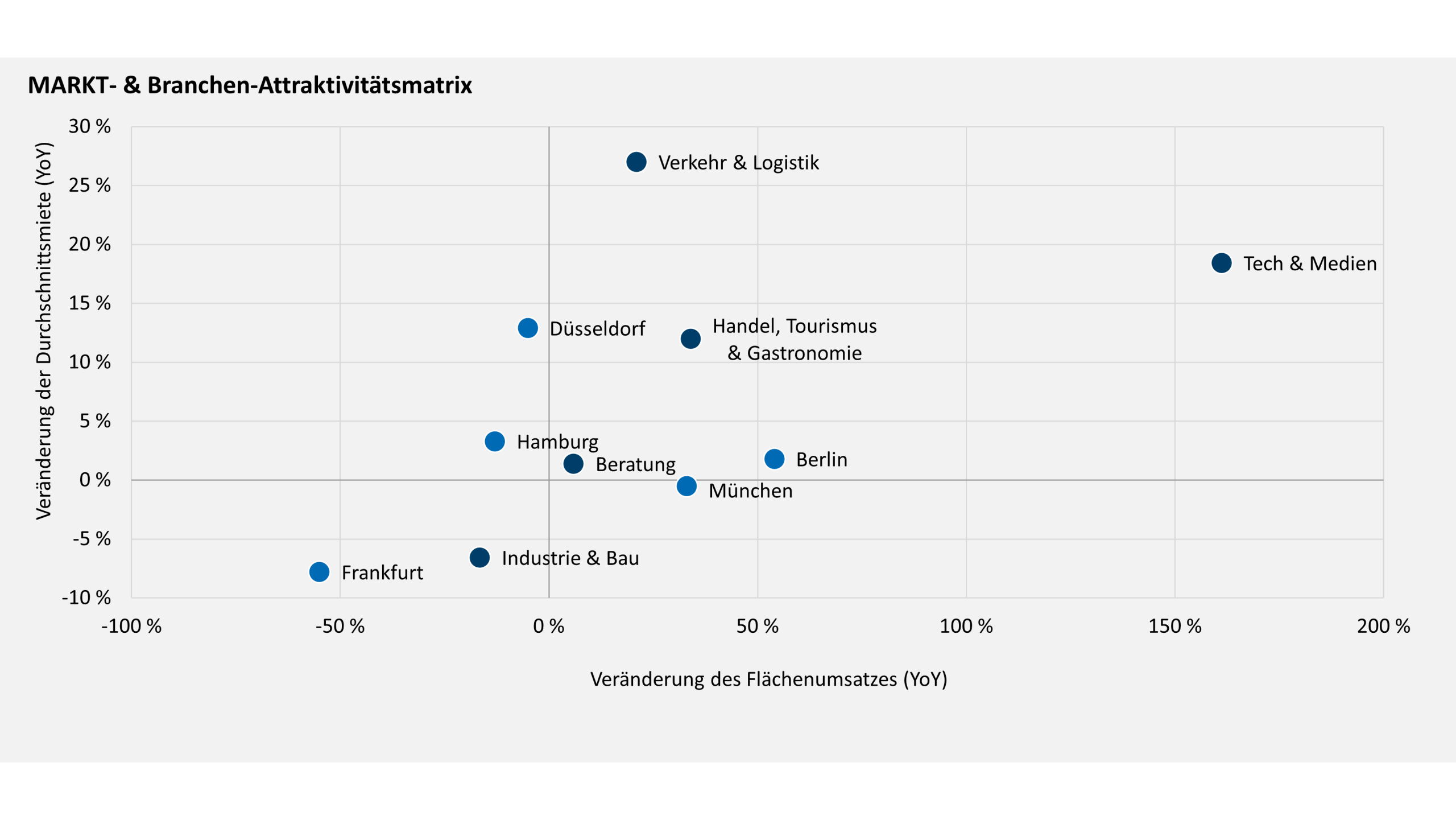
At around 373,000 square metres, Berlin recorded the highest take-up of the top 5 markets and was 54 per cent above the previous year’s figure. Munich followed with almost 350,000 square metres, an increase of 33 per cent. In both markets, several major deals shaped the result. Frankfurt reached around 158,000 square metres without comparable deals, 55 per cent less than in the first half of 2025, while Hamburg reached 187,000 square metres, a drop of 13 per cent. Düsseldorf remained the smallest of the five markets with around 98,000 square metres.
“Despite the challenging economic situation, we are seeing a lot of activity and movement in the market. Companies are optimising their space requirements and increasing location and space quality in a targeted manner,” says Nathalie Wegner, Head of Office Leasing Berlin at Newmark.
Vacancies and prime rents rise
The vacancy rate in the top 5 markets increased to 7.29 million square metres by the end of the second quarter. The vacancy rate rose by 0.7 percentage points to 9.3 per cent within a year. Frankfurt had the highest rate at 12.1 per cent, followed by Düsseldorf at 11.9 per cent. Hamburg was the lowest at 6.8 per cent.
At the same time, high-quality space in central locations became more expensive. The average prime rent of the five stores rose by 6.9 percent year-on-year to 49.60 euros per square meter. Munich reached 60.00 euros, Frankfurt 54.00 euros, Berlin 48.00 euros, Düsseldorf 46.00 euros and Hamburg 40.00 euros. The average rent across all markets rose by only 0.9 percent to 25.45 euros per square meter. The maximum rent, i.e. the most expensive new leases, was still above the achievable prime rent in most markets.
Special features from the individual markets
The Market Monitor analyses the special features of the five top cities in depth. While some developments can be observed across locations, others are particularly evident in individual cities.
Vacancies and prime rents are developing in opposite directions, and supply is increasingly spreading as a result. Modern, energy-efficient and well-equipped space in sought-after locations remains scarce. Older existing buildings will come under greater pressure if they are neither modernised nor impress with suitable rental conditions and services.
An important driver is the increased construction costs. In Frankfurt, the cost of new office buildings in 2025 was around 71 percent above the level of 2016. Prime rents rose by 35 percent in the same period. Newmark expects this gap to partially close in the coming years.
“We expect significant rent increases for prime space in Frankfurt’s CBD in the next few years. Prime rents are likely to develop towards the 60-euro mark, and maximum rents are likely to permanently exceed the 70-euro mark,” explains Lukas Kasperczyk, Head of Office Leasing Frankfurt at Newmark.
The structure of demand also differs significantly. In many markets, companies from the “Technology & Media” sector in particular are driving the market. Munich is currently seeing strong demand from technology- and research-related growth sectors such as robotics, defense, semiconductors and life science.
“Users are increasingly willing to compromise on location if the space is modern and service-oriented. Properties with a campus character, a high quality of stay and additional services are particularly in demand,” says Matthias Hausch, Head of Office Leasing Munich at Newmark.
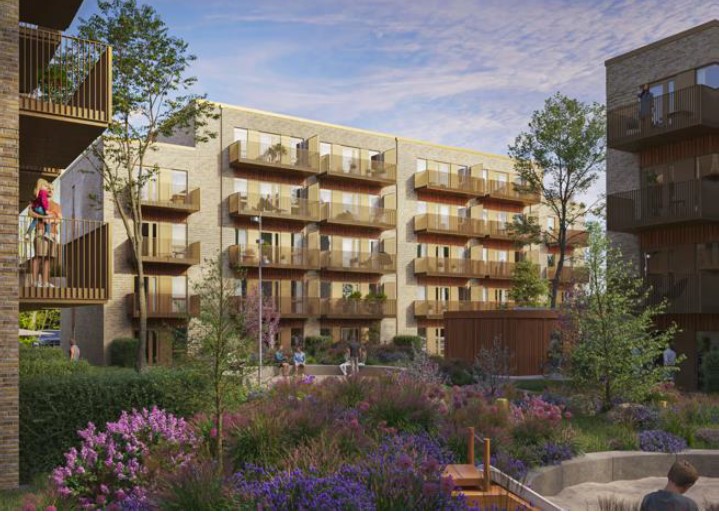
At the same time, the pressure to act is growing for older existing buildings. In Berlin, owners are increasingly looking at other uses. These include coliving, serviced apartments and fitness facilities. Whether a conversion is economically feasible and feasible under building law must be examined individually for each building. Where it is out of the question, modernization, flexible rental models and additional services are gaining in importance.
Outlook: Stability with local fluctuations
Newmark expects a largely stable level of sales for the top 5 markets in 2026 as a whole. Whether the recovery extends beyond Berlin and Munich depends primarily on larger lettings and the available supply of modern space. For owners of older buildings, investments in quality, flexible usage concepts and targeted incentives are becoming increasingly important.
The complete “Market Monitor Office Leasing H1 2026” contains key figures, forecasts and market insights on the top 5 markets as well as detailed analyses for Berlin, Frankfurt, Hamburg and Munich.