

The boom in artificial intelligence is devouring huge amounts of capital. A growing part of this is flowing into data centers and the necessary infrastructure. The public debate focuses primarily on how much capital is invested. No less relevant is where the associated risks actually appear. For institutional investors, this raises a question whose definitive answer could be painful at the end of this cycle: Do we actually still know exactly where our risks lie?
At first glance, it is not exactly difficult to get an overview of your own allocation in the portfolio: A certain proportion can be in real estate, for example, another in infrastructure, private debt, corporate bonds or structured finance.
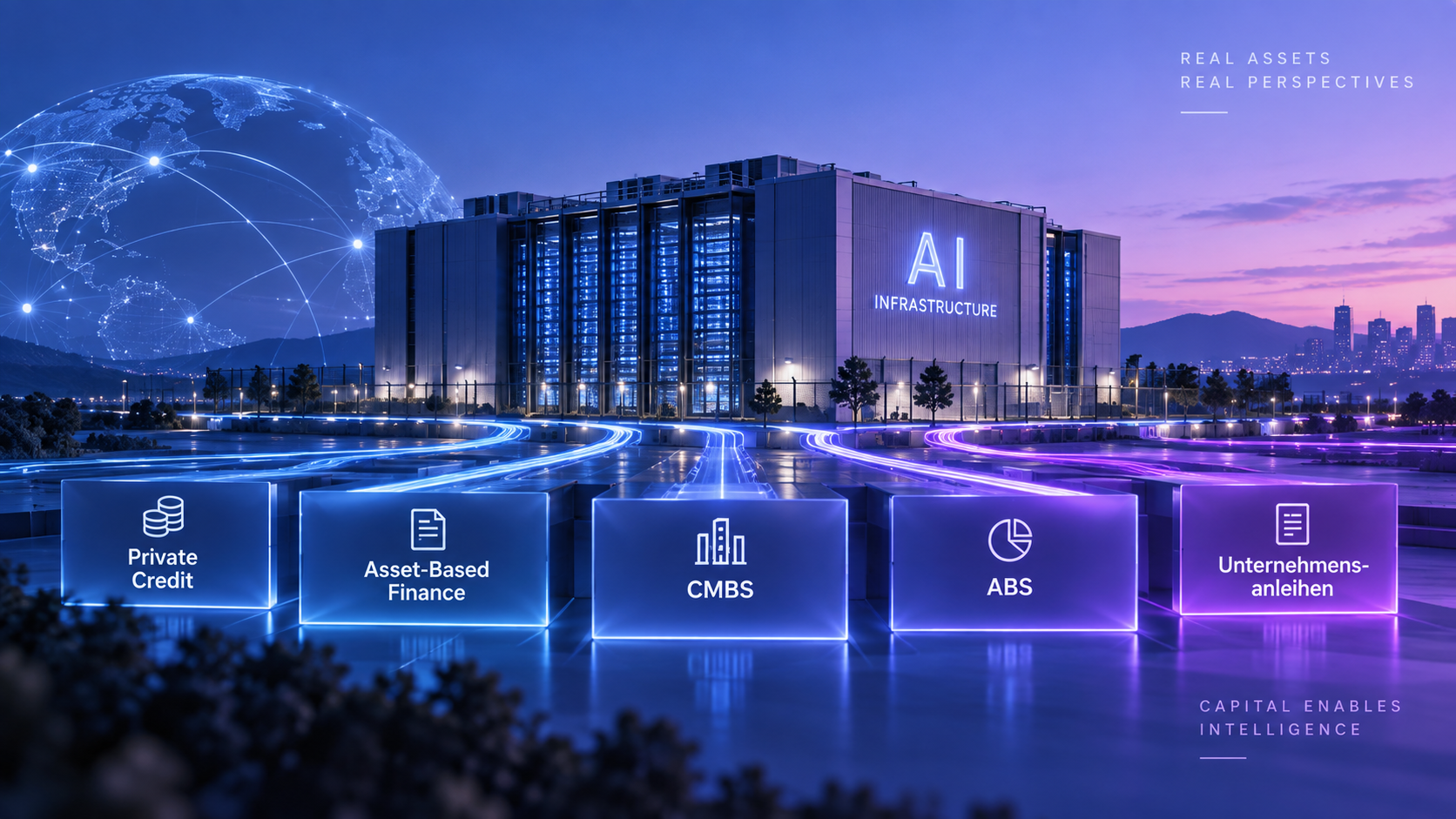
However, the current boom in AI infrastructure raises the question of whether this allocation allows sufficient conclusions to be drawn about the actual risks. The transparency problem also lies in the complex structuring of the huge investment requirements. The more enormous the amounts of capital that data centers require, the more diverse the financing channels become. S&P Global Market Intelligence points out that AI infrastructure is now financed via private credit, asset-based finance, CMBS, ABS and classic corporate bonds. According to the Bank for International Settlements, gross bond issuance by large hyperscalers alone rose to more than 100 billion US dollars in 2025.
For the institutional investor, corresponding investments can appear in completely different places in his portfolio. An infrastructure fund invests directly in data centers. A private credit fund finances an operator. A structured credit portfolio holds financing secured by data centers. A bond fund, on the other hand, holds bonds from a hyperscaler. Different forms of financing and investment, perhaps even different asset classes depending on your point of view, can thus represent a very similar economic risk. After all, all these investments can ultimately be based on the same demand: the need of a few large technology companies for more and more computing power.
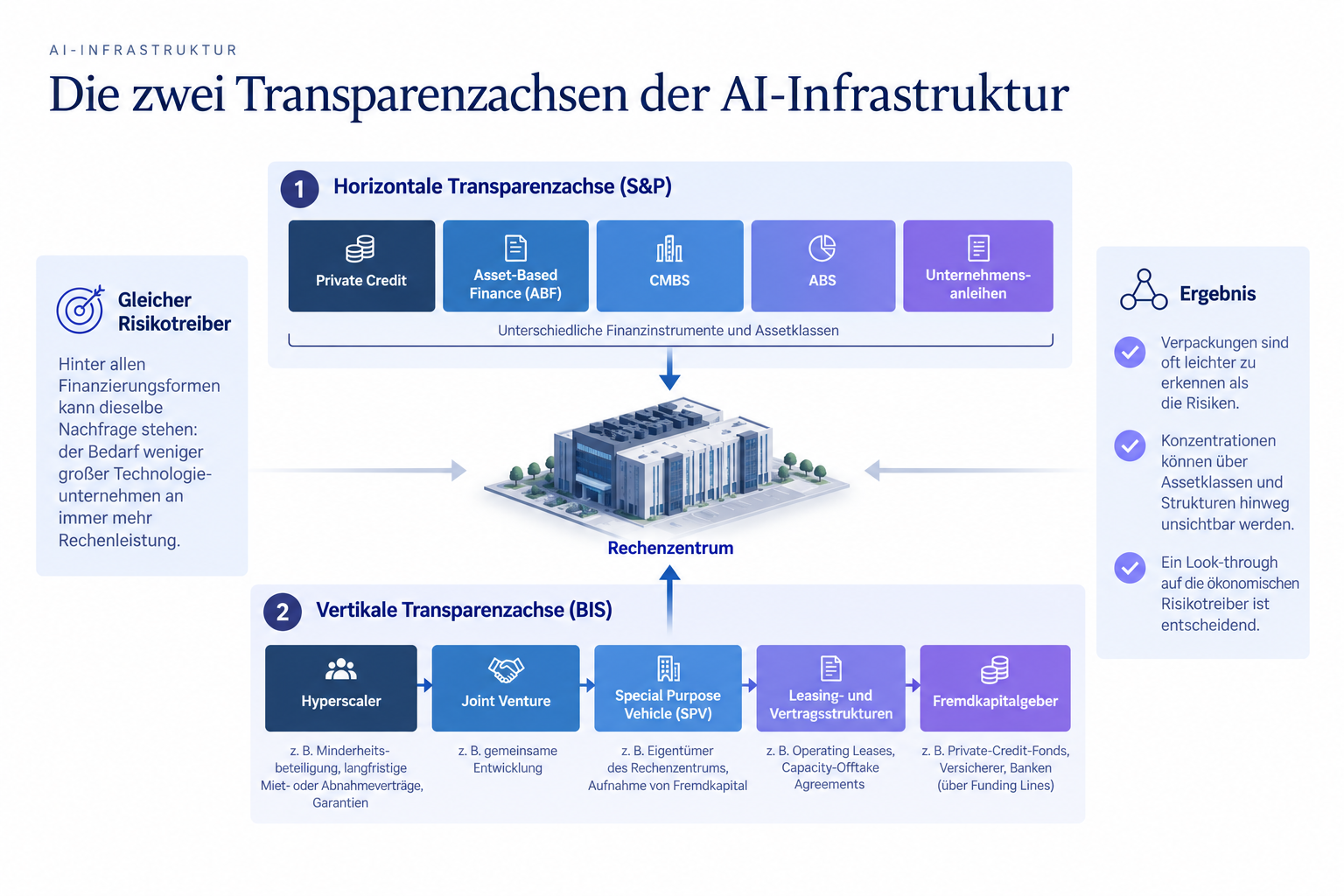
This creates two different transparency problems:
On the one hand, there is the finding described by S&P that the same economic risk can be found in different financial instruments. Data center debt can appear diversified across different structures or asset classes, even though a significant portion of the underlying exposure is attributable to the same small group of hyperscalers. Concentrations that would be easily recognizable within an asset class can thus become more invisible if they are spread across multiple asset classes.
On the other hand, the Bank for International Settlements is investigating how the big tech companies are financing their huge investments in AI infrastructure. In doing so, it comes across constructions in which data centers are not directly financed by the hyperscaler itself. Instead, a joint venture or a special purpose vehicle, for example, builds the data center. Equity comes from various investors, debt capital from private credit funds or other institutional investors, for example. The hyperscaler itself can only hold a minority stake, but at the same time commits itself to long-term rental or purchase agreements and, if necessary, guarantees. Economically, financing thus continues to depend largely on the hyperscaler. However, the debt lies with the vehicle. The BIS refers to such structures as “shadow borrowing”: obligations that are economically comparable to debt, but are largely outside the company’s balance sheet.
📌 Result:
- Two axes of transparency in AI infrastructure investments: On one axis, economic exposure is distributed horizontally across different financial instruments and asset classes. On the other axis, it is distributed vertically across companies, joint ventures, SPVs, leasing and contract structures.
- The problem could lie in the difficulty of risk management: The distribution of the huge investments among different investors over a variety of financing channels does not necessarily represent a risk in itself. This is an expression of the depth of developed capital markets. However, the real risk could lie in risk management if the packaging is easier to identify than the economic risks.
- S&P aptly describes the consequence of this: Risks in the context of AI investments must increasingly be considered across markets and not just within individual transactions. For institutional investors, this ultimately means a stronger look-through on the economic risk drivers. After all, an investor not only wants to know how his portfolio is formally divided. He also wants to know what proportion of his portfolio earns money for different reasons – and can lose money for different reasons.
Sources
S&P Global Market Intelligence, AI Infrastructure Debt Is Testing Private Market Valuations, August 28, 2026.
Bank for International Settlements, Eren/Krohn/Todorov, Financing the AI infrastructure boom: on- and off-balance sheet borrowing, BIS Quarterly Review, March 2026.
Bank for International Settlements, Aldasoro/Doerr/Rees, Financing the AI boom: from cash flows to debt, BIS Bulletin No. 120, January 2026.