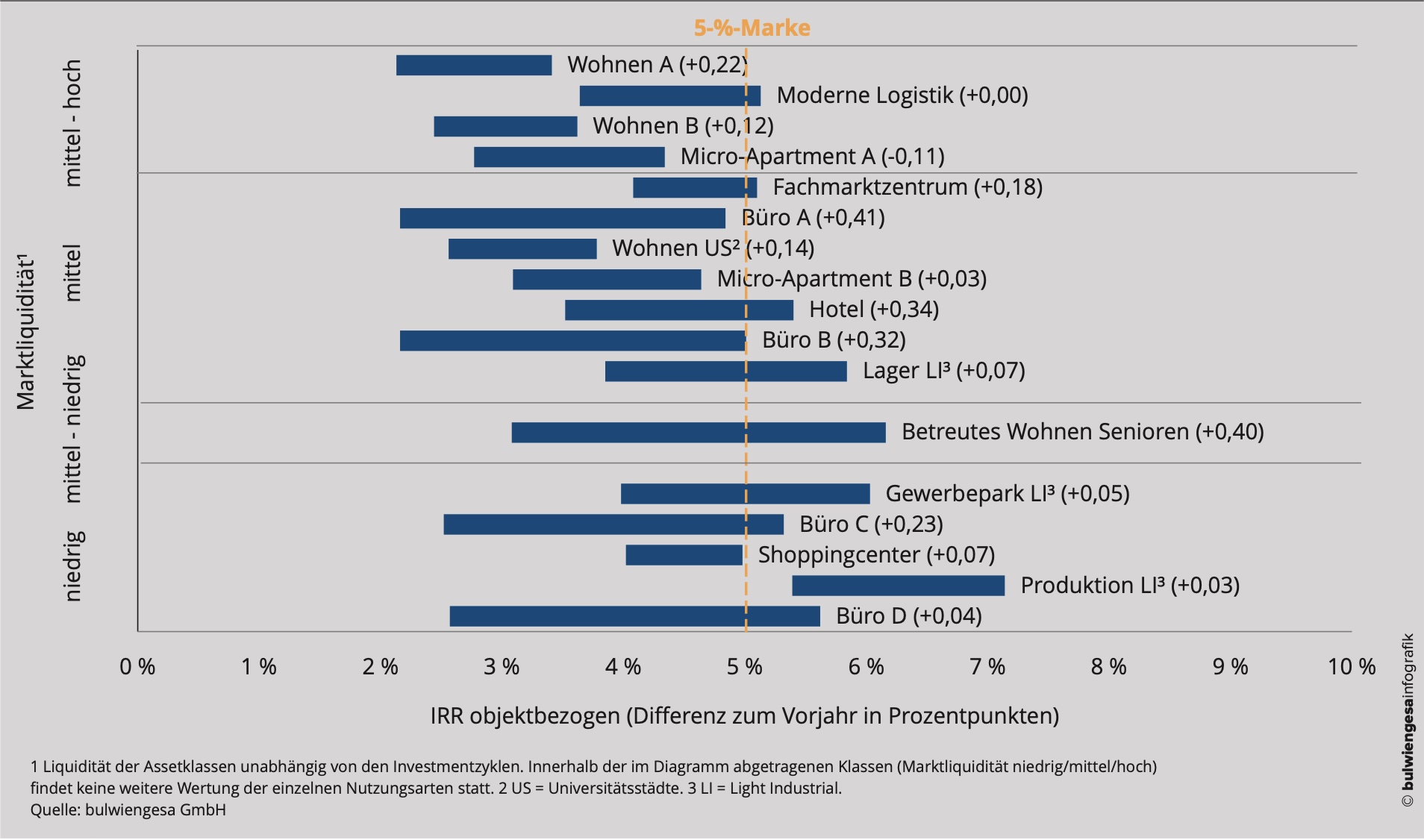

The adjustment process in the German real estate market is continuing. Valuation adjustments are being made successively and have not yet been completed, while the slump in transactions continues, especially in the commercial segment. At the same time, the calculated return potentials are rising slightly compared to the previous year in almost all asset classes examined. The reasons for this are higher return requirements from investors and increased inflation expectations. This is shown by the twelfth 5% study by bulwiengesa with the support of ADVANT Beiten.
Real estate market remains in adjustment mode
The phase of abrupt revaluation has largely been completed, but the resulting valuation adjustments are gradually continuing. Financing conditions can be calculated more easily again, and the price expectations of buyers and sellers are also slowly converging. However, this has not yet resulted in a broad revival of the transaction market – market activity remains weak, especially in the commercial segment. The market no longer expects a return to the conditions of the past years of low interest rates. Rather, a new market environment has established itself in which investment decisions have become more differentiated and demanding.
Real estate market remains in adjustment mode
In addition to financing costs, the quality and future viability of a property today determine its value. Energy efficiency, ESG requirements, rising construction and operating costs as well as changing user needs are increasing the pressure to act, especially for older portfolios. At the same time, modernization, conversion and repositioning open up opportunities for investors with the appropriate capital, know-how and long-term perspectives.
Real estate market remains in adjustment mode
The slight increase in IRRs is not only an expression of changed real estate markets. Higher yield requirements of investors and increased inflation expectations also have an impact on long-term return expectations.
Sven Carstensen, Managing Director of bulwiengesa GmbH, explains: “The ‘new normal’ is still characterised by adaptation. Valuations are gradually correcting themselves, while the slump in transactions continues, especially in commercial real estate. The slightly increasing yield potential should therefore not be confused with a broad market recovery.”
Office: Higher yields, but still high selectivity
The change is particularly evident in office properties. The IRR base value will increase from 3.91% in 2025 to 4.32% in 2026 in A cities. It will increase to 4.72% in B cities, 5.05% in C cities and 5.61% in D cities.
Office: Higher yields, but still high selectivity
This is the first time that C-cities have exceeded the 5% mark for the underlying. However, the higher yield potential is also an expression of increased risk and return requirements. At the same time, the market remains selective: modern, well-let properties in central locations are once again becoming more of an investor focus. Older portfolios, on the other hand, are coming under increasing pressure without targeted modernisation. Location, property quality and third-party usability are thus becoming decisive criteria.
Light Industrial maintains the top yield
Production properties will continue to lead the yield rankings in 2026. With an IRR base value of 6.17%, they are practically at the previous year’s level of 6.14%. Business parks follow with 5.27%. Modern logistics properties also remain almost unchanged at 4.93%.
Light Industrial maintains the top yield
The higher return potential of Light Industrial goes hand in hand with lower market liquidity and higher demands on asset management. Corporate real estate thus remains attractive for specialist investors – but not as a sure-fire success.
Housing remains the anchor of stability
Residential real estate confirms its comparatively defensive position. The IRR baselines in 2026 are 2.98% in Class A cities, 3.13% in Class B cities and 3.38% in university towns. Housing shortages, low new construction activity and rising rents are supporting earnings prospects. Compared to the previous year, the changes are moderate.
Other segments are approaching the 5% mark
For hotel properties, the IRR base values are between 4.84 and 5.21%, depending on the category. Shopping centers reach 4.96%, but remain highly dependent on property quality, positioning and possible repositioning measures.
Returns are increasingly created through differentiation
The results show less the beginning of a new real estate cycle than the further development of a changed market environment. Higher return potential is offset in particular by higher letting, investment and exit risks. Active asset management is thus increasingly becoming a success factor.
Florian Baumann, Partner at ADVANT Beiten, says: “Current developments show that return and risk must be considered even more together. In addition to a reliable economic calculation, investment decisions today also require a close look at legal, regulatory and property-specific risks.”