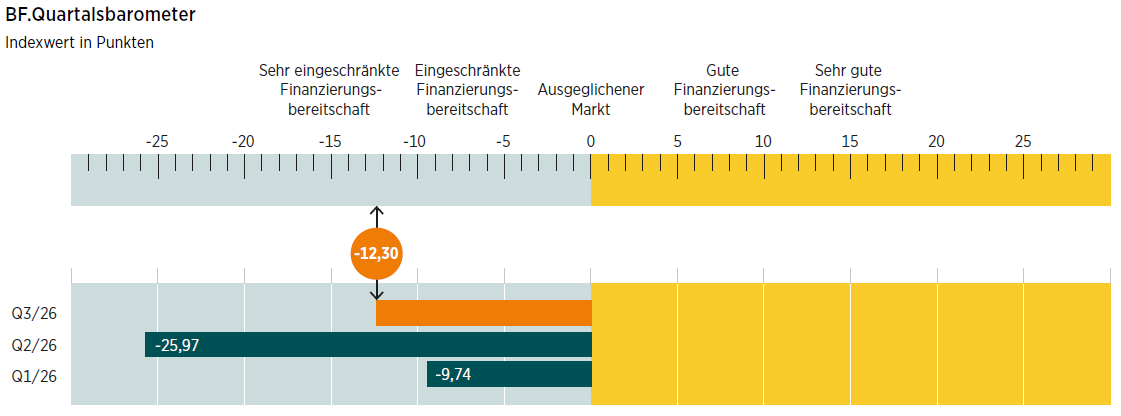
Sentiment among commercial real estate financiers improved in the third quarter of 2026, but remains in clearly negative territory. This is shown by the current BF. Quarterly barometer, compiled by BF.direkt AG in cooperation with the Handelsblatt Research Institute. The barometer value rose from -25.97 to -12.30 points.
Several key parameters led to the increase in the barometer value, including slightly positive developments in new business. 35 percent of respondents report an increase in new business (Q2: 23 percent). The proportion of respondents who observe a decline in new business fell to zero percent (Q2: 23 percent). The rest recorded stagnating new business.
While 46 percent of respondents said in the second quarter that financing conditions had deteriorated overall compared to the previous quarter, this figure fell to 15 percent in the third quarter. 80 percent of the experts spoke of unchanged financing conditions in the third quarter.
On average, the probability of non-performing loans has decreased slightly. The proportion of respondents who registered an increase in their NPL ratio in the past three months fell from 31 to 25 percent. For 50 percent (Q2: 35 percent), the ratio has not changed, for 15 percent it has decreased (Q2: 19 percent). The others did not provide any information.
For financing in the building portfolio, the average margin value is 156 basis points (bp), just under two bps less than in the second quarter. If the various property types are considered separately, the lowest average margin is found for residential real estate at 120 bp, the highest for supermarkets at 170 bp. In the financing of project developments, the average margin rose by almost four to 273 bp. In the third quarter, the institutions demanded the highest margin for office buildings at 309 bp, and the lowest for logistics properties at 210 bp.
At 64.5 percent, the average loan-to-value for portfolio financing is almost at the level of the previous quarter. The average loan-to-cost for project developments is 67.9 percent, which is a slight increase.
Fabio Carrozza, Chief Sales Officer of BF.direkt AG, comments: “Even though the barometer value remains negative, the significant improvement is remarkable. More institutions report an increase in new business. Nevertheless, higher financing costs remain a major challenge for all market participants. It should also be taken into account that the ECB’s latest key interest rate hike did not take place until after the survey had been completed. Whether this step was already anticipated by the respondents and is thus indirectly reflected in the results cannot be reliably assessed at present.”
At 75 percent, a larger proportion of respondents now assume that interest rates on financing with a ten-year fixed interest rate will be higher at the end of the year compared to the current level. In the second quarter, it was still 69 percent.
Prof. Dr. Steffen Sebastian, Chair of Real Estate Finance at IREBS and scientific advisor to the BF. Quarterly Barometer, says: “A new development is that real interest rates have recently risen independently of inflation. We expect this to be permanent. Interest rates will not fall to the previous level even with low inflation. This means more than the end of the low interest rate phase. It is a fundamental paradigm shift. In addition to higher interest rates, political and economic security has also declined. Investors must be prepared to make decisions under much greater uncertainty in the long term.”
Methodology
The BF. Quarterly Barometer is compiled by the Handelsblatt Research Institute on behalf of BF.direkt AG, a specialist in the financing of real assets. Scientific advisor to the BF. Quarterly Barometer is Prof. Dr. Steffen Sebastian, holder of the Chair of Real Estate Finance at IREBS. The index comprehensively reflects the mood and business climate of real estate financiers in Germany.
To determine the BF. Quarterly Barometer, 38 experts are currently surveyed quarterly, all of whom are directly entrusted with lending to real estate companies. The panel consists of representatives of various banks and alternative financiers.
The value of the BF. The Quarterly Barometer is made up of statements on the following aspects: assessment of current financing conditions, development of new business, average loan volume of individual transactions, leading department in credit decisions, development of the NPL ratio, importance of alternative financing options and development of the competitive situation.