- Transaction volume of EUR 8.6 billion on the investment market (residential and commercial) confirms moderate market recovery
- Commercial segment exceeds previous year’s start by 25 percent – driven by large-volume portfolio transactions
- Foreign capital much more active
- Geopolitical developments will continue to influence market movements
- Renewed price corrections – also in the core segment – not ruled out
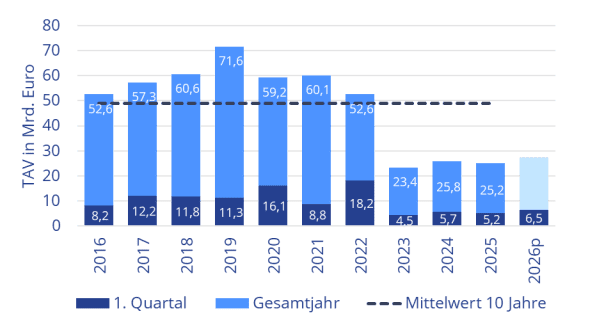
According to Colliers, real estate worth 8.6 billion euros was traded in Germany in the first quarter of 2026. Of this, 6.5 billion euros were attributable to commercial real estate and 2.1 billion euros to the institutional residential segment of ten residential units or more. The 11 percent increase in transaction volume compared to the start of the previous year is largely due to the commercial sector, which increased by 25 percent, while the residential segment recorded a decline of 16 percent. The number of transactions in the commercial segment reached the previous year’s level, resulting in a slight increase in average transaction size from EUR 20 million to EUR 25 million.
Start of the year marked by moderate growth
Michael R. Baumann, Head of Capital Markets Germany at Colliers, comments: “The quarterly result in the commercial segment is in line with the “recovery in small steps” we expect for the current year – provided that economic growth is moderate and the financial and capital markets remain stable. At minus 12 percent, the decline in transaction volume compared to the fourth quarter of 2025, which had the highest turnover, is moderate by historical standards, as fluctuations of 30 to 40 percent are usually observed. At the same time, we are recording the strongest start to the year since the end of the interest-driven boom phase.”
The result was supported by a total of six large-volume transactions from 200 million euros, which accounted for almost 30 percent of the total volume. Four of these were portfolio sales, whose market share reached 28 percent, the highest level since 2022. The two largest transactions are in the healthcare sector. These include the majority takeover of the Belgian REIT Cofinimmo with its 59 German nursing homes by the Belgian REIT Aedifica and the sale of a European portfolio with 17 German clinics and medical centers from the Canadian REIT Northwest Healthcare Properties to the US asset manager TPG. These market-defining deals meant that healthcare and social real estate with a market share of 16 percent is only just behind industrial and logistics real estate (17 percent) in fourth place among the types of use with the highest turnover. In addition, the transfer of the thermal spa portfolio of the Wund Foundation to the Therme Group, which was announced at the end of 2025, was approved by antitrust law.
Foreign capital drives major transactions
“The trend towards special properties with sustainable operator concepts, which has been observed for some time, continues. In this comparatively cycle-independent segment, Germany remains an attractive target for strategic takeovers, especially for international investors, due to its low market maturity and existing consolidation opportunities,” Baumann emphasizes. This is supported by the generally stable framework conditions on the German investment market, where a noticeable revival of market activity from abroad can currently be observed. Between January and March, the share of international capital was 43 percent.
With a share of 26 percent of the transaction volume, office properties ranked first among the types of commercial use and recorded an increase of 15 percent compared to the same quarter of the previous year. Among other things, the purchase of an office building including a data center and printing plant in Kaarst by the state of North Rhine-Westphalia as an owner-occupier for over 300 million euros contributed to this. This is the largest single transaction since the beginning of the year. Retail real estate also increased by 13 percent and came in second place with an 18 percent market share.
Transactions predominantly outside the top 7
Transaction activity continues to take place mainly outside the seven major investment centres. In the first quarter, these accounted for only 32 percent of the total volume – a historically low figure in a long-term comparison. The only transaction in the three-digit million range within the top 7 is the Munich city center property “Alte Akademie” from the Signa insolvency estate.
Baumann explains: “No deals have yet been concluded from the well-filled transaction pipeline – including properties in prime inner-city locations in the top 7. However, given the typically longer marketing processes in the large-volume segment, this was not surprising at the beginning of the year. Despite developments in the Middle East since the beginning of March, investment momentum remains stable overall. Individual large-volume key transactions could be postponed, but are likely to provide important impetus for the investment market in the course of the year.”
Commenting on the impact of geopolitical tensions on the real estate market, Francesca Boucard, Head of Market Intelligence & Foresight at Colliers, said: “The recent rise in inflation risks, particularly as a result of higher energy costs, is dampening the prospect of short-term rate cuts. Rather, it can be assumed that key interest rates will remain at an elevated level over a longer period of time. For the real estate market, this means a more challenging, but not unexpected, market environment: financing costs have risen significantly, and the planning security of risk premiums and interest rates that has been gained in the meantime is being put into perspective by a renewed increase in volatility. As the conflict continues, the pressure on the real estate market to adapt will also increase.”
Yield movements possible over the year
Baumann observes that current 10-year swap rates and yields on long-term German government bonds of over three percent are increasingly being taken into account in ongoing price negotiations. “Banks take a careful look at financing. After prime yields reached a stable level at the end of the interest rate hike cycle and have remained largely constant over the past three months, renewed upward movements are possible in the course of the year. Away from the core segment, repricing could thus develop more dynamically than originally assumed,” says Baumann.
Outlook: Market recovery remains dependent on the course of the crisis
“The start of the year is encouraging, and the discussions at MIPIM have also shown growing investor interest – especially on the part of international investors,” Baumann sums up. “Against this background, we consider an increase in transaction volume of 10 to 15 percent to around 30 billion euros in the course of the year to be realistic.” However, if the geopolitical situation continues to deteriorate, he believes delays in large-volume transactions and additional price adjustments could slow the market ramp-up and momentum in the current cycle.