

Uncertainty slows down take-up at the start of the year
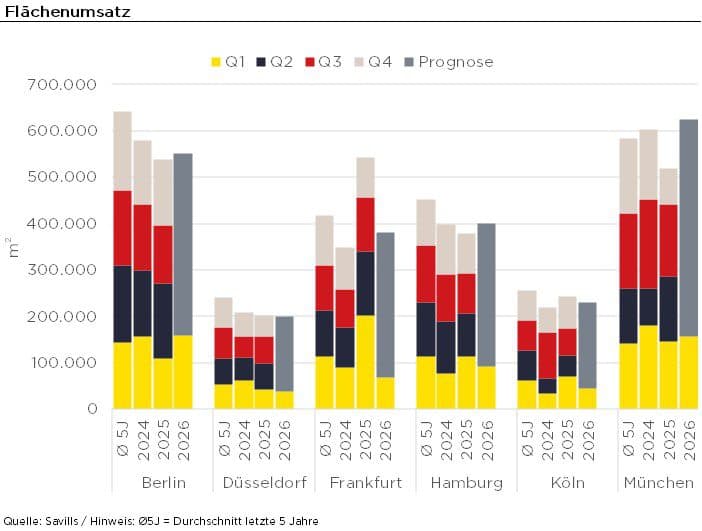
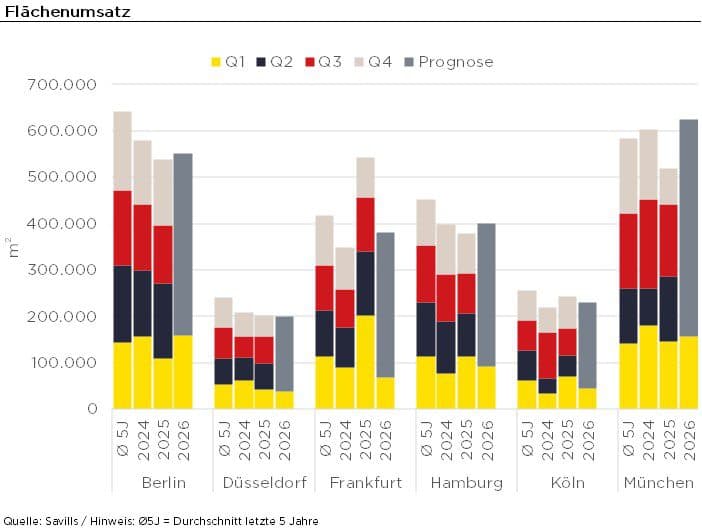
In the 1st quarter of 2026, take-up in the top 6 office markets* reached 560,800 m². This was 18% below the previous year's figure. Compared with the ten-year average, take-up fell by 21%.
Jan-Niklas Rotberg, Managing Director and Head of Office Agency Germany at Savills, comments: "The start of the year in the top 6 office markets was subdued and there was no recovery. The uncertain geopolitical and economic environment continues to slow down the willingness to relocate, and many companies are taking significantly more time to make decisions. Location and space options are carefully analysed, and costs, location and future viability are intensively weighed up. At the same time, extension options are being examined and often used."
Hybrid working drives relocations and leads to a shift in demand
Hybrid working remains an important reason for moving. Antonia Wecke, Associate Research at Savills, explains: "Flexible working models are fundamentally changing the demand for space. While companies are reducing their space requirements, they are also placing higher demands on floor plans, collaboration space, and building standards. As a result, demand is increasingly concentrated on high-quality, centrally located office space. In this segment, supply is rather limited, vacancy rates are relatively low and the bargaining position between tenants and landlords is balanced. Quality-oriented industries in particular accept higher rents and reduce their total area in return - with further increases in prime rents as a result."
Away from the top segment, users benefit from a more relaxed market
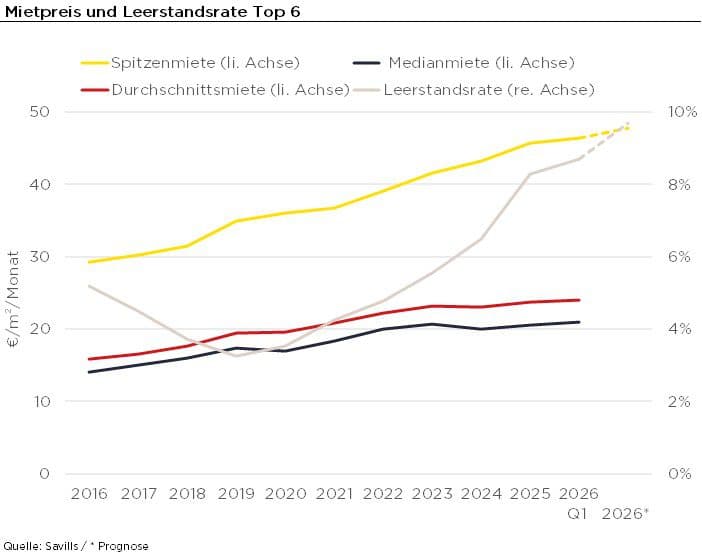
Jan-Niklas Rotberg observes: "Away from the top segment, many users are currently experiencing a much more relaxed market. The shift in demand towards higher quality and central locations means that peripheral and less competitive stocks are becoming less attractive and vacancies are rising. In these properties, users often have a strong negotiating position when renewing contracts, which is reflected in flexible terms and attractive incentives. Many companies therefore extend existing contracts in order to gain time to clarify costs, expansion and future space requirements. Overall, the increasing focus on quality is reinforcing the segmentation of the market." The rising prime rents combined with increasing vacancies illustrate an increasing market polarization. On average, the prime rent was higher than the top rent. -6 cities increased by 1.5% quarter-on-quarter, while the vacancy rate rose by 40 basis points to 8.7%.