Annual balance sheet 2025 and trends 2026 of DIP – Deutsche Immobilien-Partner
According to analyses by DIP 2025, the logistics segment was divided into two parts:
- The transaction volume with logistics real estate fell by 17% to around EUR 6.1 billion in 2025, falling from first to third place in the commercial investment market.
- Logistics space take-up, on the other hand, rose significantly by 13% year-on-year to around 5.9 million square metres.
The logistics market benefited, among other things, from continued strong online and mail order trade: According to surveys by the German Retail Association (HDE), online retail sales rose again by around 4.5% to EUR 92.4 billion in 2025 (2024: around EUR 88.4 billion). This means that the sales level is still more than 40% above the pre-Corona level. At the same time, brick-and-mortar retail was also able to make up some ground against online retail after the end of the pandemic.
In particular, the continuing increase in the importance of online and mail order trade as well as structural changes in supply chains and warehousing are sustainably supporting the high demand for modern, high-performance logistics space. There is an increasing focus on last-mile logistics with corresponding city hubs, for which previously otherwise used areas and real estate can also be used (e.g. former petrol stations, abandoned commercial buildings, office properties that are no longer marketable).
In addition, in order to achieve even greater resilience of supply chains in the face of global crises and to reduce dependence on foreign production sites and suppliers, the demand for buffer warehouses is also increasing in order to ensure a broader delivery capability in the future. In addition, the logistics industry is benefiting from the relocation of production to the main demand countries (re-shoring; near-shoring).
However, it is not only digitization that places higher technical demands on logistics properties: both environmental and transport policy requirements and significantly rising energy costs are leading to an accelerated focus on sustainability. Corresponding measures include, for example, the revitalisation of brownfields, photovoltaic systems on facades, walls and roofs, efficient lighting systems (LEDs) and modern heating systems.
Overall, logistics and industrial properties will remain in the focus of investors in the German market for commercial investments in 2026.
Investment turnover decreased, space turnover increased.
The fundamentally positive outlook is also reflected in the logistics segment:
- Take-up of logistics space leased or newly built for owner-occupiers in Germany rose to around 5.9 million m² in 2025, exceeding the previous year’s result (2024: 5.2 million m²) by 13%, but remains well below the record level of 2021 (approx. 8.3 million m²).
With around 1.82 million m² of space taken in 2025, the regions of the “Big Five” once again accounted for a significant share, with the increase in take-up compared to the previous year (2024: approx. 1.46 million m²) amounting to approx. 25 %.
Frankfurt am Main once again took first place with an increase in take-up of around 470,000 m² compared to the previous year, followed by Berlin (426,000 m²), Hamburg (340,000 m²), Düsseldorf (338,000 m²) and Munich (275,000 m²).
- The dynamics of the logistics market are also reflected in high completion volumes , which have averaged around 3.8 million m² of new-build logistics space annually since 2016. In 2025 , the figure was again very high with around 4 million m² of new logistics space, but is 9% below the previous year’s figure (2024: around 4.4 million m²).
According to the evaluation of Logivest’s logistics real estate seismograph, the completion volume in the DIP locations is projected to be around 1,450,000 m² of logistics space within the city limits and in the immediate vicinity of the cities in 2025. The DIP value of the previous year (2024: approx. 1,869,000 m²) was undercut by approx. 20. For 2026, a further lower new space of around 1,250,000 m² is expected for the DIP locations.
- The market for logistics investments generated a cash turnover of around EUR 6.12 billion in 2025, a result that was around 17% lower than in 2024 (EUR 7.34 billion). and thus fell from first to third place in the commercial investment market behind the retail and office asset classes.
The front-runner in the “Big Seven” was Berlin (approx. EUR 765 million), followed by Frankfurt (approx. EUR 700 million), Hamburg (approx. EUR 610 million), Düsseldorf (approx. EUR 545 million), Munich (EUR 500 million), Cologne (EUR 355 million) and Stuttgart (approx. EUR 230 million). This means that the Big Seven accounted for around 60% of the total logistics investment volume in 2025.
Increased prime yields for logistics properties.
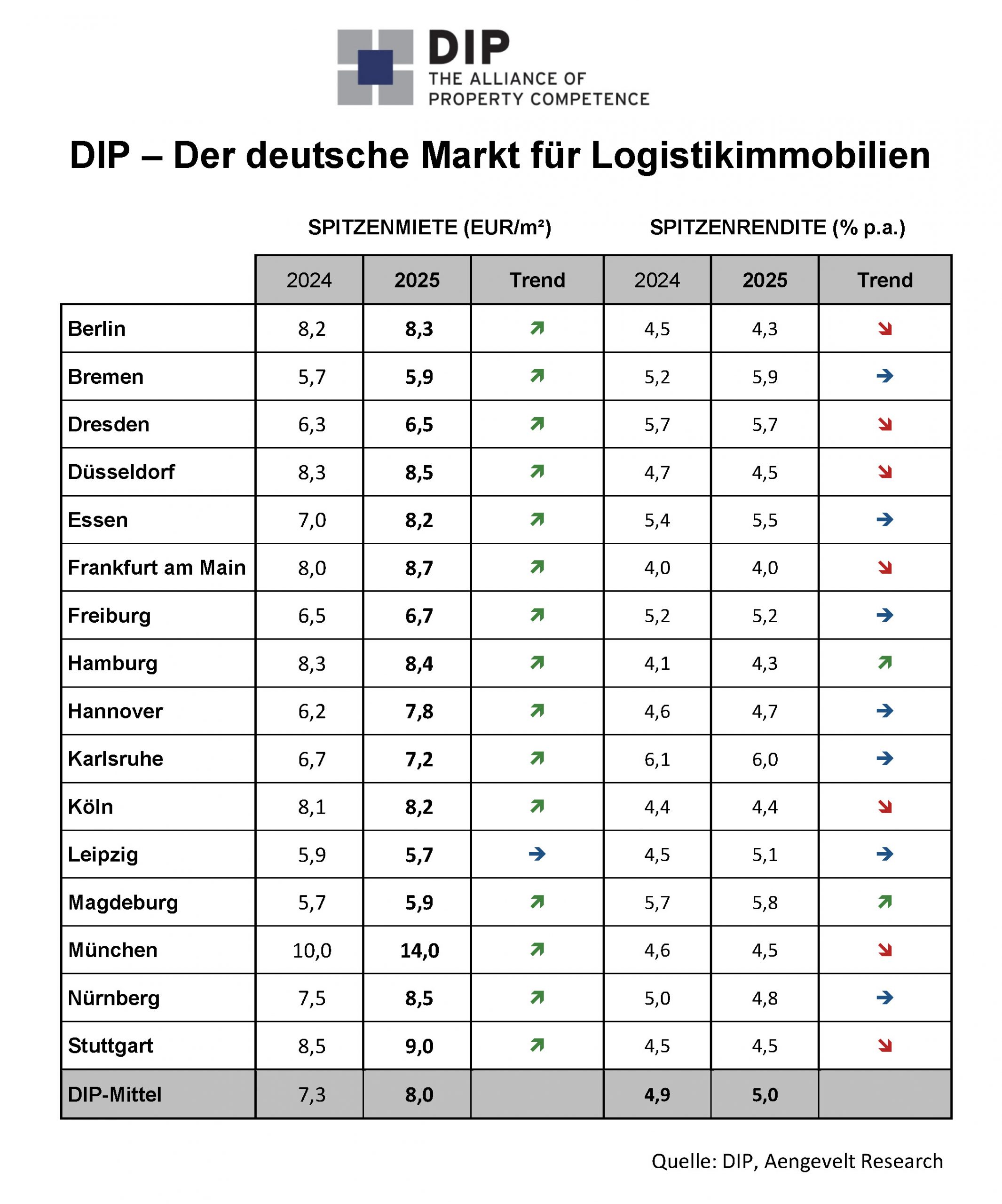
- While prime yields in the logistics segment in the 16 DIP locations analysed (Berlin, Bremen, Dresden, Düsseldorf, Essen, Frankfurt am Main, Freiburg, Hamburg, Hanover, Karlsruhe, Cologne, Leipzig, Magdeburg, Munich, Nuremberg, Stuttgart) reached their lowest value in 2021 at around 4.3% p.a., they have risen continuously again since 2022. This trend continued in 2025 with an increase to 5.0% p.a. (2024: 4.9% p.a.).
- The most expensive city in 2025 in terms of prime yields for top logistics properties was Frankfurt (4.0% p.a.), followed by Berlin and Hamburg with 4.3% p.a. each, Cologne (4.4% p.a.) as well as Düsseldorf, Munich and Stuttgart with 4.5% p.a. each, Hanover with 4.7% p.a. and Nuremberg (4.8% p.a.).
- In the other locations, the prime yield ranges from 5.1% p.a. to 6.0% p.a.
Stable land price level.
In the 16 DIP markets analysed, the average commercial building land prices are stable at around EUR 268/m²:
- The most expensive city and metropolitan region is Munich, with an average of EUR 860/m². This is followed by Stuttgart (EUR 590/m²), Frankfurt (EUR 375/m²) and Düsseldorf (EUR 370/m²).
- In the middle of the price range are Hamburg (EUR 250/m²), Nuremberg (EUR 245/m²), Freiburg and Karlsruhe (EUR 240/m² each), Cologne (EUR 230/m²), Berlin (EUR 225/m²) and Hanover with EUR 180/m².
- Prices are significantly lower in Essen (EUR 125/m²), Bremen (EUR 120/m²), Leipzig (EUR 90/m²), Dresden (EUR 85/m²) and in the Magdeburg region (EUR 70/m²).
When it comes to the development of land prices, it should be noted that a further marked price increase in central locations is to be expected due to a shortage of land.
Continuously increasing rent level.
- The prime rent for modern, demand-driven logistics space increased by almost 10% on average at the DIP locations to around EUR 8.00/m² (2024: EUR 7.30/m²).
- The most expensive logistics location – measured by the prime rent level – is the Munich Metropolitan Region (EUR 14.00/m²), followed by Stuttgart (EUR 9.00/m²), Frankfurt (EUR 8.70/m²), Düsseldorf and Nuremberg (EUR 8.50/m² each), Hamburg (EUR 8.40/m²), Berlin (EUR 8.30/m²), Cologne and Essen (EUR 8.20/m² each) and.
- Hanover (EUR 7.80/m²) and Karlsruhe (EUR 7.20/m²) are at a medium level, while space in Freiburg (EUR 6.70/m²) and Dresden (EUR 6.50/m²) is cheaper to rent.
- In Magdeburg and Bremen (EUR 5.90/m²) as well as in Leipzig (EUR 5.70/m²), on the other hand, the rent level is even more friendly for settlement.
Prospects
- The weakening macroeconomic development of the last three years is now also reflected in the demand for logistics properties. As a result, growth-dependent speculative new construction has largely come to a standstill, so that projects are usually only built for specific customers with concluded contracts.
- Re-lettability or third-party usability are becoming even more important, as is the divisibility of space, especially since subletting has also increased in the logistics segment.
- As soon as the overall economy gradually recovers – which the Bundesbank, economic institutes and other market observers expect to do in the coming years on a segment-differentiated basis – the logistics industry will also participate. In particular, the Europe-wide and intercontinental increases in defence spending will lead to a significant increase in demand for market-oriented commercial and logistics space, especially in the industry-relevant regions, albeit with significantly higher requirements for security, etc. than in other logistics segments.
- The trade agreements signed or envisaged between the EU and India and Latin America will also gradually boost logistics development. Overall, the logistics segment thus continues to offer solid, good investment prospects in the medium to long term.
- In city centres, city logistics is leading to a high and sustained dynamic, also because markets – e.g. for food delivery services – still have to develop and scale, and some concepts are still in the testing stage. For the last mile, new transport and delivery technologies are also being developed, such as robots. Electrified air transport, e.g. in the form of (autonomous) transport drones, is also gaining in importance much faster than previously assumed by public administration and politics in the course of legislation and technical and economic feasibility that are being implemented at EU and state level.