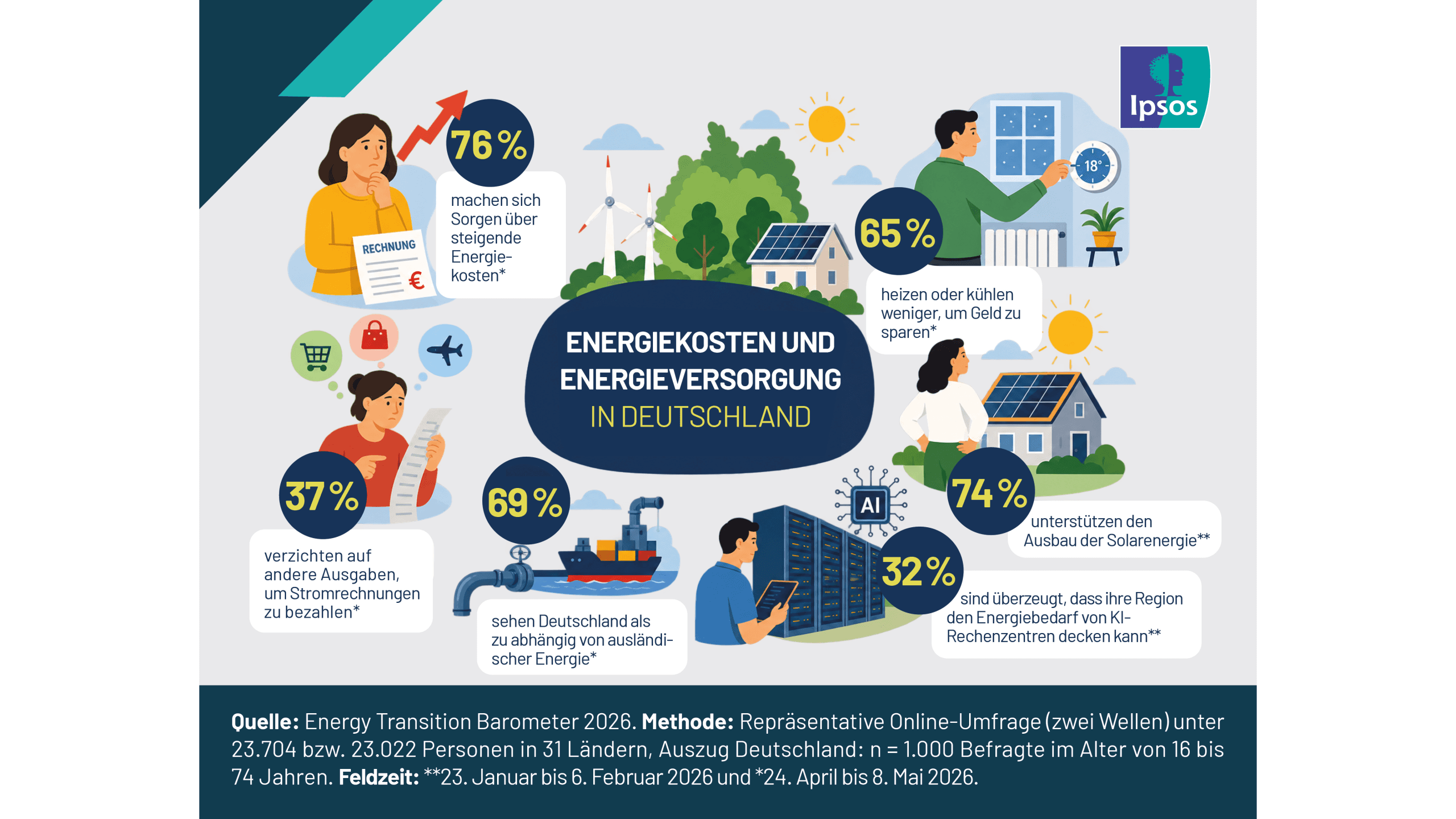
Rising energy costs are a burden on many households in Germany: Three out of four Germans (76%) are currently worried about the development of energy prices. More than one in two (54%) also has the impression that it has become more difficult to bear the energy costs of the household. The consequences are also evident in everyday life: 37 percent have already reduced their expenses in other areas to be able to pay their electricity bills, and 65 percent heat or cool their homes less to save money.
At the same time, a majority is in favor of the expansion of renewable energies. This is shown by the Energy Transition Barometer 2026 by Ipsos, for which experiences and attitudes towards energy supply were examined in 32 countries worldwide.
Majority in favor of more energy independence
Beyond the personal burdens of rising energy costs, Germans are also concerned about the country's future energy supply. 69 percent of Germans fear that Germany is relying too much on foreign energy sources in view of current world events. A narrow majority (57%) also believes that Germany's energy independence should be a priority, even if this means higher costs.
Doubts about the power supply for AI data centers
With regard to the future electricity supply, the population is cautiously optimistic overall. 44 percent of Germans believe that their region has enough electricity to meet future demand. A similar number (43 percent) are confident that the increasing demand for electricity can be met by additional investments in renewable energies.
There is less confidence when it comes to artificial intelligence: Only 32 percent are convinced that their region has enough electricity to cover the increasing energy demand of AI data centers. 28 percent doubt this.
Majority relies on renewable energies for investments
When it comes to investments in electricity supply, a clear majority of Germans (60%) are in favor of renewable energies and energy storage facilities. This is followed at a considerable distance by new small modular nuclear reactors (39%) and oil and natural gas pipelines to improve the import and export of fossil fuels (28%).
Support for the expansion of solar energy is particularly high (74%). Seven out of ten Germans (70%) also support a greater expansion of hydropower, while 67% are in favour of more wind power. At the same time, these energy sources are considered the most environmentally friendly forms of energy generation: solar energy (84%), hydropower (82%) and wind power (75%).
Support for the expansion of nuclear energy (38%) and gas power (33%) is significantly lower. Coal is the fewest supporters (17%); at the same time, it is by far the least perceived as an environmentally friendly energy source (13%).
Carolin Basedow, ESG Lead and sustainability expert at Ipsos in Germany, sees the results as a clear indication of the population's expectations of the energy supply of the future:
"Our data show that a clear majority of people in Germany demand the expansion of solar and wind power and give priority to renewables. For many, it is not only the environmental aspect that is likely to play a role, but also the desire to free themselves from dependence on expensive foreign energy imports. Many citizens see the energy transition not only as a climate policy task, but increasingly also as a question of security of supply."
Method
These are the results of the Energy Transition Barometer 2026 study, which Ipsos conducted in 31 countries via its online platform Global Advisor. For the online survey, a total of 23,704 (wave 1) and 23,022 (wave 2) people were interviewed between January 23 and February 6, 2026 (wave 1) and between April 24 and May 8, 2026 (wave 2). In Germany, respondents were between 16 and 74 years old, and the sample included around 1,000 people.
In addition to Germany, the 32 countries surveyed include: Argentina, Australia, Belgium, Brazil, Canada, Chile, France, India, Indonesia, Ireland, Italy, Japan, Malaysia, Mexico, New Zealand (wave 1 only), the Netherlands, Peru, Poland, Saudi Arabia (wave 2 only), Singapore, Spain, South Africa, South Korea, Sweden, Switzerland, Thailand, Turkey, the United States.
In 18 of the 32 countries surveyed, Internet penetration is so high that the samples can be considered representative of the entire population in the age groups studied – including Germany.
The data were weighted in such a way that the sample composition of each country best reflects the demographic profile of the adult population according to the most recent census data. The "global country average" reflects the average result of all 32 countries in which the survey was conducted. It has not been adjusted for the population size of each country and does not represent an overall result.
The accuracy of Ipsos' online surveys is calculated using a so-called confidence interval. A survey with N=1,000 has an accuracy of +/- 3.5 percentage points, a survey with N=500 has an accuracy of +/- 5.0 percentage points.
Further information on the method description can be found in the study report.