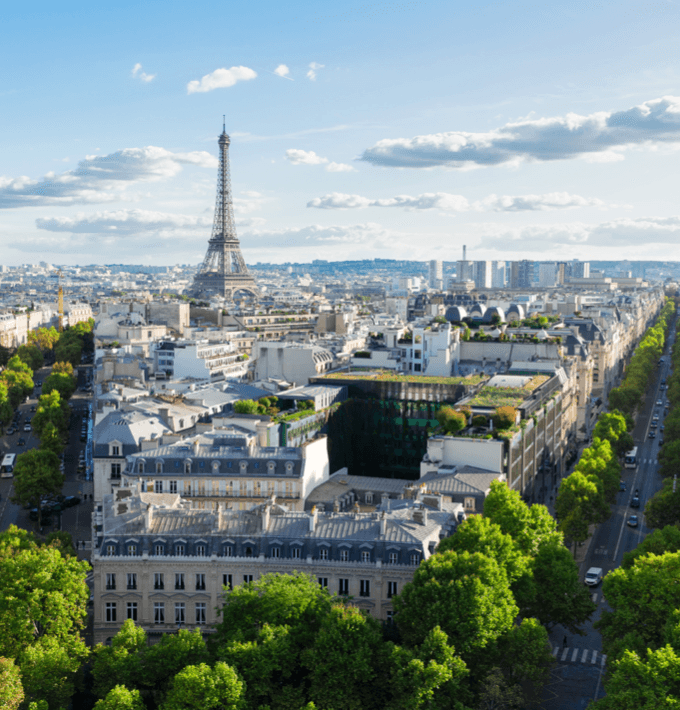
“In the face of the slowdown seen in 2026, the Parisian luxury market is following its own cycle. The decoupling even appears to be accelerating further this year,” notes Christophe Michel, CEO of Engel & Völkers France.
Demand remains resilient and is concentrated in the very high-end segment
Between 2016–2017 and 2024–2025, the number of transactions fell by 31 per cent in Paris, driven in particular by the rise in interest rates since 2022. Transactions by non-resident buyers fell by only 13 per cent, compared with 32 per cent for residents, and their share of Parisian sales thus rose from 6.3 per cent to 7.9 per cent.
Although they represent a minority of the market as a whole, non-resident buyers are concentrated at the top end: they account for 6.6 per cent of sales under €750,000, but nearly a third of those exceeding €3 million. Nearly 44 per cent of them are French expatriates, a proportion that is declining in favour of a foreign clientele that is undergoing a shift in composition.
Americans are the leading foreign buyers
With 414 transactions in 2024–2025, Americans are the leading foreign nationality amongst non-residents in Paris. Their share has risen from 4.5 per cent to 11.5 per cent over ten years, and accounts for 23 per cent of non-resident sales exceeding 3 million euros. They pay an average of €15,600 per square metre, compared with €10,900 per square metre for residents, for larger properties that are often fully renovated. Their average age of 59 reflects the fact that they have built up their wealth over a long period of time.
Behind them, the Lebanese (162 transactions) and the Italians (151) are ahead of the Germans, the Belgians and the Swiss. Buyers from neighbouring European countries have also gained ground, rising from 12.2 per cent to 16.9 per cent of non-resident transactions. Although fewer in number, Canadians pay the highest price per square metre, averaging €15,900 per square metre. In the Inner Suburbs, the picture is different: Algerians and Lebanese lead the way, ahead of Americans.
Second homes and turnkey properties
Interviews with Karen Schoemaker, a Private Office agent at Engel & Völkers, and Victoria Garnier-Vigier, a partner and co-founder of Odyssée Notaires, shed light on these figures. A pied-à-terre, sometimes occupied for several months a year, remains the primary motivation. Demand is concentrated in a few key areas, from the 6th arrondissement to the Golden Triangle, and a range of properties renovated to the very highest standards, designed to meet international standards, has been developing over the past three years or so. Taxation, for its part, rarely holds projects back.
“It’s more a matter of following one’s heart than a strictly financial decision,” emphasises Victoria Garnier-Vigier.
2026–2027: a growing decoupling
Following the recovery in 2025, the market slowed down again in early 2026, initially affecting the most affordable properties and second homes. The luxury and ultra-luxury sectors, however, are holding up well. American buyers remain very active, despite a less favourable exchange rate.
Over the coming months, Engel & Völkers France anticipates a period of caution in the high-end property market, linked to political and fiscal uncertainty in the run-up to the 2027 elections, followed by a fairly rapid recovery once the elections are over.
“This study confirms what our teams see on a daily basis: for a discerning international clientele, Paris remains a leading property destination. And our network enables us to support these buyers well before they arrive in Paris,” concludes Christophe Michel.
* In this study, purchasers whose place of residence is outside France at the time of sale are considered non-residents. The concept is therefore based on place of residence rather than nationality: a French national living abroad is counted as a non-resident, whilst a foreign national resident in France is counted as a resident. The terms ‘international buyers’ and ‘non-residents’ are used interchangeably in the study.