Residential climate vs. economic sentiment – The scissors of the indicators as a signal provider?
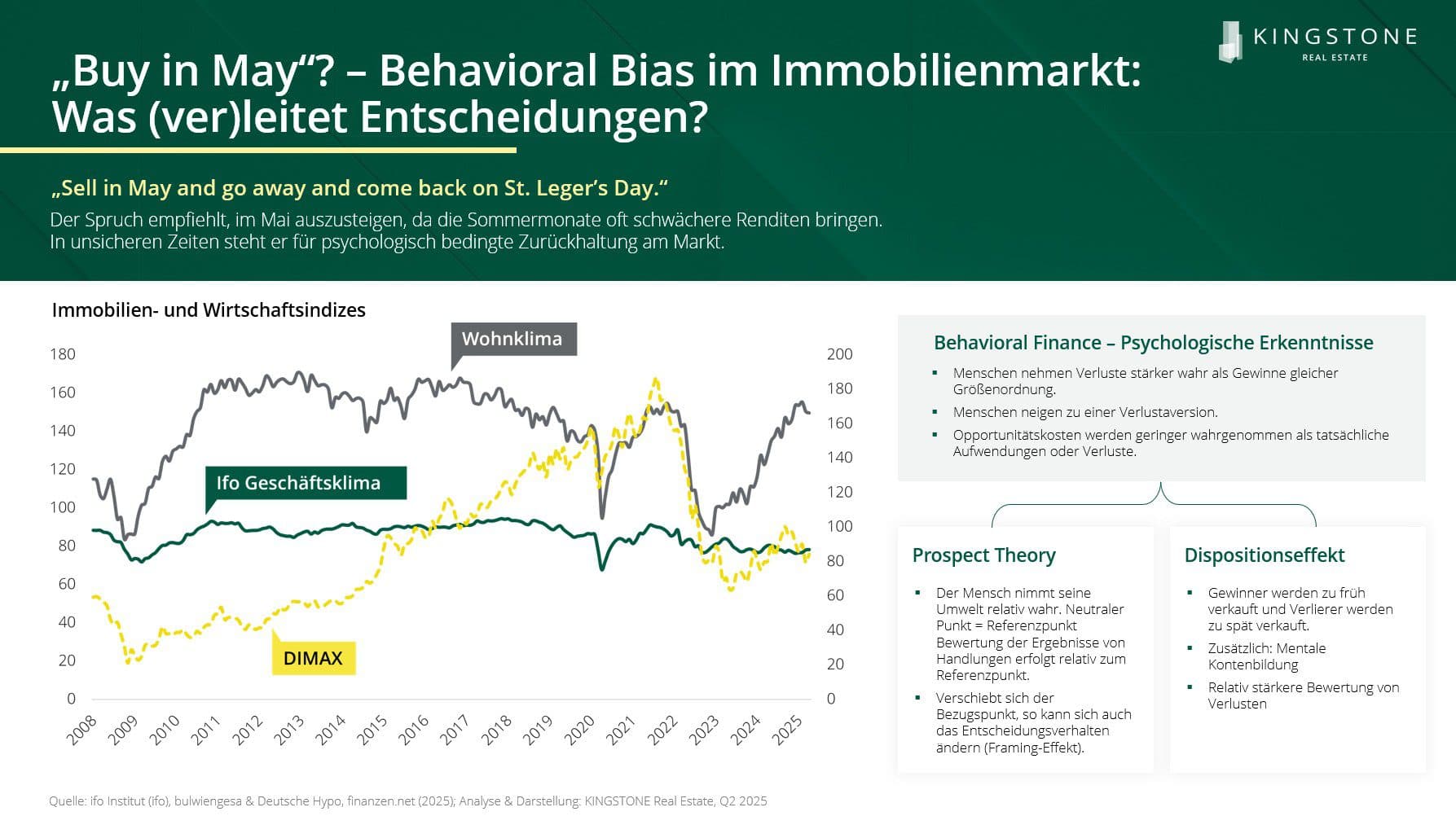
The residential climate barometer of bulwiengesa and Deutsche Hypo traditionally shows a close correlation with the ifo business climate index. Both indicators are considered relevant early warning systems for investment behaviour and price developments. Since the beginning of 2024, however, there have been significant deviations between the two indices. While the ifo business climate remains at a low level and the German economy as a whole tends to be characterized by uncertainty, restrained consumption and reluctance to invest, the residential climate is significantly higher. This divergence cannot be explained primarily by short-term economic impulses, but refers to structural expectations of shortages that could increasingly have a price-forming effect.
The background to this is the sharp decline in construction activity: in 2023, around 294,000 apartments were completed nationwide - in 2024 only 252,000 units. This means that new construction activity is significantly below the structural demand of around 320,000 apartments per year identified by the BBSR (Federal Office for Building and Regional Planning). In conjunction with rising construction costs, regulatory uncertainties and financing hurdles, this results in a supply bottleneck that stabilises medium-term earnings expectations in the residential segment despite macroeconomic weakness – especially in high-demand sub-markets.
The German Real Estate Stock Index (DIMAX), which is traditionally strongly influenced by listed housing portfolio holders, is currently showing some stabilisation, but does not reflect the recent significant increase in the residential climate to a comparable extent. Rather, a persistent market restraint can be seen, which corresponds to the well-known seasonal stock market wisdom “Sell in May”.
This discrepancy can also be classified in terms of behavioral economics: Both prospect theory and the disposition effect, central concepts of behavioral finance theory, provide explanations for why a structurally justifiable brightening of gross cash flow expectations has so far only been moderately reflected in the price development. According to prospect theory, market participants evaluate their environment relative to a mental reference point. After significant price losses – as observed in the wake of the interest rate shock – this reference point often remains negatively coloured. Even objective improvements are then perceived as distorted or underweighted, a classic framing effect. The disposition effect further reinforces this: losses are sat out, winners are realized too early – which slows down the repricing process. Taken together, these cognitive distortions lead to an asymmetrical reaction to new information – the structurally increasing gross rental income is thus superimposed by the psychological processing of past losses.