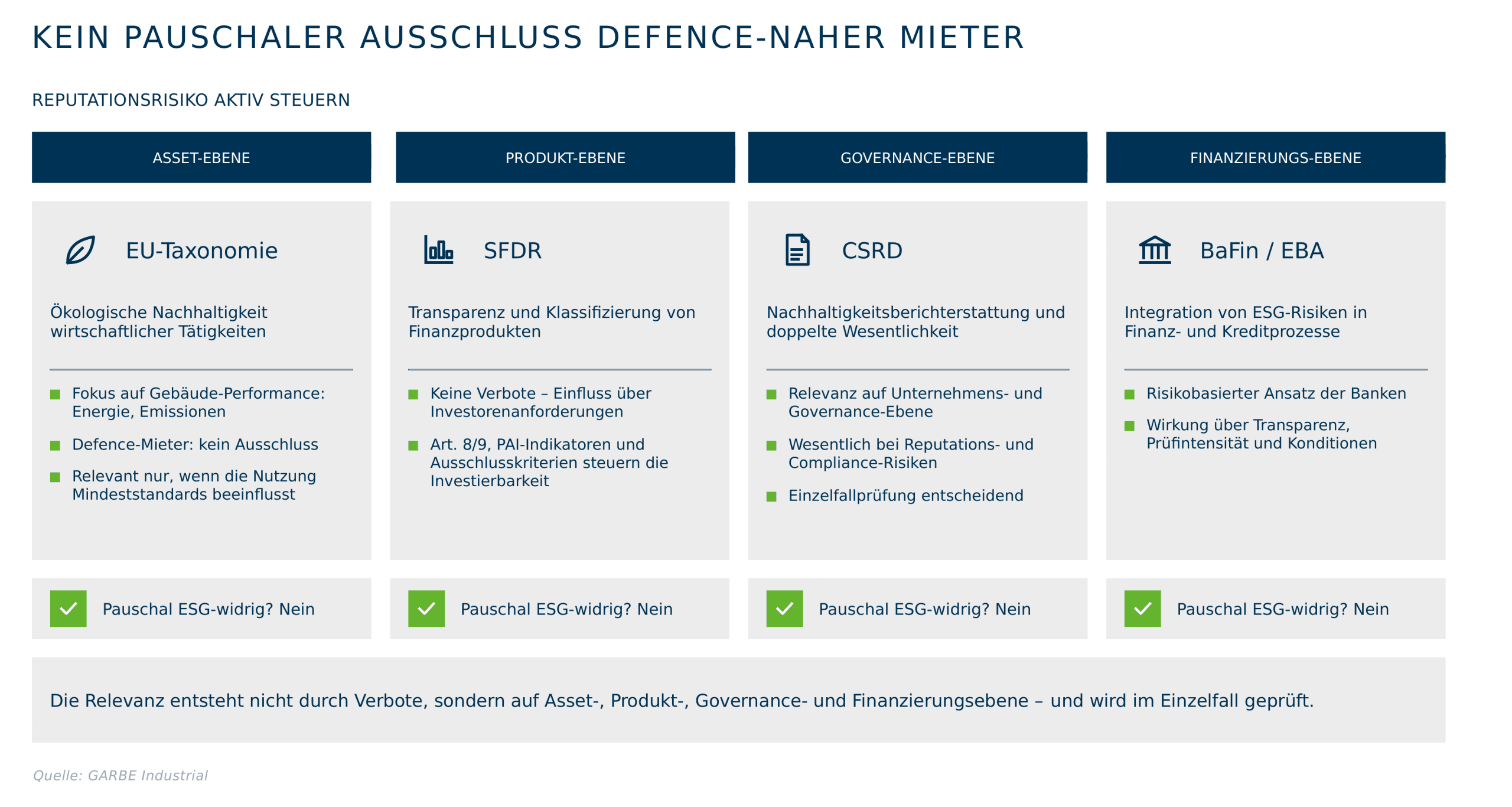
GARBE Industrial, one of the leading developers, providers and managers of logistics, industrial and commercial real estate in Germany and Europe, has published a new white paper on the ESG classification of real estate in the defence and security sector together with the international law firm Baker McKenzie. The analysis shows that the relevant European ESG regulations do not fundamentally exclude armaments-related tenancies, take a neutral view of defence-related uses and thus generally enable corresponding properties or funds as an investment.
Neither the EU taxonomy, nor the Sustainable Finance Disclosure Regulation (SFDR) or the Corporate Sustainability Reporting Directive (CSRD) provide for blanket sectoral exclusions for such uses.
The building is valued, not the tenant
The focus of the assessment is on the characteristics of the property as well as the owner's governance and risk management structures. Criteria such as energy efficiency, emissions, use of resources or sustainability management are decisive for ESG classification. The tenant's industry, on the other hand, does not represent an independent regulatory assessment criterion.
"A modern industrial or logistics property does not automatically lose its ESG capability because it is used by a company in the defence or security sector," explains Tobias Kassner, Member of the Executive Board and Head of Research at GARBE Industrial. "The decisive factors are the quality of the asset, compliance with regulatory requirements and the company's ability to manage potential risks transparently."
At the same time, the study shows that regulatory permissibility and investability are not necessarily congruent. "Defense-related tenants and real estate have now arrived in the regular investment canon. However, individual investors and market participants can still rate defense-related uses as risky, especially if reputational risks are feared. However, this assessment is increasingly differentiated by market participants and our analysis does not provide any ESG regulatory justifications for this," says Kassner.
Third-party usability as a central factor
In addition, the study highlights the importance of third-party use of armaments-related properties. While highly specialised properties can only be reused to a limited extent in the event of a change of user, standardised industrial and logistics properties offer significantly more flexibility.
"For investors, third-party usability remains a key factor," says Dr. Daniel Bork, Partner in Real Estate at Baker McKenzie and co-author of the white paper. "It reduces potential rental risks and supports the long-term marketability of a property. It also contributes to the long-term and resource-saving use of real estate and can therefore also be viewed positively from an ESG perspective."
"Our white paper shows that defence-related uses are neither a general ESG exclusion criterion nor a sure-fire success for the real estate industry," says Kassner. "A differentiated classification is crucial. Those who take into account regulatory requirements, the expectations of investors and financing partners as well as the long-term usability of a property in equal measure can make a well-founded assessment of corresponding uses."
The white paper can be downloaded here: Defense and Real Estate Portfolios