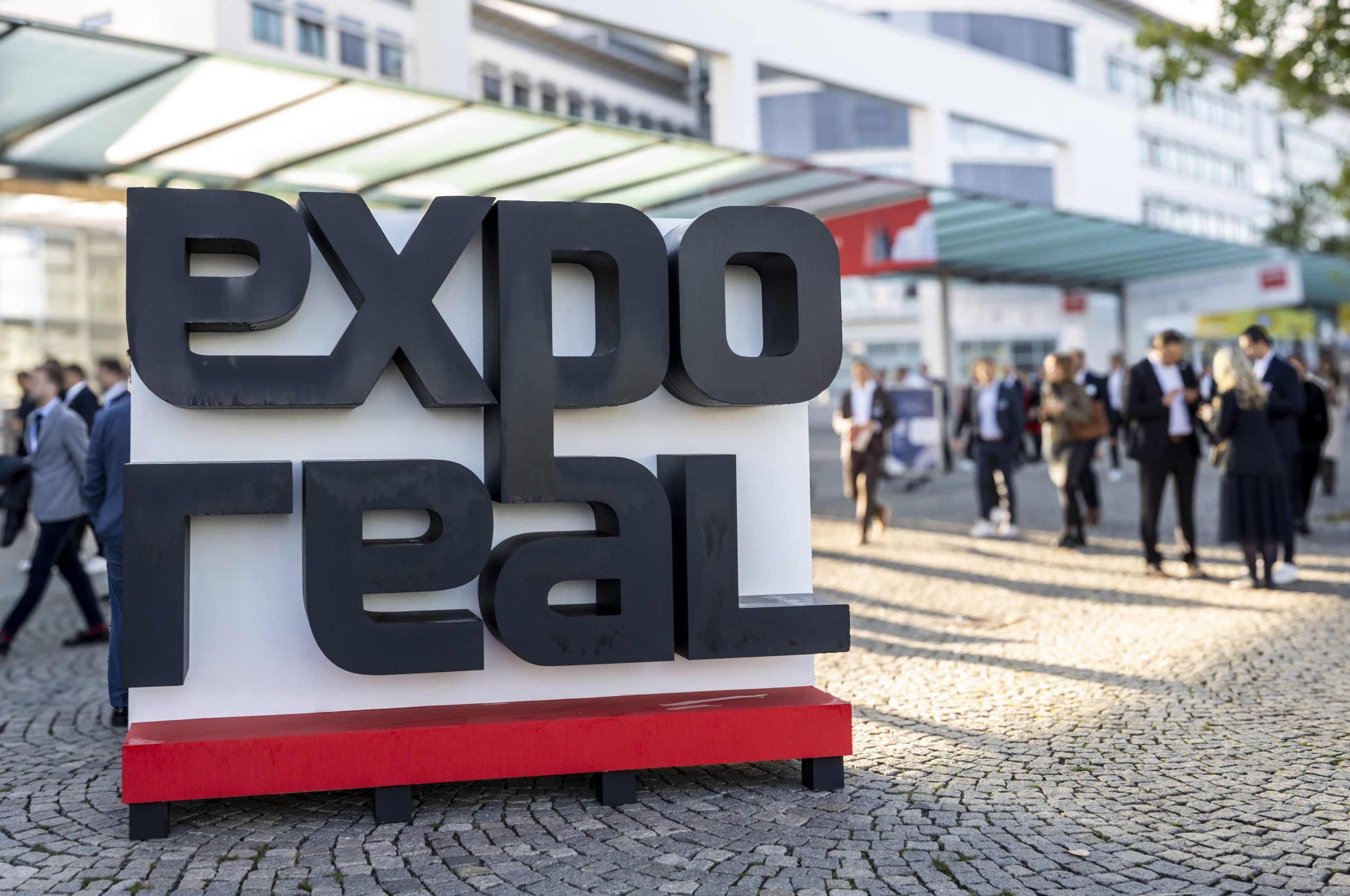
In 2026, EXPO REAL will once again live up to its role as the property sector’s key meeting place, with around 1,777 exhibitors from 37 countries and some 42,000 attendees.
The trade fair showcases an industry that has adapted to the changed market conditions without downplaying the existing challenges. Hardly anyone expects a rapid recovery; financing and investment remain challenging, and the pressure on many market segments remains high. At the same time, concrete business opportunities are once again being identified, and the focus is shifting more strongly towards the existing portfolio, its management and further development. The trade fair itself is perceived primarily as a business-focused event: despite a somewhat lower visitor turnout in some cases, many market participants report having had in-depth, open and high-quality discussions. Overall, a nuanced picture emerges, characterised by lingering uncertainty, greater pragmatism and selective optimism.
We have gathered some insights from the property sector regarding this important European industry event. You can find the details here:
Investment and asset managers / financiers
Stefan de Greiff, board member and founder, aam2core Holding AG: “The sector has entered crisis mode and the days of denial are over. At EXPO REAL, we had many frank and surprisingly candid discussions. For developers in particular, the pressure to refinance remains high; at the same time, given current price levels, there is often a lack of capital and suitable properties for new transactions. The key factor will be when the necessary market correction can actually begin. At present, rigid market valuations, amongst other things, are preventing a faster adjustment. Consequently, realistic pessimism prevails: hardly anyone is expecting a short-term recovery.”
Jens Ebert, Member of the Executive Board, aam2core Holding AG: “The mood at EXPO REAL was decidedly more sombre than upbeat. Above all, the renewed rise in interest rates is a cause for concern in the market and has once again put numerous business models and transactions under pressure in recent weeks. At the same time, many market participants lack a clear vision of where a turnaround might come from in the short term. However, the greater openness in the market was also striking: even banks are now speaking much more clearly about weak new business and portfolios where action is needed. It is precisely from this that new approaches to restructuring and transactions may emerge in the coming months.”
Michael Schleich, Member of the Executive Board, aam2core Holding AG: “I believe that by now even the last person has realised that we will not simply return to the old market. The current situation is not a temporary state of emergency, but the ‘new normal’, and it will force the sector to make structural adjustments. I view open-ended property funds as particularly vulnerable: should valuations be brought more into line with today’s market conditions, this could put considerable pressure on funds, financing and equity structures. At the same time, it remains entirely unclear where the impetus for a sustainable recovery is to come from in the short term. It was precisely this uncertainty that was palpable throughout EXPO REAL.”
Thomas Häbich, Managing Director, AIF Capital Group: “Contrary to popular belief, the mobility transition actually holds great growth potential for parking infrastructure: rising car registration figures are offset by ever-decreasing public parking spaces and an increasing number of traffic-calmed zones in city centres. Parking infrastructure helps to manage traffic flows and is therefore an integral part of the mobility transition – and, as a sustainable, inflation-protected source of returns with stable cash flows, it also offers great potential for institutional portfolios.”
Dr Sebastian Scharpf, Managing Director, AIF Capital Group: “Sustainability is increasingly becoming a key issue – both technical and economic – in the existing building stock. It is important to identify renovation and modernisation needs at an early stage and to assess their impact on running costs, investment and long-term value retention. It is precisely in the existing building stock that it is determined whether sustainability remains merely a regulatory requirement or becomes a genuine contribution to a property’s future viability.”
Denisa Bonanno, Head of Investment, AIF Capital Group: “The mood at EXPO REAL is one of cautious optimism, and the willingness to invest is growing. This makes it all the more important to scrutinise opportunities carefully: not every care home that benefits from demographic change, and not every car park that is gaining in importance as part of the mobility transition, is automatically a good investment. For us, the key is a detailed analysis of the specific property, its location, the quality of the operator and the lease terms, as well as the long-term economic prospects.”
Heiko Szczodrowski, Executive Board Member, AIF Capital Group: “Infrastructure is becoming increasingly important for institutional property investors – and real estate infrastructure can serve as an interesting bridge in this regard. Parking illustrates this particularly clearly: mobility hubs combine traditional property with urban mobility infrastructure and can therefore be classified as infrastructure investments. This combination makes them attractive to investors with a long-term focus. In our view, the real value creation stems from active asset management: the key factors are the relevant expertise and the right partners to successfully manage the transformation and operation of such assets.”
Marcel Wnendt, CEO and CFO, Bayerische Hausbau Real Estate: “The discussions at this year’s EXPO REAL were open and revealed a new sense of realism in our sector, although this manifests itself in very different ways. On the one hand, one senses a sense of exhaustion, and in some cases frustration, following the challenging years we have just been through. On the other hand, however, we are also seeing renewed energy, a clear focus and, above all, the determination to take an active role in shaping the future once again. We at Bayerische Hausbau Real Estate share this determination, and it shapes the way we work. I was therefore all the more delighted by the enthusiastic response to our new flex-office brand, LEVL, which underlines precisely this new beginning. This confirms our belief that now, more than ever, is the right time to develop new offerings and consistently address changing user needs. My conclusion regarding the trade fair is therefore a positive one: the challenges remain, but our focus is once again firmly on the future.”
Curth-C. Flatow, Managing Partner, FAP Group: “The sunshine in the sky reflects the mood amongst international investors and financiers, some of whom are new to the German market or wish to invest here again. Several of those we spoke to are focusing on the office again. This positive sentiment has not reached the German market. Rather, in many quarters, a sense of realisation and disillusionment has set in, with the understanding that the current situation is unlikely to change for the foreseeable future and that hopes of a return to normality have therefore been dashed.”
Daniel Werth, Managing Director of Commercial Property at HAMBURG TEAM: “From an operational perspective, there are excellent opportunities. However, in the context of the portfolio, a property must now deliver a significantly higher return to justify its place. Until it does so, liquidity will remain tight. Meanwhile, the major challenges lie within the existing portfolio, and this means that excellent asset management is once again becoming a core competence.”
Václav Matoušek, CEO Germany, HB Reavis: “Many people come to Munich with specific plans and are keen to do business. Following the difficult past few years, you can sense that the property sector has adapted to the new reality. Rather than waiting and seeing, companies are looking for partners and solutions that will enable projects to be implemented even under the current conditions. This attitude is shaping the discussions at the trade fair.”
We are seeing this at HB Reavis too. We have a clear strategy and are consistently developing both our existing portfolio and our projects in Germany and the UK. As far as Germany is concerned, the improved economic data and the recent strong figures from the office lettings market give me cause for optimism. We are seeing increased activity once again and, above all, new business opportunities.”
Simon Hübner, Managing Director of Development, Finance & Operations at Livory: “EXPO REAL demonstrates that the residential property market offers attractive growth opportunities despite challenging conditions. Now more than ever, viable concepts, active management and a clear focus on the right locations are crucial. Livory’s focus remains on Berlin, Munich and Hamburg, as well as other major cities and growth regions where we have been active for many years. At the same time, we see considerable further growth potential in the serviced apartments sector with smartments – particularly in tight housing markets, where there is a growing demand for flexible, professionally managed accommodation options suited to different living and working situations.”
Michael Preuße, Head of Office and Retail Letting at NAI apollo: “The trade fair went well, and I got the impression that even the last of the optimists has now come round to reality and realised that we need to rethink things, and that a return to occupancy rates of 30 per cent or more isn’t going to happen any time soon.”
Boris Schran, Managing Partner, Peakside Capital Advisors: “The market environment continues to be characterised by a range of challenges – interest rates, inflation and structural upheavals. Overall, I found the mood to be objective and level-headed, yet constructive. Despite all the uncertainties in the market, progress is certainly evident both operationally and structurally. This is creating opportunities in various areas. Overall, we once again had many fruitful discussions and came away with some exciting ideas. That is why such trade fairs are, and will remain, important for our industry.”
Kai Panitzki, Managing Partner at BitStone Capital & Realyze Ventures: “EXPO REAL was a very dynamic event. Digital solutions, AI and smart energy management systems are increasingly becoming key to sustainable building operations. Not only do they help to reduce CO₂ emissions and operating costs, but they are also becoming a decisive factor in the long-term value retention of property. The future belongs to solutions that not only promise operational efficiency but also create measurable added value.”
Minh Chung, Vice President of DACH Sales at SINGU: “This year’s EXPO REAL was characterised by cautious optimism – which was due not only to the good weather, but above all to the sector’s clear refocus on its core business, as well as the optimisation and digitalisation of operational processes. As our solutions address precisely this pain point, we consider our experience at the trade fair to have been extremely positive. We are taking this momentum from our discussions with us and are already looking forward to the expected turnaround in the property sector in 2027.”
Markus Buchner, founder and managing director of the Buchner Group: “This year, EXPO REAL has come down to earth. Whilst visitor numbers are more modest, you meet all the more genuine industry professionals. Overall, there is a slight sense of optimism in the air. The sector is optimistic, but realistic and free of euphoria. Whilst record-breaking figures are being celebrated at the Oktoberfest, the property sector at EXPO REAL is deliberately cautious and has a clear-eyed view of what is achievable.”
Property developers
Alexander Heinzmann, CEO, BPD Immobilienentwicklung GmbH: “EXPO REAL 2026 has once again demonstrated the vital role that face-to-face interaction plays in the property sector. Despite market conditions that remain challenging, the exhibition halls were already well attended right from the start of the event and characterised by in-depth discussions. The high level of openness shown by many market participants in jointly seeking solutions to the sector’s current challenges was particularly encouraging. For BPD, the trade fair has thus once again confirmed its status as the most important industry gathering in Germany. Particularly in a demanding market environment, the fair offers the opportunity to exchange perspectives, strengthen existing partnerships and gain fresh impetus for future projects. Another key focus was on strengthening the links between property and infrastructure issues. From BPD’s perspective, it will become even more important in future to take a holistic view of housing, mobility, energy supply, and social and green infrastructure, and to consider these factors together at an early stage in order to create liveable neighbourhoods that function effectively in the long term. Overall, therefore, the assessment of this year’s EXPO REAL is positive.”
Andreas Stegmann, CEO of HT Group: “Hardly anyone expects a swift recovery any more – a ‘bunker mentality’ prevails amongst many: holding out until the market turns. At present, we are seeing activity primarily in the area of consolidation, ranging from strategic partnerships to full takeovers. At the same time, there is growing concern that further funds will come under pressure, resulting in even more properties coming onto the market for which there are hardly any buyers. And when it comes to yield requirements, it has long been the case that 5 per cent is at least the new 4 per cent. This is becoming a particular challenge for core residential properties. We are increasingly seeing opportunities in niche solutions such as micro-living.”
Marco Buchner, Managing Director, BA Real Estate Partners: “The lower visitor numbers were clearly noticeable this year – with some halls and stands standing empty. This is in line with the overall market picture: virtually all asset classes remain under pressure. Residential property in the ‘Big 7’, particularly Munich, where the market is proving comparatively robust, is something of an exception. At the same time, there are signs of movement on the financing front: banks are increasingly recognising the need for write-downs on existing exposures and are slowly showing a willingness to accept the necessary discounts. When it comes to new business, however, lending remains subdued. We used the trade fair to examine new property opportunities, as we are interested in making new acquisitions.”
Amos Engelhardt, CEO and founder of i Live Group: “EXPO REAL was a successful trade fair for our PBSA segment. We are seeing a growing willingness to sell plots of land at more realistic prices, whilst at the same time more and more projects originally planned for commercial use are being reimagined as residential developments. Both of these trends play into the strengths of our product.”
Despite the financing environment remaining challenging, the PBSA and microliving sectors remain attractive due to the structural shortage of supply and high demand. We were also particularly pleased with the significant increase in international interest in i Live and Rioca.
"The success of the trade fair is already reflected in our pipeline: several new acquisitions and strong partnerships are currently taking shape as a result of the contacts made at EXPO REAL."
Property service providers/architects
Marcus Bohrer, Managing Director, Areal Consulting GmbH: “I’ve stopped waiting for the sector to finally take a positive view of the future again. At least in our field of activity, developments are already sending an encouraging signal: demand for office space has risen noticeably, owners are investing in the modernisation of their portfolios, and unrealistic expectations of returns seem to have increasingly given way to more realistic assessments. There is enormous potential in the existing property stock in particular. After all, the location remains the same, but the property itself can be altered, redesigned to meet market demands and developed to ensure its future viability. It was with precisely this in mind that we attended EXPO REAL this year, and many discussions we had there have confirmed our view. I therefore regard the current situation as positive and see good reason to look ahead with confidence.”
Felix von Saucken, CEO, Colliers Germany: “EXPO REAL 2026 shows that buyers and sellers have adapted to the new market reality. The market remains constructive and dynamic, but decisions are being made in a much more selective manner. Quality and income prospects are becoming increasingly important. Strong cash flow, long-term prospects and a compelling investment story are the deciding factors in transactions.”
Enno Philipps, Head of Operations at FASTR: “For us, three days at the trade fair also mean three days away from the boiler room. Nevertheless, work on our projects continues whilst we’re here. Whilst others are still discussing, developing concepts and weighing up strategies, we’re already putting things into practice. FASTR Pulse is on the move. I believe it is precisely this combination of exchanging ideas, thinking ahead and taking action at the same time that is one of our strengths.”
Alexander Milde, Interim CEO, FASTR: “It is clear at EXPO REAL that the issue of energy is becoming increasingly important with each passing year. In particular, aspects such as decarbonisation, energy efficiency and the future energy supply are coming increasingly into focus. For us, therefore, EXPO REAL was also a good opportunity to discuss what we have been working on intensively over the past few months: solutions for the existing building stock and the question of how we can work together with the property sector to make the right decisions for the coming years. After all, the existing building stock in particular requires practical, long-term sustainable solutions – and a shared understanding of what makes sense from a technical, economic and energy perspective.”
Dr Andreas Iding, Managing Director, GOLDBECK Services GmbH: “The economic fundamentals remain challenging, which continues to pose major challenges for our sector. Yet it is precisely in uncertain times that new opportunities arise. Investments in data centres and public infrastructure are providing a positive impetus. At the same time, the focus is shifting even more strongly towards the existing portfolio. Ensuring its sustainable development and management will be one of the key tasks in the coming years. This requires tailor-made, integrated strategies rather than off-the-shelf solutions – and the courage to break new ground.”
Alexander Ubach-Utermöhl, Managing Director, LAVA ENERGY: “The operating environment for the property sector remains challenging. We therefore did not observe any noticeable upturn at EXPO REAL. Many market participants are still taking a wait-and-see approach. At the same time, there was a strong need for face-to-face interaction. Alongside numerous constructive discussions, there were also some optimistic voices to be heard. It was striking, however, that the generally upbeat mood at the trade fair did not always reflect the actual state of the sector. In terms of substance, heat supply under contracting arrangements is increasingly becoming a focus for investors and companies, whilst new market participants are also entering this field. Whilst ‘ESG’ was less prominent as a buzzword, the decarbonisation of buildings and neighbourhoods is nevertheless being incorporated into strategic considerations.”
Marcus Lehmann, founder and managing director of LAVA ENERGY: “EXPO REAL remains the industry’s premier event for us. Admittedly, the aisles were noticeably emptier this year and the general hustle and bustle had subsided somewhat. At the same time, we saw this as an advantage: the discussions were of a very high standard, and the people we spoke to took significantly more time to engage in dialogue. This led to a more in-depth and even more valuable exchange.”
Thorsten Czoske, Managing Director of Commercial Property at MVGM Germany: “This year’s EXPO REAL was one of our most successful trade fairs at MVGM. The many constructive discussions and new business opportunities far exceeded our expectations. These discussions have shown just how much demand there is for professional property management in the current market climate.”
Dirk Tönges, Managing Director, MVGM Germany: “Our business is less dependent on economic cycles and is not tied to transaction volumes: property must be managed reliably, regardless of purchases and sales. Particularly in the current market climate, owners need property managers who keep an eye on costs, look after tenants and ensure day-to-day operations run smoothly.”
Marcus Lütgering, Country Head, Newmark Germany:
“At Expo Real, realism and differentiation are increasingly gaining ground: whilst rents are still expected to rise in the resilient prime locations on the lettings market, demand in other locations remains significantly more selective. Competition for tenants is intensifying in these areas, making the choice of the right partner all the more important for both owners and occupiers.
In the investment markets, a sense of pragmatism and ongoing uncertainty are shaping the mood. Market participants currently expect neither significant interest rate cuts nor a rapid easing of the situation.”
Jan Bewarder, CEO, REM CAPITAL: “Plenty of fruitful discussions, but the mood is decidedly subdued: EXPO REAL shows that the sector has come to terms with reality. Concerns about further price falls and selling pressure are shaping the market. Capital is available, but investors are adopting a wait-and-see approach and financing conditions remain challenging. The data centre boom, with its high energy requirements, is opening up opportunities for us. The key is to make projects financially viable. Subsidies and suitable financing structures are becoming increasingly important in this regard. That’s good news for us.”
Yama Mahasher, CEO, Westbridge: “This year’s EXPO REAL shows that the property market continues to be characterised by ongoing stagnation. The uncertainty is palpable, investment decisions are being made with greater caution, and the market remains in a phase of reorientation. At the same time, it is becoming clear that energy efficiency and the stabilisation of service charges are becoming increasingly important for the sector. Particularly in a stagnant market environment, forward-looking energy management is becoming a key factor in the economic viability and sustainability of properties. At least the weather in Munich is helping to lift the mood a little these days.”