Talents – the carriers of creative capital – are the key to the economic success and resilience of a location. In order to be attractive to these talents, cities and regions need not only internationally renowned universities and innovative companies as potential employers. According to Florida, attracting (and retaining) talent will only succeed if the city has a tolerant and stimulating culture. After all, creative and innovative work develops particularly well where openness to new ideas and influences and a productive approach to different perspectives and abilities can be found. This is the only way for the creative city to stand out from conventional location policies and city marketing and be successful in the long term in the competition for the sought-after knowledge workers and creative people.
Cosmopolis
The dynamism and innovative power of cities has always been the result of a continuous influx of ideas, goods and people. Immigrants not only import new ideas and skills, but also their contacts at home. Port cities were so innovative because, even if they did not permanently host their immigrant populations, they were connected to other places and provided a temporary refuge for people and things that circulated around the globe. Too
the astonishing success of the city of Athens in the 5th century BC was due in large part to its openness to outside influences and the fact that over a third of its free population was foreign-born (Wilson 2022).
Even today, there is a significant economic impulse from immigrants, for example in Silicon Valley in California. Around a third of the companies based there were founded by immigrants. Just over half of U.S. billion-dollar startups (unicorns) have at least one immigrant founder, and 80 percent of these companies have an immigrant in a key position (Visual Capitalist 2023).
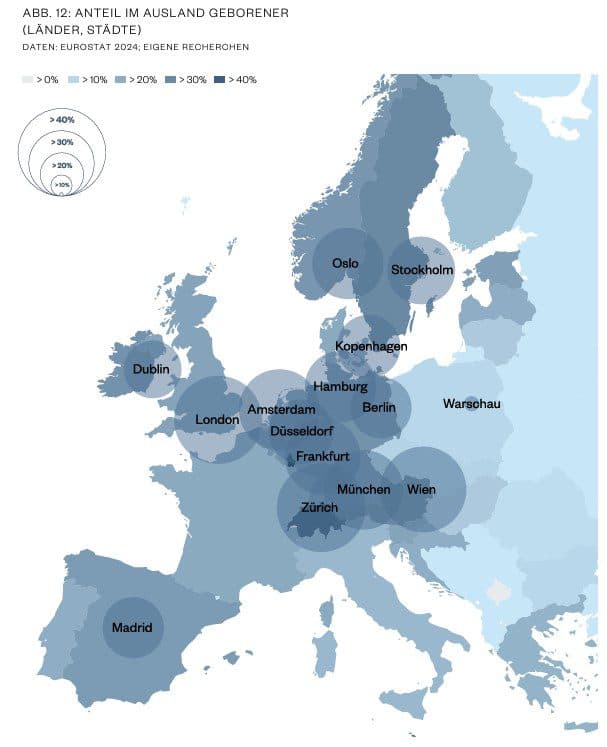
Openness also refers to the proportion of foreign-born residents, the so-called melting pot index. The metropolises in the Florida Ranking have a high proportion of the foreign-born population compared to the national average (Fig. 12). Zurich, London, Vienna, Amsterdam, Munich and Frankfurt, at 31 to 42 percent, are even well above the average of European cities (below 20 percent) (Eurostat 2022).
However, the statistics on foreigners and foreign-born people do not give a complete picture of a city's diversity and diversity. They do not provide any information about what percentage of the population are children or grandchildren of immigrants. In addition, they do not provide any information about the diversity of nationalities or their position within the city. The city of Amsterdam is particularly known for its cosmopolitanism. People from more than 180 countries live there, without any group dominating.
In addition, another 50 percent of residents have at least one parent born outside the Netherlands (so-called allochthonous). These details highlight the enormous complexity of diversity and integration of different cultures and nationalities within cities.
Tolerance and openness
Since the proportion of migrants in German and European cities will continue to grow in the future, they can hardly afford a destructive approach to integration and cultural diversity in the long term. Following Richard Florida's thesis, namely that regions will only be economically successful in the future if they show a positive appreciation of international and social diversity, there should be a change of perspective in the integration debate, which has so far had rather negative connotations. In this sense, the focus should be much more on the social and economic opportunities and potentials and these should be promoted in a targeted manner.
Recent studies show that a structural lack of a welcoming culture can significantly hinder the recruitment of skilled workers from abroad (ZEW, InterNations 2024). In particular, (large) companies with an international orientation and internationalised structures therefore refrain from investing in regions with a high level of xenophobia. Xenophobia damages the image and attractiveness of a business location and thus its future viability. For example, the current flight of the AfD threatens to increasingly burden East Germany as a business location.