

The strongest growth in turnover is taking place outside the major cities
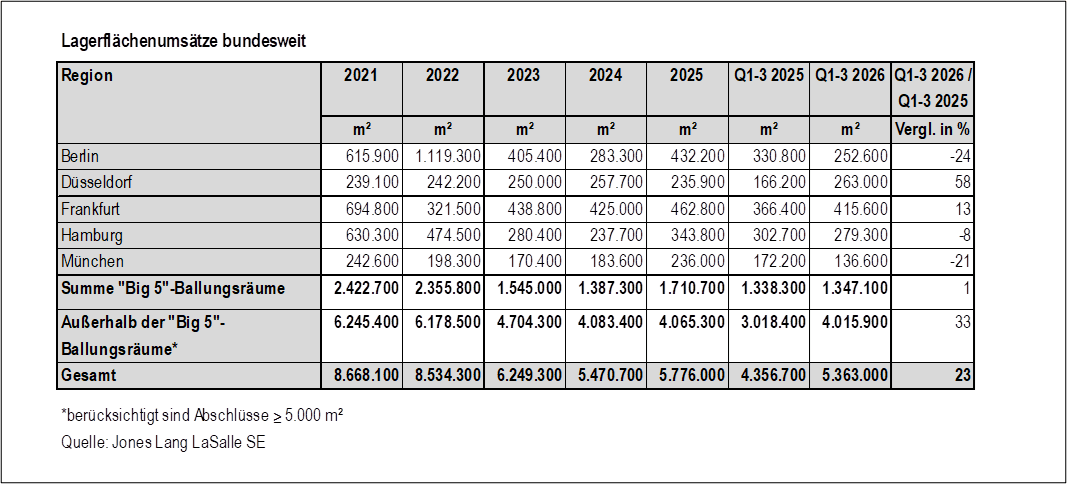
The German market for warehouse and logistics space grew significantly in the first three quarters of 2026. The total take-up amounted to around 5.36 million m², exceeding the previous year’s figure of 4.36 million m² by around one million square metres, or 23 per cent. The comparable five- and ten-year averages were also exceeded, albeit only slightly by two and four per cent respectively. At 524 contracts, the number of transactions remained on a par with the previous year. The increase in take-up is primarily attributable to the rise in transactions of 10,000 m² or more: so far in 2026, 179 contracts have been recorded in this segment, 33 more than in the same period last year.
Whilst lettings turnover rose by 43 per cent compared with the previous year, the share of owner-occupiers in total turnover fell by 26 per cent. At around 907,600 m², they accounted for just 17 per cent of the total. “Experience shows that the fourth quarter is often the strongest. If this proves to be the case, we could break the seven million m² mark for take-up this year,” says Sebastian Bögel, Head of Industrial & Logistics Agency at JLL Germany, looking ahead to the coming months.
Total turnover in the five major cities remains stable, with regional variations
The volume of space let in the five major metropolitan areas – Berlin, Düsseldorf, Frankfurt, Hamburg and Munich – reached the previous year’s level in the first three quarters of 2026, at around 1.35 million m². However, the regions fell short of the five-year average by eight per cent. Frankfurt was once again the region with the highest volume of space let, at 415,600 m², representing a year-on-year increase of twelve per cent. Hamburg (279,300 m², down eight per cent), Düsseldorf (263,000 m², up 58 per cent) and Berlin (252,600 m², down 24 per cent) followed some way behind. Munich recorded the lowest take-up among the five cities, at 136,600 m², representing a fall of 21 per cent.
Companies in the transport, logistics and warehousing sector proved to be the most active user group, with a take-up of 605,600 m² – 45 per cent of total take-up and an increase of around 43 per cent compared with the previous year. One of the largest deals in this sector was the lease of approximately 40,000 m² by the Chinese logistics provider JD Logistics in Ludwigsfelde, near Berlin.
By contrast, industrial companies recorded a decline of nine per cent to 341,500 m²; the largest transaction here was the lease of around 32,000 m² by Siemens in Offenbach (Frankfurt region). Despite the largest deal to date – the lease of more than 50,000 m² by a well-known online retailer in Hamburg-Allermöhe – retail companies recorded a 34 per cent fall, totalling 227,800 m².
Tight supply of space is driving up prime rents
There is still significantly less supply coming onto the market than in the previous year. From January to September, only around 219,000 m² of warehouse space was completed in the five major cities – just half the amount completed in the same period last year. Compared with the five-year average, the decline is as much as 57 per cent. At the time of completion, only around 70,000 m² (32 per cent of the space) was still available; 52 per cent had already been let, and the remaining space had been allocated to owner-occupiers. “As there is a shortage of modern, readily available space in many major cities, the situation remains tight,” says Bögel. Construction activity presents a more positive picture: at around 883,000 m², there is currently a good 60 per cent more space under construction than a year ago, of which around 55 per cent is still unlet. Berlin recorded the highest level of construction activity at around 319,000 m², whilst Hamburg recorded the lowest at around 116,000 m².
In the third quarter, prime rents for warehouse space of 5,000 m² or more rose by 4.8 per cent to 11.00 euros/m²/month in Berlin and by 2.8 per cent to 9.25 euros/m²/month in Düsseldorf. In the other major cities, rates remained stable. Munich now leads the way alongside Berlin, both at 11.00 euros per square metre per month. In Hamburg and Frankfurt, rates stand at 8.50 euros per square metre per month. According to Bögel, a further rise in rents is also expected here.
Regions outside the major cities are growing significantly faster
At around 4.02 million m², the volume of transactions outside the five major conurbations in the first nine months of 2026 was around a third higher than in the same period of the previous year (Q1–Q3 2025: 3.02 million m²). This exceeded the five-year average by six per cent and the ten-year average by eight per cent. Around 20 per cent of total take-up was accounted for by owner-occupiers.
Companies in the transport, logistics and warehousing sectors recorded another significant year-on-year increase (up by around 700,000 m²) and continued to dominate demand for space in the first nine months of 2026. Accounting for around 48 per cent of the total, this sector accounted for approximately 1.91 million m². This included seven leases of 50,000 m² or more: contract logistics provider Ceva Logistics leased around 90,000 m² each in Frankfurt (Oder) and in Lich near Gießen. Maersk Logistics signed a contract for around 69,000 m² in Herleshausen, North Hesse; ID Logistics leased around 67,000 m² in Alsdorf near Aachen; and Goodcang Logistics leased around 65,000 m² in Rieste, Lower Saxony.
Chinese companies are driving demand in the Ruhr region
With around 487,800 m² and a 20 per cent increase year-on-year, the Ruhr region tops the list of regions outside the five major cities. Around 43 per cent of the turnover generated here is attributable to leases taken out by Chinese companies. The average size of these leases was around 14,200 m². “The Ruhr region continues to benefit particularly strongly from the sustained demand from Chinese companies,” explains Bögel.
The Hanover/Braunschweig region took second place with 359,800 m², more than quadrupling the previous year’s figure. Transactions by retail companies dominate here, accounting for 44 per cent of total turnover. Takko Fashion’s lease of around 56,800 m² marks the largest deal in the region. Third place is taken by the Osnabrück/Münster region with 259,100 m² and an increase of 185 per cent.