

Transaction volume after three quarters just below the previous year’s figure
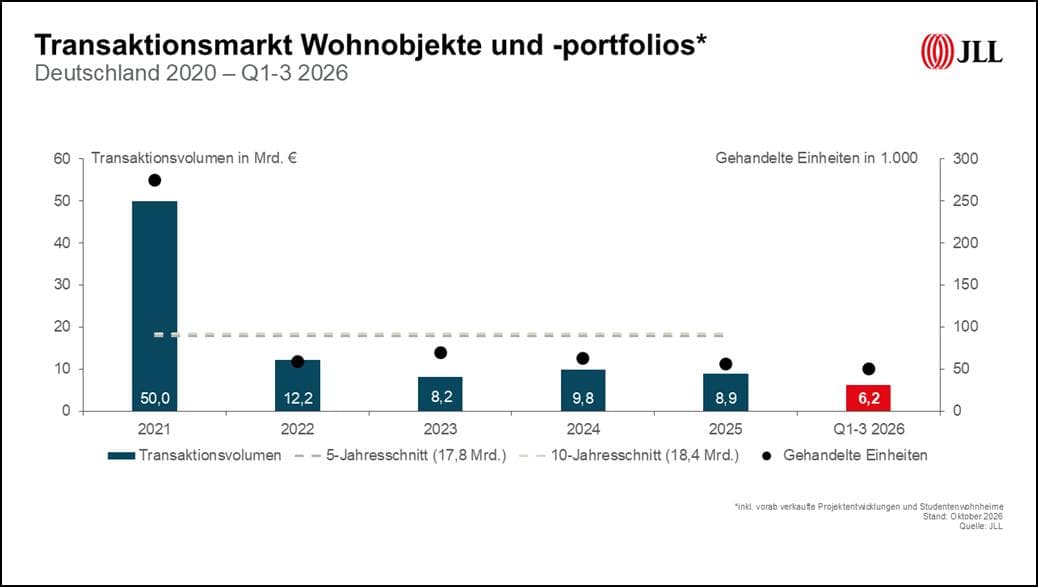
The commercial residential investment market in Germany is holding its own at a stable level in a market environment characterised by geopolitical tensions, rising financing costs and high uncertainty. Following a transaction volume* of around 1.9 billion euros in the third quarter (previous year: 2.02 billion euros), the total for the first three quarters of 2026 stands at around 6.2 billion euros, which is only slightly below the previous year’s figure of 6.4 billion euros.
With 53 recorded transactions, market activity in the third quarter was lower than in the corresponding period of the previous year, which saw 65 deals. A total of around 50,000 units were traded (previous year: 41,600). The average deal size rose to 36 million euros, compared with 31 million euros in the same quarter of the previous year.
According to Michael Bender, Head of Residential at JLL Germany, the market is thus continuing to demonstrate a high degree of resilience. “The operating environment is challenging, yet the volume of investment remains close to last year’s figure. Whilst the market is operating at a lower level than in previous years, it is still at a level that reliably generates transactions. Demand remains strong, particularly in the core and core-plus segments,” comments Bender.
Large-scale transactions continue to form a key pillar of market activity. In the first three quarters, eleven deals in the three-digit million range were recorded, which together accounted for around 2.2 billion euros, or 35.1 per cent of the total investment volume (previous year: 36.8 per cent). Inter-regional portfolio transactions also maintained their significance, accounting for a market share of 38.7 per cent (previous year: 40.4 per cent) or around 2.4 billion euros.
Niche segments are gaining in importance
At the same time, alternative residential segments are continuing to gain in importance. Student accommodation (PBSA) and retirement living, in particular, are broadening the spectrum of institutional residential investments and attracting growing interest from international and domestic investors. Among the more significant transactions in the third quarter was Madison International Realty’s acquisition of a minority stake in Home & Co. “Specialised segments such as PBSA and senior housing are increasingly establishing themselves as standalone investment products with attractive risk-return profiles,” says Helge Scheunemann, Head of Research at JLL Germany. “Investors are increasingly looking for resilient property types with stable long-term demand.”
Overall, the structure of the risk categories continued to be dominated by core and core-plus investments. Core transactions accounted for a market share of 42.4 per cent in the first three quarters, whilst core-plus deals accounted for 39.9 per cent. Value-add transactions increased their share to 16.6 per cent, although this was largely attributable to the sale of a portfolio in northern Germany comprising around 5,600 residential units.
Investments outside the major cities are dominating market activity
Regionally, market activity continued to be concentrated in locations outside the seven key property hubs. Around 61.3 per cent of the capital invested went into B and C locations. By contrast, the share accounted for by the major cities stood at just 38.7 per cent. Within the major cities, Berlin leads the way with a transaction volume of around 1.2 billion euros, well ahead of Hamburg with 530 million euros and Munich with around 190 million euros. According to Scheunemann, the high level of activity outside the seven major cities underlines that investors are increasingly taking a differentiated view of regional fundamentals. “In particular, locations with stable rental growth, limited supply and a solid economic base are coming more into the focus of institutional investors.”
Forward transactions accounted for 22.5 per cent of the total market volume in the first three quarters, amounting to around 1.4 billion euros across 33 deals. The decline compared with the same period last year reflects the continued weakness in new-build activity. More than three-quarters of the registered forward deals were for subsidised or price-capped projects. Municipal and state-owned housing companies remained the dominant buyer group, accounting for around 43 per cent of the volume, or approximately €600 million.
Affordability limits further rent growth
The situation on the German rental housing markets remains tight, despite a slight slowdown in rent growth. Affordability is increasingly becoming a limiting factor on the growth of rents for new tenancies, particularly in the upmarket segment. At the same time, rents for existing tenancies continue to rise as a result of the persistent excess demand.
From a macroeconomic perspective, the German economy continued its recovery in the summer of 2026. At the same time, the German inflation rate rose. The European Central Bank responded to the persistent price pressures in September with a further interest rate rise. As a result, long-term borrowing costs also rose significantly. The five-year swap rate stood at around 3.60 to 3.64 per cent at the end of September, whilst ten-year mortgage rates were once again above the four per cent mark.
Prime yields are rising, whilst differences in quality are becoming more pronounced
Against this backdrop, prime yields rose across the board in the third quarter of 2026. The average core yield in the seven key property markets rose to 3.61 per cent. For medium-quality properties in very good micro-locations, the average yield was already 4.34 per cent. The quality spread thus widened to 72 basis points.
“The widening spread highlights that property quality, micro-location and ESG standards are playing an increasingly important role in a more challenging market environment. Investors continue to focus clearly on high-quality and long-term competitive products, but a certain scarcity of supply is preventing prices from adjusting more significantly,” explains Dr Sören Gröbel, Director of Living Research at JLL Germany.
Bender expects market activity to remain stable for the rest of the year. In particular, larger portfolio sales and selective core and core-plus transactions are likely to continue to shape the market in the final quarter.
* The sale of residential property portfolios and student halls of residence comprising at least ten residential units and with 75 per cent residential use, as well as the sale of company shares involving the acquisition of a controlling stake, excluding initial public offerings