

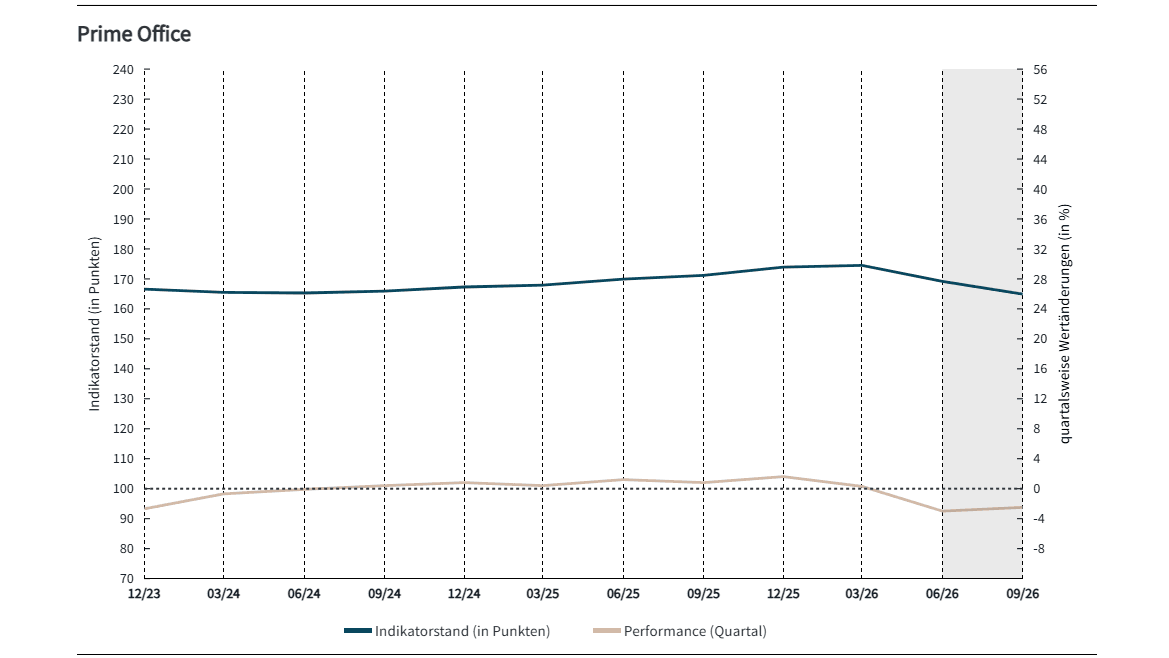
The Victor Prime Office office performance indicator, published quarterly by JLL, recorded a further decline across all five of Germany’s top office locations in the third quarter of 2026. The current indicator stands at 164.9 points, 2.5 per cent below the previous quarter’s figure. The continued downward trend in Berlin, Hamburg, Munich, Frankfurt and Düsseldorf reflects the ongoing revaluation of the German office property market. Rising net initial yields are proving to be the primary drivers of this development.
“The indicator currently reflects the ongoing market correction, the extent of which we have not seen since the financial crisis,” said Ralf Kemper, Head of Value and Risk Advisory at JLL Germany, commenting on the figures.
Discussions with market participants and the monitoring of ongoing transactions in the investment market have revealed a remarkable shift in sentiment over recent weeks: sellers, such as banks, are increasingly demonstrating realism and acceptance of the changed market conditions. “The hope for a short-term positive turnaround that was widespread just a year ago has given way to the sober assessment that the correction phase is likely to continue to characterise the market at least until 2027. To put it positively, it is precisely this realistic attitude that opens up new opportunities for transactions, as the gap between sellers’ and buyers’ asking prices is likely to narrow,” says Kemper.
In the third quarter of 2026, however, investment activity in the office market remained sluggish. Whilst transaction volumes in the ‘Big 5’ markets considered here had each amounted to around one billion euros in the first two quarters, the transaction volume in the third quarter totalled just under 540 million euros.
By contrast, the office lettings markets remain robust, with cumulative take-up of just under 640,000 m². This is around nine per cent higher than the quarterly average over the past three years. Whilst the upward trend in prime rents has paused, there is further potential for growth over the remainder of the year given the scarcity of sought-after prime space in premium locations.
The interest rate environment remains the decisive factor for future market developments. Developments in the bond markets, as one of the key benchmarks for potential alternative investments, are also significantly intensifying competitive pressure on property investments. For example, yields on US government bonds rose by around 70 basis points over the summer and have now reached the five per cent mark. In an environment characterised by geopolitical risks, institutional investors are increasingly favouring the security of government bonds over the complexity of direct property investments. The European Central Bank’s interest rate policy suggests that further adjustments to office yields are likely by the end of the year.
Munich once again shows the smallest decline in value
In the third quarter of 2026, all five cities saw their indicators fall compared with the previous quarter, albeit to varying degrees. As prime rents remained stable across all locations, the sole cause of the index movements was the adjustment in prime yields. Berlin’s prime locations were hardest hit: The prime yield there rose by 20 basis points – the sharpest increase when compared across cities – pushing the index down by 4.6 per cent to 166.3 points. Hamburg’s city centre also felt the pressure on yields significantly. Here, a rise of 15 basis points led to a decline of 2.6 per cent to 187.1 points.
The banking markets in Düsseldorf and Frankfurt am Main were on an equal footing: with yields up by ten basis points in each case, the indicator fell by 2.2 per cent in both cities, leaving Düsseldorf at 150.5 points and Frankfurt at 145.0 points. Munich’s prime location maintained its position as the most resilient market and, despite a prime yield that had also risen by ten basis points, came through the quarter best with a moderate fall of 1.8 per cent to 187.8 points.
The cumulative effect of the weak quarterly results is now clearly reflected in the year-to-date figures (comparison of indicator levels for Q3 2026 with Q3 2025): compared with the third quarter of 2025, there is now a decline of 3.7 per cent across all locations. In the previous quarter, the decline was just 0.4 per cent. Hamburg is the only one of the five markets to remain just in positive territory, although its year-on-year performance of 0.4 per cent is now only a fraction of its previous level. The figures are negative for all other locations: Düsseldorf is down 2.8 per cent, Munich down 2.9 per cent and Frankfurt down 4.6 per cent. Berlin brings up the rear in the city comparison, down 7.9 per cent.
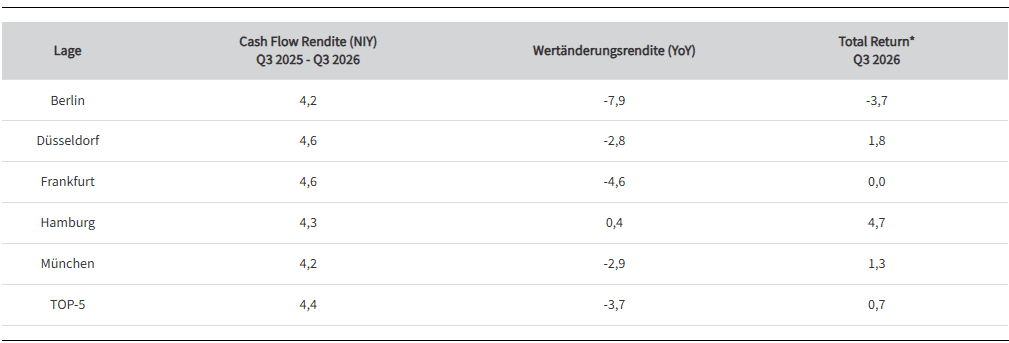
*Total Return: Observed annual performance of the indicator plus the expected return on cash flow (net initial yield from the previous year); Source: JLL
“We are seeing structural pressure to adapt affecting property owners and lenders,” said Kemper. The greater the pressure to generate liquidity becomes, the more likely it is that sellers or banks will have to accept a reduction in their price expectations. “The ‘wait-and-see’ strategy is increasingly losing credibility in light of refinancing cycles and investment market expectations. For example, cash outflows and the challenges in generating liquidity in the fund segment, driven by market activity, are continuing to weigh on book values.” Outside this segment, maturing loans – particularly those taken out during the low-interest-rate period – are causing headaches for property owners and banks, as loan extensions or refinancing are imminent on significantly less favourable terms.
This trend is not confined to Germany. A similar picture is emerging in France, where price adjustments are taking place both in the prime segment and in outlying areas. Bank-driven disposals have already provided the first data points here, which demonstrate the significantly greater need for price corrections in secondary locations.
“Many office investment markets in Europe, including the German office property market, are currently undergoing a necessary period of consolidation. A transparent assessment of this development is crucial for long-term stability and the market’s recovery. For investors with patience and reasonable return expectations, opportunities are certainly emerging – after all, liquidity is available. However, this must be preceded by an acceptance of the ‘new normal’ on the part of property owners,” explains Kemper.