The German industrial and logistics property market continued its recovery in the third quarter of 2026. During this period, take-up totalled around 5.2 million square metres, exceeding the previous year’s figure by 18 per cent. A key driver of this development was the return of large-scale lettings of 10,000 square metres or more, which accounted for around 22 per cent of total space taken up. The German Armed Forces’ clothing management division was particularly active in the third quarter, letting several logistics sites, each covering more than 30,000 square metres. Other deals that shaped the market included leases taken out by the Asian e-commerce logistics company Goodcang. The company has leased a total of just under 87,000 square metres of logistics space across three locations. The share of Asian companies in take-up rose to 15 per cent in the third quarter and thus remains well above the previous year’s figure.
Christian Kah, Head of Industrial & Logistics Germany at Colliers, comments: “The German logistics property market is one of the largest and most significant in Europe. Against the backdrop of geopolitical developments and the growing importance of resilient supply chains, Germany is becoming increasingly important within the European logistics network. At the same time, we are seeing new drivers of demand, originating in particular from Asia and driven primarily by e-commerce companies. Furthermore, demand from the defence-related sector is becoming more concrete. Since the start of the year, the first large-scale lettings in this segment have already been recorded. We expect the market to pick up further in the coming quarters.”
Regional differences among the top eight markets
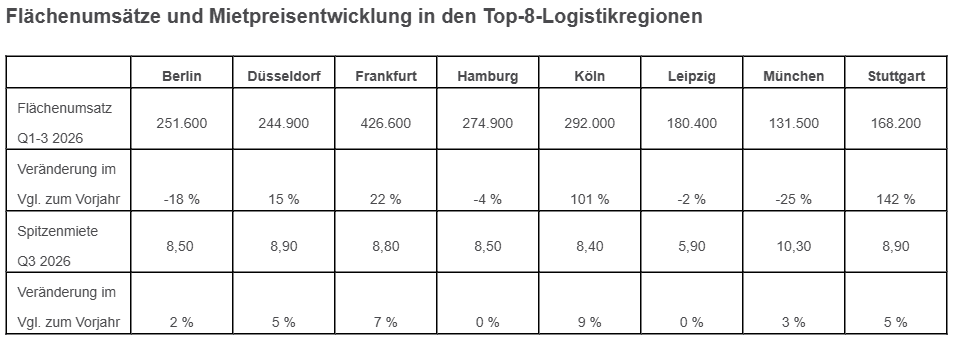
At the end of the third quarter, the top eight logistics regions recorded a total take-up of 2.0 million square metres, exceeding the previous year’s figure by 14 per cent. For the first time since the market downturn began in 2023, take-up returned to the five-year average. Across all markets, demand is concentrated primarily in the small- to medium-sized segment. There continue to be significant differences in the pace of recovery across individual markets. Whilst Düsseldorf, Frankfurt, Cologne and Stuttgart recorded growth, in some cases substantial, Hamburg and Leipzig were only slightly below their figures from the previous year. The Berlin and Munich markets, by contrast, continued to underperform.
With a take-up of 426,600 square metres, Frankfurt topped the ranking of the top eight regions. Despite a decline in the number of transactions, the region exceeded its previous year’s result by 22 per cent. The key factor behind this was the increased demand for spaces of 10,000 square metres or more. A large number of enquiries in this space segment are coming from e-commerce companies in particular. The Cologne region followed in second place with a take-up of 292,000 square metres. Driven by a high number of transactions, the result was double that of the previous year. The presence of Asian tenants, who accounted for 38 per cent of total take-up, is particularly high here. Within the top eight regions, Cologne is the most important location for this user group. Hamburg recorded the third-highest take-up at 274,900 square metres. Although the result was below the long-term average and the number of transactions declined, the region remains one of Germany’s top-performing logistics locations in terms of take-up due to the size and significance of the market.
Berlin recorded a take-up of 251,600 square metres. Despite a substantial supply of space, market activity remained below average by historical standards. Düsseldorf generated 244,900 square metres, the fifth-highest take-up among the top eight regions. Overall, the region exceeded its previous year’s figure by a solid 15 per cent.
The Leipzig (180,400 square metres), Stuttgart (168,200 square metres) and Munich (131,500 square metres) markets each remained below the 200,000-square-metre mark for take-up. These markets were characterised by strong demand in the small- to medium-sized segment, which was reflected in particular in a rising number of lease agreements concluded.
Kah puts the figures into context: “Despite new drivers of demand, the traditional user profiles of the individual logistics regions remain largely unchanged. Whilst the retail and e-commerce markets in Düsseldorf, Cologne, Frankfurt and Berlin are benefiting from a high level of activity from new market entrants, the regions of southern Germany remain closely linked to the manufacturing sector and are therefore more heavily affected by subdued industrial demand. At the same time, new links are emerging between established industrial clusters and growth sectors such as defence and robotics. These user groups rely on existing industrial sites, a skilled workforce and well-established value-added networks. Against a backdrop of limited land supply and low levels of new-build activity, their demand is increasingly focused on existing properties. This further strengthens established industrial and commercial sites.”
Within the top eight markets, the proportion of Asian users stood at 15 per cent, just as it did in the Germany-wide comparison. The focus was on regions where demand is traditionally driven by e-commerce and retail companies: Cologne (38 per cent), Berlin (26 per cent) and Düsseldorf (25 per cent).
Rent growth and outlook: momentum in the rental market is picking up
The continued moderate year-on-year growth in prime and average rents partly masks recent market developments: following a period of largely stagnant rent levels, momentum in the Top 8 markets has recently picked up noticeably on a quarterly basis. On a 12-month basis, the average prime rent across all Top 8 regions rose by 4 per cent, whilst existing rents increased by 6 per cent. Only in Hamburg and Leipzig did rents remain stable for the time being.
Kah explains: “The ongoing shortage of space remains a key driver of rental price trends in many locations. At the same time, it is becoming increasingly clear that a nuanced analysis of demand is necessary, as the requirements of individual user groups differ significantly from one another. Whilst Asian users predominantly seek modern big-box logistics properties of new-build quality with ceiling heights of at least twelve metres, companies in the defence-related sector often focus on existing properties. Of particular relevance to users are high floor load-bearing capacities, robust building structures and existing technical features suitable for production-related uses. In the coming quarters, this demand is likely to become more concrete, thereby providing fresh impetus for project developers. There will be increasing demand for properties that facilitate both traditional logistics and production-related uses. Such multifunctional or dual-use concepts are becoming increasingly important against the backdrop of changing user requirements and limited availability of space. For the year as a whole, we expect space take-up to exceed 7 million square metres. This would mean that the German logistics property market could exceed the 7 million square metre mark for the first time since the pandemic.”