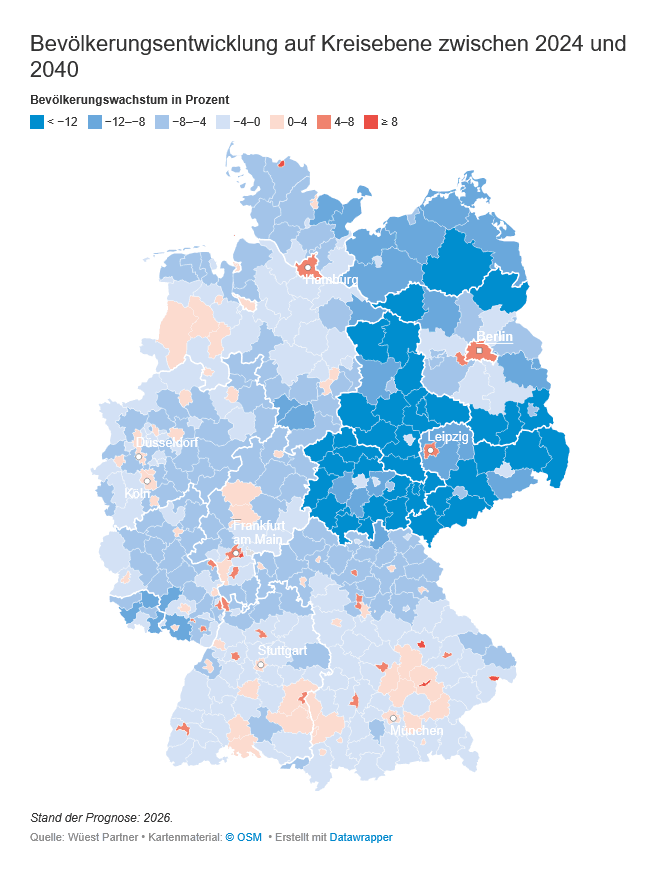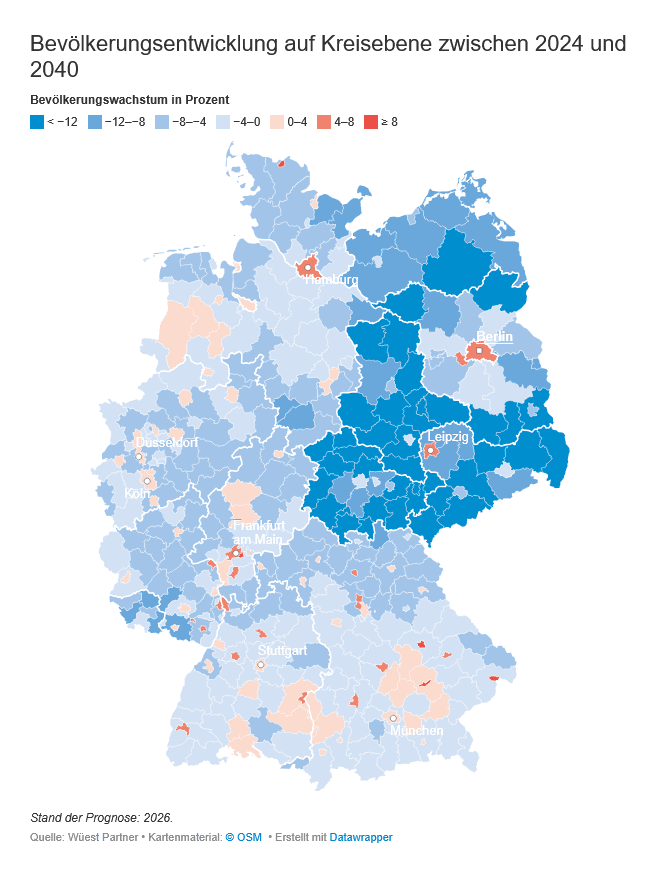
Germany’s demographic trends are increasingly becoming a matter of specific location for property investors. By as early as 2040, growing and shrinking municipalities will be situated right next to one another in almost 60 per cent of districts. A district may therefore appear stable overall, whilst individual municipalities see their populations grow significantly and others lose residents. For the long-term assessment of property locations, a look at higher-level regional data is therefore often insufficient.
This is demonstrated by the new population forecast from Wüest Partner, which is based on a standardised methodology across Germany and maps population trends for all 10,753 inhabited towns and municipalities up to 2050. In addition to the total population, trends are forecast by gender and across 17 age groups. The small-scale forecast data is also available for individual location and market analyses. This enables investors, project developers and local authorities to identify local growth potential, assess demographic risks at an early stage and base long-term decisions on a sound data foundation.
“When it comes to property decisions, what matters most is how the population and age structure are actually developing locally. Growth, decline and ageing can vary considerably even within a single district. With this new forecast, we are creating a uniform basis for identifying such trends at an early stage and incorporating them into location and investment decisions,” says Stefan Möller, Expert Data Scientist at Wüest Partner.
District-level forecasts fall short
The Alb-Donau district illustrates just how much highly aggregated figures can obscure local developments. Whilst some of its 55 towns and municipalities are set to grow by around 10 per cent between 2024 and 2040, others will lose around 9 per cent of their population over the same period.
There are also marked differences between the various types of local authority. Whilst the population of large cities is set to grow by an average of 1.9 per cent by 2040, it will decline by 6.8 per cent in rural municipalities, by 5.2 per cent in small towns and by 4.0 per cent in medium-sized towns. As a result, the proportion of the population living in large cities will rise from 32.0 per cent in 2024 to 33.6 per cent in 2040.
Ageing is changing demand for housing
In addition to population size, the age structure is also changing almost everywhere. By 2040, the number of people aged 65 and over will increase in around 93 per cent of local authorities, whilst the number of under-18s will decline in around 94 per cent. However, an ageing population does not necessarily mean a decline in population: even growing local authorities can simultaneously age significantly.
These developments are highly relevant to property markets. Demographic trends and age structure influence demand for housing, the types of housing in demand and long-term location prospects. In stagnating or shrinking markets, vacancy, marketing and exit risks may increase. At the same time, an ageing population can alter the demand for smaller, well-connected and age-appropriate homes.
Population forecasts for well-informed location and investment decisions
These small-scale forecasts make it possible to identify regional and local growth potential, analyse changes in the age structure and derive future demand potential for various housing and property segments.
Wüest Partner provides the forecast data to address specific questions and supports companies, investors, project developers and public institutions in evaluating and interpreting it – from individual locations right through to bespoke decision-making frameworks.
The full study can be found here: Germany is drifting apart: New population forecast at local authority level