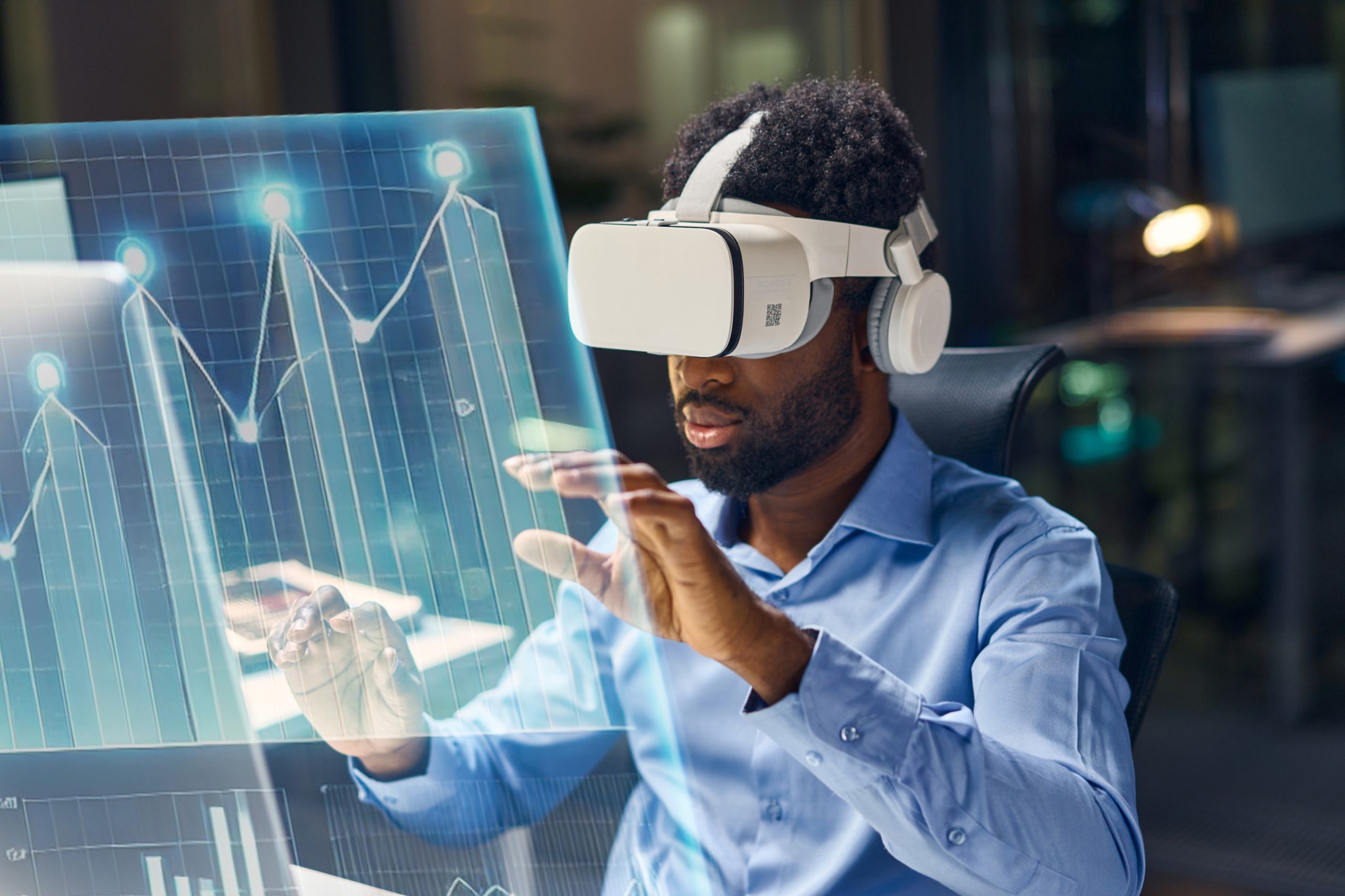
VR is one of the most anticipated innovations for the Office 2050 © MARCO
Office 2050: How neural implants, AI and VR will change the world of work
Neural implants provide a direct link between the human brain and external devices and are considered by both HR managers and employees to be the most important new technology that will enter the workplace by 2050 (33% and 26% respectively).
Virtual reality (VR): 70% believe that VR/AR will replace most traditional interactions in the office.
The end of the classic eight-hour workday: 69% of HR managers predict that long daily commutes will disappear in the next 25 years.
According to a new study by IWG, neural implants that connect the human brain directly to external devices are the most important new technology that workers worldwide expect to see in the workplace by 2050.
The study, “IWG’s Work Reimagined: The Office of 2050,” highlights how rapidly advancing technologies will transform the workplace over the next 25 years. The International Workplace Group is the world’s largest workspace platform with brands such as Spaces and Regus.
Both HR managers and employees believe that technology in the workplace will fundamentally change by 2050 (68% and 72% respectively), as innovations such as neurotechnology move closer to practical application. It is also expected that intelligent systems will automate complex workflows, adapt work environments individually and significantly accelerate decision-making processes in the future.
AI and immersive technologies will fundamentally change the world of work
AI will continue to transform the workplace in the future. HR leaders and employees alike believe that artificial intelligence and automation will reshape most office tasks (71% and 73% respectively). Around two-thirds think AI will determine the optimal place and time for collaboration (64% of employees, compared to 69% of managers). This shift towards intelligent support is underpinned by a study by the Hans Böckler Foundation, which concludes that AI will primarily serve to reduce cognitive load, allowing employees to focus more on their empathetic and managerial tasks1.
AI-powered upskilling accelerates the learning process and allows young people to move through the learning curve far faster than previous generations.
As a result, the pace of business will accelerate: 74% of HR managers predict that the pace of work will increase significantly in the coming decades.
Long commutes and the classic eight-hour working day will disappear, according to forecasts
The study also emphasizes that work patterns will change fundamentally over the next 25 years. Nearly seven in ten HR managers and employees believe that long daily commutes and the traditional eight-hour workday will be a thing of the past by 2050 (69% and 68% respectively). These results are in line with the Bertelsmann Stiftung’s “Working World 2050” scenarios, which describe a transition to “Liquid Work”. In this future, fixed working hours are dissolving in favor of flexible productivity, making a decentralized network of professional workspaces an indispensable infrastructure for a self-determined workforce2.
Instead, work will increasingly be done through a network of distributed locations. 64% of employees expect hybrid working to become the standard model, while 66% of HR managers believe that strict return-to-office regulations will disappear as companies prioritize flexibility.
Smarter work environments and human-technology integration
In addition to neurotechnology, immersive tools for collaborative work are expected to play a central role in shaping future working environments in the future.
Meeting rooms with virtual and augmented reality technology that bring employees together on-site and remote work rank second among the most anticipated innovations. While VR dominates routine digital interaction, studies by Fraunhofer IAO suggest that the physical office will remain an indispensable “social hub” and evolve into a high-quality multispace specifically designed for complex creative collaboration and intense social bonds3.
According to the employees, workplaces will also be more responsive, intuitive and better adapted to human needs. Office landscapes should automatically adapt lighting and environmental conditions to the internal clock of each individual (28%); they should have systems that detect fatigue and prompt them to take breaks or recover (30%); and they are expected to offer fully interactive, cloud-connected workspaces where walls act as digital, touch-sensitive surfaces (24%).
The office of the future is flexible, people-oriented and in harmony with nature
While technology will fundamentally change the way people work, future workspaces are expected to be more human-centric and well-being-centric.
Popular concepts for future workspaces include: family-friendly spaces including in-house childcare areas (23% of managers and 30% of employees) and multifunctional environments that adapt throughout the day to meet specific needs such as work, learning, socializing and recreation (23% and 30% respectively).
Many also envision offices that are inspired by nature and equipped with green walls, interior gardens and areas with natural light to create healthier and more inspiring working environments for both managers and employees.
Work-life balance and flexibility will shape the working world of the future
Looking ahead, flexibility is expected to be a key factor in attracting and retaining talent. Three-quarters of HR leaders and employees believe this will be crucial for companies in 2050, as more and more employees value work-life balance and well-being (75% each).
Mark Dixon, CEO and founder of International Workplace Group plc, says: “Technology has always shaped the way we work. The difference today lies in the speed at which this change is taking place. Advances in AI are accelerating the world of work at a pace that most companies and individuals are currently struggling to comprehend.
AI is part of an exponential innovation curve, making it arguably the most significant change I’ve seen since I started in business six decades ago. Innovations like AI and neurotechnology are driving a future where work happens faster, more intuitively, and exactly when and where it’s needed. Exponential change changes not only jobs, but also the pace of the economy itself. The world of work will be completely different by 2050.”
Methodology:
Survey: March 3 – March 11, 2026, conducted by Censuswide. The data on the DACH region is based on studies by GPPi, Fraunhofer IAO, the Bertelsmann Foundation and the Hans Böckler Foundation from 2025/2026.
Target audience: 2,002 HR executives and employees (1,002 HR executives and 1,000 employees) aged 18 and over from the UK and the US (1,000 and 1,002 respondents, respectively). The survey takes into account age, gender and region.
Sources:
- https://www.boeckler.de/de/faust-detail.htm?sync_id=HBS-009053
- https://www.bertelsmann-stiftung.de/de/publikationen/publikation/did/arbeit-2050-drei-szenarien
- https://www.iao.fraunhofer.de/de/presseservice/aktuelles/homeoffice-steigert-produktivitaet-aber-nur-bis-zu-einem-kipppunkt.html