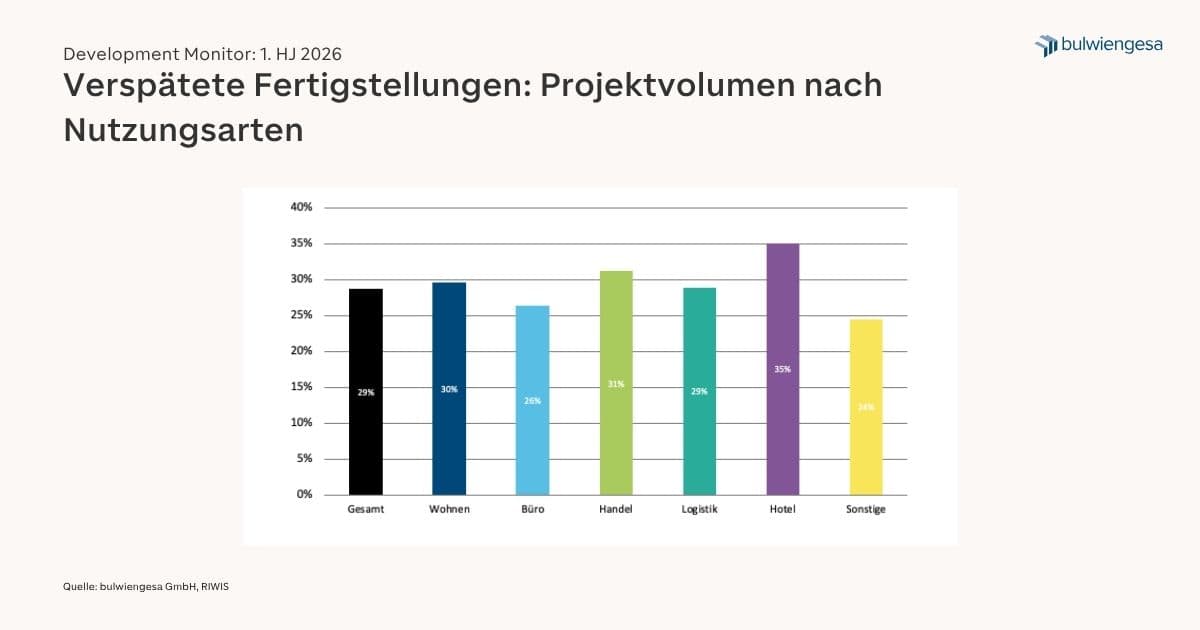
The crisis in German residential construction is increasingly evident in the gap between planned and actually realized projects. A review of bulwiengesa's Development Monitor shows: At the end of 2023, residential projects with around 30.1 million m² of living space were known to be completed by the end of 2026. According to the current status of the project, around 9.4 million m² of this will not be realised as expected at the time. This corresponds to 31 percent of the project volume at the time, or around 125,000 apartments.
"The decisive question is not only how much living space is planned, but how much of it is actually created. If there is a mathematical shortfall of around 125,000 apartments compared to the original plans, this shows the dimension of the implementation backlog," says Felix Embacher MRICS, Managing Director at bulwiengesa.
Larger residential pipeline does not yet mean a construction turnaround
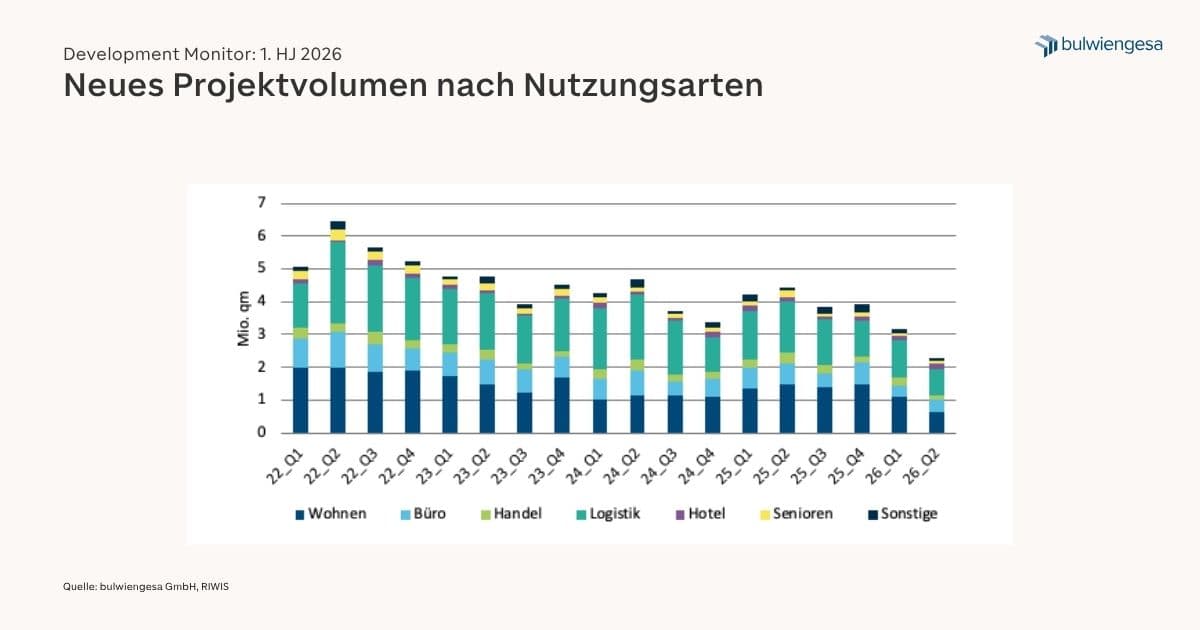
As of 30.06.2026, the Development Monitor covers almost 22,000 projects with a total project area of around 174 million m². The total volume recorded is thus 2.7 percent below the level of 31.12.2025.
While many types of use continue to decline, the recorded residential project volume has risen by 2.9 per cent to around 68 million m² compared to the last reporting date. The strongest growth was recorded in the other locations outside the classic A to D cities with 6.6 percent. The A-cities also grew by 3.4 percent in the residential segment.
However, the increase can only be understood to a limited extent as a recovery in construction activity. Around 31 million m², or almost half of the recorded residential volume, are still in the concrete planning stage. Only around 15.5 million m² are currently under construction.