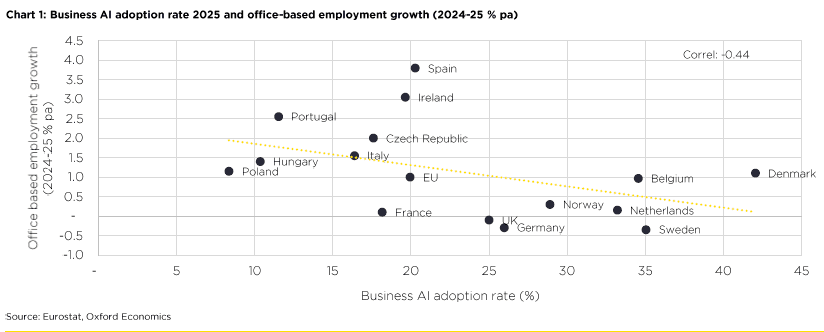



Despite growing concerns about the impact of artificial intelligence on traditional office jobs, there is no evidence of a nationwide decline in office employment in Europe due to the new technology. This is the result of a recent analysis by the international real estate service provider Savills, which examines European labour market, economic and AI adoption data.
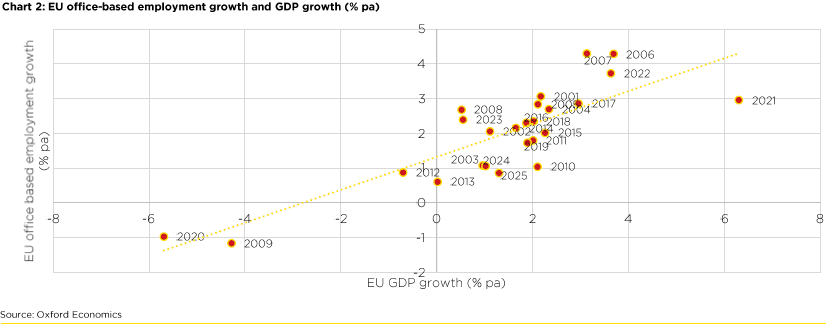
Rather, the study shows that economic growth continues to be the significantly stronger driver of the development of office employment than the introduction of AI technologies. While the correlation between AI adoption and employment development is comparatively weak, there is a strong correlation between economic dynamism and the growth of office-based countries with high AI use, such as the Nordic markets or the Benelux countries, which in some cases record lower employment growth.
Current labour market data also support this assessment: According to Savills, the rate of job vacancies in the professional services sector in the EU remains at the level of the pre-pandemic average at 2.4%. So far, this has argued against a broad-based decline in employment demand in traditional office sectors.
However, according to Savills, this is primarily due to near-total employment, demographics, and already high income levels – not structural AI-related job cuts.
At the same time, many of the leading AI companies are currently expanding into European office markets. Databricks recently leased around 13,000 square meters of office space in Amsterdam, OpenAI is planning its first permanent office in London, and Anthropic is expanding its presence in Paris and Munich. JetBrains is also one of the most active tech users of high-quality office space in Germany: The company has leased around 20,000 square meters of high-quality office developments in Munich and Berlin.