


The investment environment for real assets has changed fundamentally. Higher interest rates, persistent inflation risks, geopolitical tensions and increasing fragmentation of the global economy are coinciding with high investment needs in property and infrastructure. This brings one question more sharply into focus: what return is required to adequately compensate for the risks taken on?
This question was the focus of the October issue of ‘Macro Matters – The KINGSTONE Real Asset View’. Together with Prof. Dr Michael Trübestein from Lucerne University of Applied Sciences and Arts, the macroeconomic environment, institutional investors’ risk perception and the resulting return requirements for various real asset segments were discussed. The analysis was based, amongst other things, on the evaluation of 54 fully completed questionnaires from institutional market participants.
Germany: Between Recovery and the Need for Structural Adjustment
Despite geopolitical conflicts, higher energy prices and trade tensions, the global economy has so far proved more resilient than many had anticipated. At the same time, disparities between countries and regions are widening. For real-asset investors, this means that it is not only the asset risk itself that is becoming more significant; the macroeconomic and political environment of the country in question is also becoming an increasingly important factor in return expectations.
Germany finds itself in an ambivalent position in this regard. The economy has, at least in part, left its long period of stagnation behind. The IMF forecasts real GDP growth of 1.3 per cent for 2026 and 1.1 per cent for 2027. The ifo Business Climate Clock also points to a gradual move towards recovery. Since the summer, business expectations in particular have improved. By contrast, the assessment of the current situation has remained weak and even declined slightly again in October. Expectations thus continue to outpace developments in the real economy.
It is therefore still too early to speak of a broad-based upturn. Fiscal stimulus, higher defence and infrastructure investment, and the growing importance of AI and technology investment can support growth. At the same time, high energy prices, financing costs, bureaucracy and structural competitiveness issues remain significant headwinds.
Unlike many other advanced economies, however, Germany continues to enjoy a comparatively comfortable fiscal starting point. Compared with 2014, the general government debt-to-GDP ratio has fallen, even though the current budget balance has deteriorated. This sets Germany apart from countries such as France, Italy or the US, where both the debt-to-GDP ratio and fiscal pressure have increased.
This apparent contradiction can be explained by the growth in nominal gross domestic product. The debt-to-GDP ratio measures the level of debt relative to economic output. If nominal GDP grows strongly enough, the ratio can fall or remain stable despite new deficits. Germany therefore generally has greater fiscal leeway than many other industrialised nations.
However, the crucial factor is how this leeway is utilised. Additional borrowing does not automatically increase growth potential. It can be economically sensible if it enables productive investment, for example in energy infrastructure, digitalisation, transport or defence capabilities. This shifts the debate from the sheer level of public debt to the quality of the expenditure being financed.
The base rate is back – and the country is now factored into the required rate of return
The prolonged period of low interest rates had significantly bolstered the relative attractiveness of property and other real assets. This situation no longer applies. Government bonds are once again offering substantial current yields and thus present a real opportunity cost barrier for illiquid investments.
In the survey, the average risk-free base rate cited for Germany stood at around 3.3 per cent. Around two-thirds of respondents placed the risk-free reference yield between three and four per cent. For any real asset investment, this therefore raises a simple question: what additional return justifies tying up capital in the long term and taking on additional risks?
However, the base rate alone is not sufficient. Even the choice of country alters the required return. Compared with Germany, an average of around 73 basis points was required for France, around 82 basis points for Spain, around 108 basis points for Poland, around 112 basis points for Italy, and more than 150 basis points for Central and Eastern European countries other than Poland.
Germany thus effectively serves as the European benchmark in the survey. However, this position is not based solely on the level of public debt. Political stability, regulation, financing options, economic prospects and institutional reliability are also factored into the country assessment.
This is also reflected in the attractiveness assessment. Germany is not viewed entirely positively. Around a third of respondents rate the market as attractive, whilst the majority regard it as selective or neutral. Only a comparatively small proportion generally classify Germany as unattractive. This picture is consistent with the macroeconomic situation: Germany remains an investable market and offers opportunities, but requires more careful selection based on asset class, location and business model.
From return targets to risk premiums
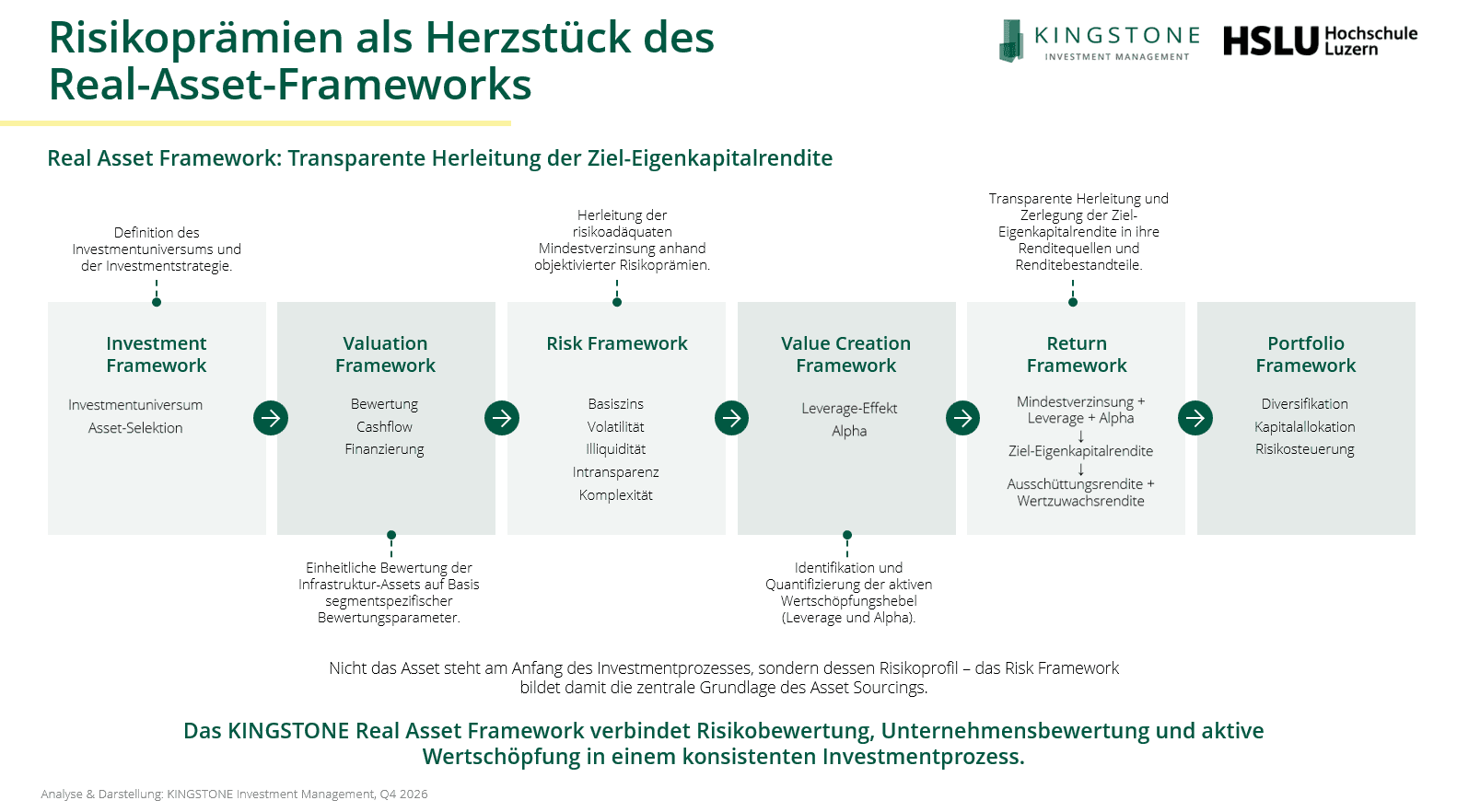
Against this backdrop, it is no longer sufficient to derive target returns solely from historical market values or past transactions. Rather, it is crucial to systematically derive the required rate of return from the underlying risk profile. This is precisely where the Real Asset Framework comes into play. Investment strategy and asset selection form the starting point. These are followed by valuation, cash flow and financing analysis. The Risk Framework then translates the specific risks of an investment into a risk-adjusted minimum rate of return. Only then are the effects of debt financing and active value creation taken into account.
The focus is on four key risk premiums. The volatility premium compensates for fluctuating cash flows and exit values. The illiquidity premium takes into account the long-term tie-up of capital and limited tradability. The opacity premium accounts for the limited availability of market, price and comparative information. The complexity premium reflects additional analytical, structuring and management costs. The Risk Framework combines these factors with the base rate to determine the risk-adjusted minimum return. The key shift in perspective lies in not assessing the asset solely on the basis of its category. The starting point should be its specific risk profile. Only from this can the minimum return required for the investment to be economically viable be derived.
A defensive risk appetite meets higher return thresholds
At the same time, the survey shows that investors are adopting a comparatively defensive stance in the current environment. 54 per cent of respondents describe themselves as risk-averse or very risk-averse. A further 27 per cent see themselves as risk-neutral, whilst only around 19 per cent state that they have a risk-seeking attitude. This understanding of risk is directly reflected in their preferred investment style. Core+ ranks first at around 44 per cent, followed by Core at around 40 per cent. Value Add accounts for only around eight per cent, whilst opportunistic strategies account for around six per cent. This means that more than four-fifths of preferences are for Core and Core+. This caution is understandable given the current market environment. Higher financing costs, geopolitical uncertainties and volatile capital markets increase the value of predictable cash flows. At the same time, institutional investors are often faced with the task of not only maximising returns but also reliably meeting long-term obligations. This increases the demand for robust assets with lower cash flow fluctuations.
However, this creates a tension. In the Core segment in particular, real assets are now once again competing directly with liquid government bonds. Those wishing to take on only minimal additional risk must nevertheless generate sufficient returns to justify the illiquidity and the greater analytical effort required compared with bonds.
The survey quantifies this additional return requirement. Compared with Core, an additional return of around 100 basis points is required for Core+, around 250 basis points for Value Add and around 530 basis points for Opportunistic. The increase is not linear. The further an investment deviates from the Core profile, the higher the required compensation becomes. This suggests that investors are currently particularly critical of additional operational, development or repositioning risks.
Real assets are more than just their initial distribution
Despite higher return thresholds, the strategic role of real assets in institutional portfolios remains significant. The survey makes it clear that their importance does not stem solely from the current distribution yield. 96 per cent of respondents cite stable current cash flows as a key function. For 69 per cent, diversification is the primary consideration; just over half cite capital preservation, and 50 per cent cite protection against inflation. Long-term capital growth comes only after these. It is striking that the explicit capture of an illiquidity premium is cited as a key portfolio effect by only around one-fifth of respondents.
The historical correlation analysis underscores this portfolio function. Core property and infrastructure often exhibit low or, in some cases, negative correlations with global equities and bonds. Real assets can thus provide a diversification effect that goes beyond mere nominal returns. However, this raises a further question: should capital allocation take place exclusively where the highest monetary return is expected, or can the strategic benefits of an investment also be taken into account? This discussion is becoming particularly relevant for Germany. There is a high demand for affordable housing, energy and network infrastructure, digital infrastructure, as well as defence and utility capacities. At the same time, a negative ‘home bias’ can sometimes be observed amongst institutional investors. Capital is deliberately invested outside the domestic market because higher returns or better investment opportunities are expected there.
In the webinar, this question was therefore put directly to the participants: Should investment once again focus more on the domestic market? This is not a call for national isolationism. On the contrary: open European capital markets remain crucial. Rather, the question focuses on whether, in addition to financial returns, the strategic and societal benefits of domestic investment can be given greater consideration.
Opinions were evenly split. 31 per cent of participants clearly advocated investing more capital in Germany again. A further 32 per cent favoured a European approach and considered European solutions to be more appropriate. In contrast, 29 per cent took the view that capital should primarily flow to where it can be used most efficiently. Only 6 per cent rejected a stronger domestic focus on principle, arguing that national isolationism could weaken open capital markets. This means that a majority of around 63 per cent generally favours a greater emphasis on Germany or Europe, without calling into question the benefits of open capital markets. However, there is a crucial link here to risk pricing. Higher returns abroad are not necessarily a ‘free lunch’. They may be compensation for higher political, regulatory, financial or macroeconomic risks. This is precisely what country risk premiums demonstrate. The supposed yield advantage of a foreign investment must therefore always be assessed relative to its additional risk.
The portfolio question is thus not ‘Germany or abroad’, but rather: what combination of return, risk, diversification and strategic benefit justifies the capital allocation?
Not every real asset carries the same level of risk
The need for differentiation becomes particularly clear when comparing the individual segments. The survey reveals significant differences both within the property market and between property and infrastructure.
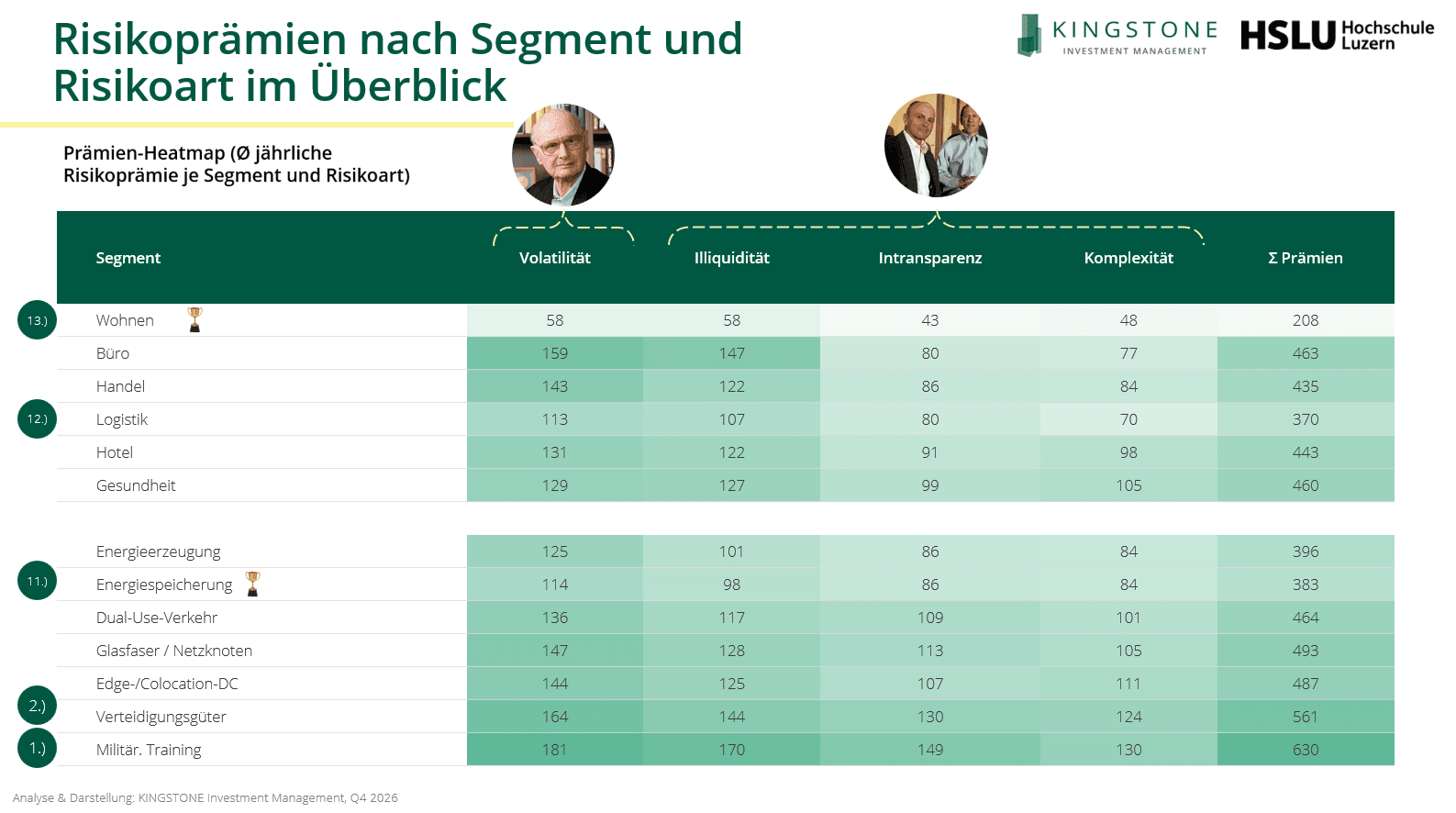
For residential property, the premiums surveyed for volatility, illiquidity, lack of transparency and complexity total around 208 basis points. Logistics, at around 370 basis points, is already significantly higher. For offices, retail, hotels and healthcare, the figures range from around 435 to 463 basis points. This also highlights a significant spread within the property markets. Residential property continues to be regarded as a comparatively defensive segment. Structural demand, high scarcity in many conurbations and relatively robust cash flows reduce the required risk premium. The office sector, by contrast, faces greater structural uncertainties regarding demand for space, working from home, capital expenditure and the need for repositioning. Infrastructure is, on average, priced at a slightly higher premium, though there are also considerable variations. Energy generation and energy storage, at around 396 and 383 basis points respectively, remain comparatively close to traditional property segments. For fibre-optic networks and network nodes, the figure rises to around 493 basis points. Defence equipment stands at around 561, whilst military training infrastructure is at around 630 basis points.
These figures illustrate why a blanket statement about ‘infrastructure’ or ‘property’ is increasingly inadequate. In the case of infrastructure in particular, a lack of transparency and complexity are rising significantly. Private markets, few comparable transactions, differing regulatory regimes, technical peculiarities and individual contract structures all complicate the pricing process. However, this is precisely where an opportunity may lie. The greater the complexity of a market, the greater the potential value of specialised investment and asset management. The premium is therefore not merely compensation for risk; it can also represent remuneration for expertise, market access and active structuring.
Infrastructure: between resilience and return potential
Alongside the risk premium, the question of which structural growth drivers underpin an investment is becoming increasingly important. This is particularly evident in the infrastructure sector. Energy and utility resilience was rated as an attractive investment theme by 85 per cent of respondents. This is followed by defence resilience at around 48 per cent and digital resilience at around 42 per cent. Within the specific sub-segments, energy storage stands out in particular. Its high appeal is understandable. The transformation of the energy supply requires not only additional generation capacity; it also demands storage, grids and intelligent management of supply and demand. During the discussion, it was therefore specifically pointed out that energy storage represents a missing link within the energy value chain.
This also changes the perspective on diversification. Investors should not think exclusively in terms of separate segments. Energy generation, storage and consumption form a single system. Data centres require electricity and grid capacity; renewable generation requires storage; and electrification requires grids. Individual infrastructure segments are thus becoming increasingly interdependent. Strategic capital allocation should therefore be aligned more closely with growth and value chains. The relevant driver is less the formal asset category than the underlying structural demand. At the same time, there is a significant gap between investment needs and the actual deal flow available for investment. Municipal investment backlogs, the energy transition and digitalisation are generating high capital requirements. However, many projects remain too small, too complex or insufficiently standardised. Platform and fund structures, standardised contracts, a sensible sharing of risk between the state and private investors, and flexible capital structures can help to transform economic needs into products that are actually suitable for institutional investment.
The whole is greater than the sum of its risks
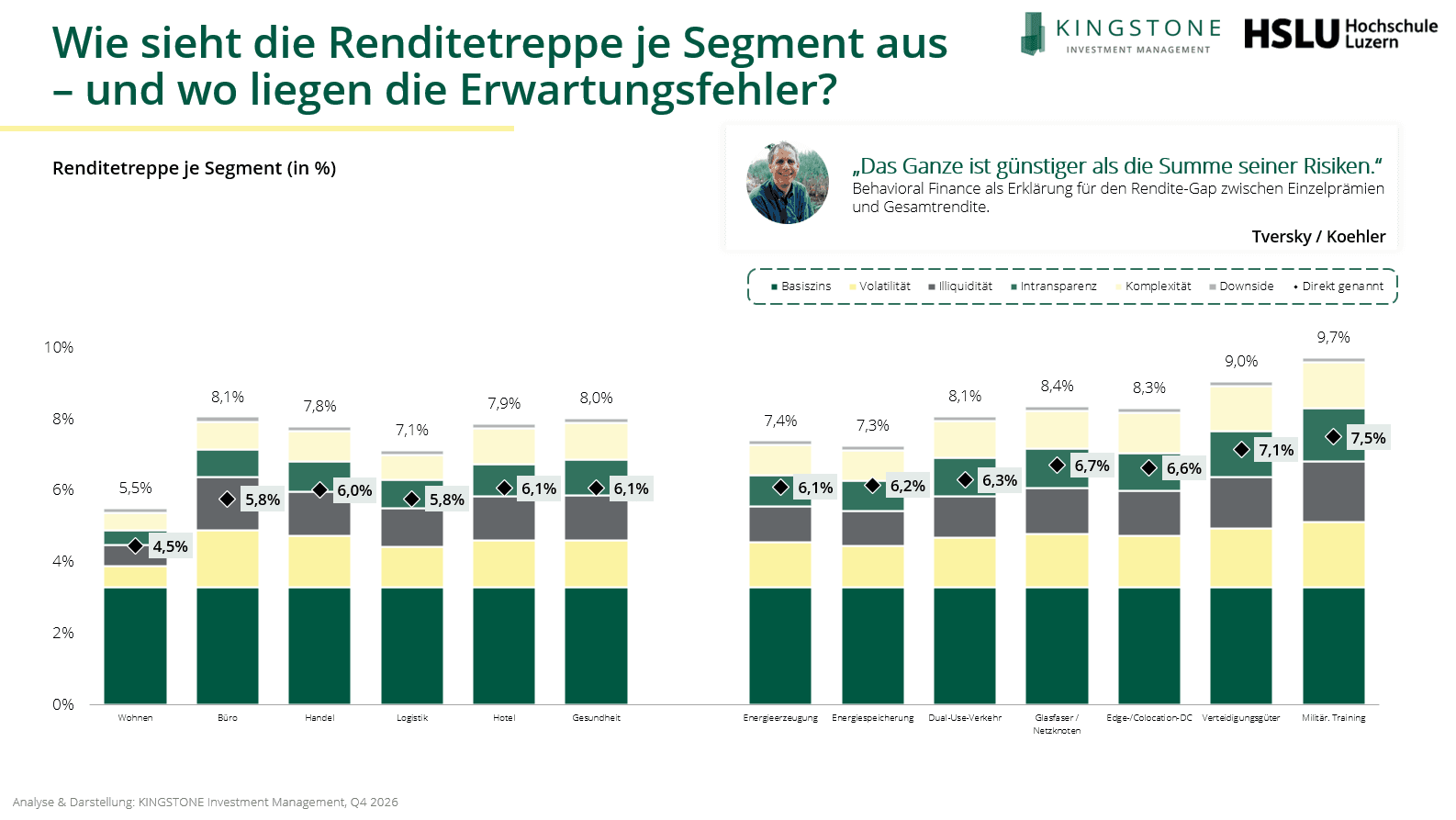
A particularly interesting finding emerges when comparing the bottom-up risk premiums with the total return obtained directly from respondents. If the base rate, volatility, illiquidity, lack of transparency and complexity are assessed individually and then added together, this consistently results in a significantly higher required rate of return than when respondents are asked directly about the necessary total return on an investment.
In the residential sector, for example, the minimum total return stated directly is around 4.5 per cent, whilst the bottom-up calculation comes to around 5.5 per cent. In the office sector, around 5.8 per cent is compared with a total of around 8.1 per cent. For energy generation, a figure of around 6.1 per cent is quoted directly, whilst the sum of the individual components amounts to just under 7.4 per cent. For defence equipment, the difference rises to around 7.1 per cent compared with just over 9.0 per cent. For military training infrastructure, 7.5 per cent is contrasted with just under 9.7 per cent. Behavioural finance offers a possible explanation for this effect. The ‘unpacking’ or ‘subadditivity’ effect described by Tversky and Koehler states that risks may be weighted more heavily when considered individually than when the same bundle of risks is assessed as a whole. If volatility, illiquidity, opacity and complexity are assessed individually, each risk is assigned its own safety margin. When an investment is considered as a whole, however, something different happens. Overlaps between the risks are intuitively taken into account, diversification is factored in, and the result is more firmly anchored to observable market returns.
Complexity, for example, can simultaneously increase both opacity and illiquidity. Simply adding up all the individual premiums therefore carries the risk of double-counting. Conversely, a direct holistic assessment may result in individual risks not being weighted heavily enough. The clear conclusion is therefore: the whole is more favourable than the sum of its risks. For investors, this return gap is of great practical relevance. Neither the simple sum of all risk premiums nor the intuitive overall return should serve as the sole benchmark in isolation. A robust derivation of returns must bring both perspectives together and examine where risks are actually independent and where they overlap.
Structural growth drivers rather than rigid segment boundaries
The new market environment therefore demands more than just higher return targets. A more nuanced assessment of the sources of risk and return is required.
The base rate once again presents a substantial hurdle. Country risks are being assessed in greater detail. Germany remains an important benchmark market due to its fiscal position and institutional stability, but at the same time faces structural challenges. The economic upturn offers opportunities, but these must first be confirmed by sustained higher growth and private investment. At the same time, individual asset risks are becoming increasingly significant. Volatility and illiquidity remain key drivers of returns, whilst, in the case of specialised infrastructure investments, a lack of transparency and complexity are gaining further prominence. Investors should therefore focus more closely on structural growth drivers. The energy transition, digitalisation, AI, security of supply and geopolitical resilience are generating long-term investment needs. Increasingly, the decisive factor is no longer simply whether an asset is formally classified as property or infrastructure.
Rather, what is relevant is its position within a value chain. Energy generation requires storage; storage requires high-performance grids; digitalisation requires data centres; and these, in turn, require additional energy supplies. A robust portfolio allocation should take such interdependencies into account and diversify across different, yet interconnected, real-asset components. This makes risk pricing a key investment competence. The key is not to avoid risks as completely as possible. The key is to identify them transparently, price them appropriately and take them on where structural growth, diversification and risk-adjusted returns converge.