New analyses by international real estate consultancy Savills show that the European serviced apartment sector recorded a transaction volume of around €1.2 billion in 2025 – equivalent to around 5% of the total transaction volume of hotel and accommodation properties. The results show that the market is undergoing a structural realignment, driven by increasing regulation of the short-term rental market, growing demand for long-term stays and clearly identifiable opportunities for institutional growth.
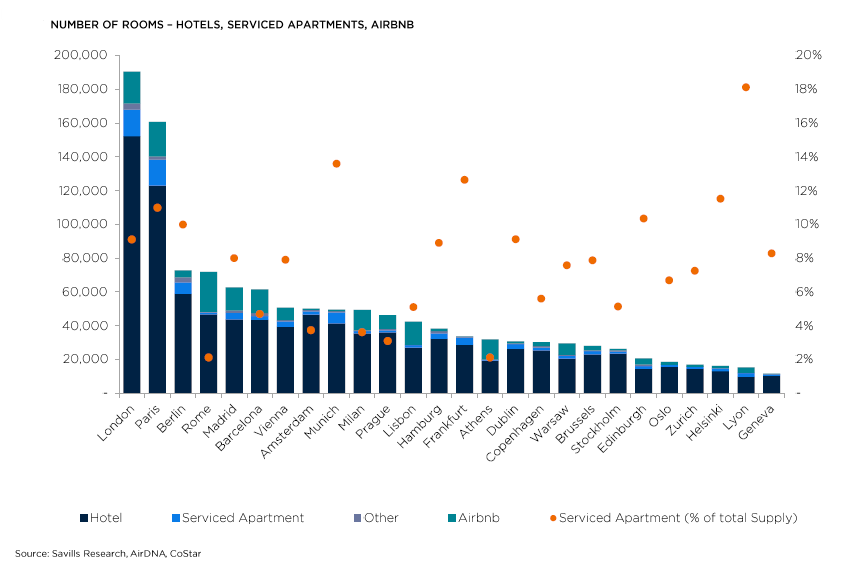
Savills analysed 26 European gateway cities and found that serviced apartments remain significantly underrepresented in relation to the total supply of accommodation. In the cities studied, serviced apartments account for 8% of existing supply and 12% of all rooms in the development pipeline – an indication of the growing importance of serviced apartments for the entire accommodation sector.
The analysis shows that the sector continues to show robust operational performance in the 26 European markets studied. In 2025, serviced apartments achieved an occupancy rate of 79% as well as an average daily rate (ADR) of 136 euros, according to CoStar. Since 2019, underlying demand has increased at a compound annual growth rate of 5.9%, compared to 1.0% across the hotel sector.
Thomas Emanuel, Head of Hospitality Thought Leadership EMEA at Savills, explains: “The growing demand for serviced apartments is driven by a combination of longer travel durations, increasing flexibility in working models and Europe’s continued strong position as the world’s largest tourism region. In 2025, Europe welcomed an estimated 800 million international visitors. Leading indicators point to sustainable growth in the mid-single-digit percentage range, supported by intra-European mobility, improved connectivity to the Asia-Pacific region and the continued high willingness of consumers to travel.”
In addition, consolidation and professionalization are making a significant contribution to the growth of the sector. Operators that have historically focused on individual domestic markets are increasingly pursuing cross-border expansion strategies in Europe – supported by institutional capital and highly scalable operating models. However, in many markets, small, locally operating operators still dominate, which underlines the fragmented structure of the sector. This results in clear potential for platform formation, consolidation and professionalization in the course of growing capital and operational competence.
Savills highlights that increasing regulation across Europe – driven by concerns about housing affordability, quality of life and sustainability – is structurally realigning accommodation demand. Measures such as overnight stay caps, permit requirements and stricter enforcement of existing regulations are reducing the economic viability of informal short-term rentals of apartments. In Amsterdam, overnight stays in informal short-term rentals fell by around 44% between 2019 and 2024 and a further decline is expected as new caps of a maximum of 15 nights per year in central city districts take effect from 2026. Cities such as Edinburgh and Paris are also tightening their regulation. Instead of dampening travel demand, Savills says these measures are directing demand potential towards compliant forms of supply. Serviced apartments benefit noticeably from this through higher occupancy rates as well as greater stability of average daily rates.
Richard Dawes, Director, Hotel Capital Markets, Savills, explains: “The investment case for serviced apartments is no longer based solely on demand growth – it is increasingly about market structure. Regulation is accelerating the withdrawal of informal offerings, while the fragmentation of the European market creates clear opportunities for scaling, consolidation and professionalisation. For capital seeking resilient income with growth potential, serviced apartments are emerging as a strategically important segment within the European hospitality industry.”
According to Savills, serviced apartments in Germany reached a transaction volume of around EUR 65 million in 2025, which corresponds to a share of around 3% of the total transaction volume of hotel and accommodation properties. Both the absolute volume and the percentage share were thus below the average of the previous five years of EUR 113 million or 7%.
Tina Haller, Director Capital Markets and Head of Hotels Germany at Savills in Germany, reports: “The German market for serviced apartments – as well as the European market as a whole – is currently in a phase of institutionalisation and consolidation, which is accompanied by a strong expansion of individual operators. At the same time, the sector’s key operating figures remained robust in 2025. Although serviced apartments continue to represent a niche in the real estate investment market, they are likely to benefit from the overall increase in investor demand for hotel properties. A key advantage lies in the comparatively broad buyer base: in addition to classic hotel investors, investors with a focus on modern, urban living and accommodation concepts are also emerging as potential buyers.”