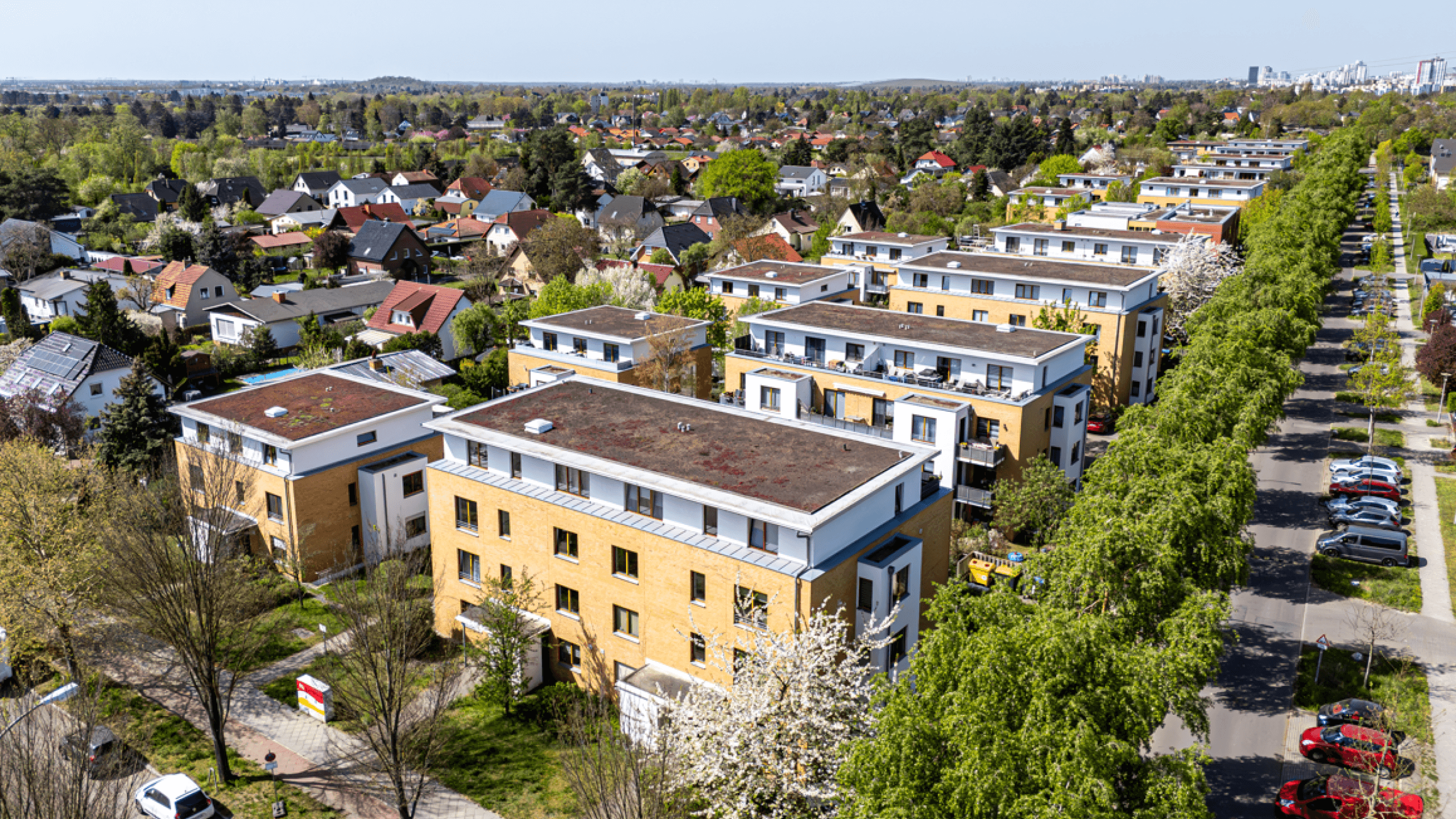
Residential real estate is considered a defensive asset class: stable, predictable, with little volatility. This classification falls short. Because "living" is not a uniform segment, but a universe. There are completely different risk and return profiles between an old inner-city building and a post-war district, between a commuter-oriented micromarket and a growing university city, between energy-efficient existing buildings and refurbishment-intensive properties.
The misconception: Focus is confused with cluster risk
To automatically derive a cluster risk from specialisation in housing misses the point. Even if the logic behind it seems plausible: If you focus on one asset class, you do without balancing effects from other segments. However, housing is not a homogeneous risk profile, but a network of different sub-markets and decision-making levels.
A portfolio is diversified by the structure of its assumptions: locations and micro-locations, construction age classes and energy profiles, tenant segments, cash flow logics, holding periods and exit routes. Anyone who assesses housing as a lump across the board ignores the fact that an inner-city core portfolio, a value-add property with a CAPEX program and a portfolio that can be privatized react to completely different drivers. In fact, a cluster risk rarely arises from "housing", but from uniformity in the procedure.
The risk of one-sidedness: When strategies become too similar
Portfolios become vulnerable when they rely too heavily on a single type of development: only new construction, only one city, only one tenant segment, only short holding periods or only one exit option. Such strategies can be very successful in certain market phases, but lose stability as soon as framework conditions change. Rising financing costs, regulatory interventions or fluctuations in demand then do not have a selective effect, but affect the portfolio across the board. The decisive factor is therefore not whether a portfolio is specialized, but whether it has sufficient internal range. One-sidedness reduces the ability to react to market changes.
Variance within housing: the central axes of risk management
At the portfolio level, a practical question then arises: along which axes do the drivers differ so much that real robustness arises? A first axis is the location, but not so much at the macro than at the micro level. Neighbourhoods react differently to the economy, regulation and shifts in demand. A second axis is construction age classes and energy profiles. Technical condition, investment requirements and regulatory requirements clearly shape the risk profile. In addition, there are tenant segments and sources of demand that influence cash flow stability and fluctuation.
The earnings logic also differentiates strongly: current cash flow follows different laws than value-oriented development strategies. In addition, there is the holding period. Shorter exits react more sensitively to market cycles, longer horizons give more leeway for management and value drivers. After all, exit channels are a risk dimension in their own right. Privatization, individual sale or portfolio exit each follow their own market mechanics and liquidity windows. Diversification means consciously varying and combining these levers.
From deal to exit: differentiation along the investment cycle
Practical implementation shows whether diversification is intended to be sustainable or remains theoretical. Different risk profiles already arise when you get started. Acquisition decisions, deal structures and risk classes determine the scope for action that opens up later on. Core-oriented investments follow different management logics than value-add strategies with an active development focus. Cash-flow-stable portfolios require different management than properties with a clearly defined value appreciation path.
These logics also have an impact on the portfolio level, for example in financing, liquidity management or reinvestment decisions. At the end of the cycle, the exit not only determines returns, but also the resilience of the entire portfolio. Privatization, individual sale or long-term institutional holding react differently to market windows and capital market signals. In this context, robustness does not arise from dispersion at any price, but from deliberately different decisions along the same cycle.
The second level of diversification: mandate logics, vehicles, governance
In practice, the internal diversification of housing often arises where different mandates are thought of in parallel. This is because investors pursue different target systems. Some are looking for predictable distributions with high stability, others prioritize value appreciation and accept more operational movement in return. A cash flow mandate, for example, buys, finances and manages differently than a value-add strategy with a clearly defined CAPEX program.
The structure of the investment is also changing. Individual investments work differently than club deals or joint ventures because governance, decision-making timing and risk sharing each have their own mechanics. This is precisely where a second level of diversification within the asset class lies. The residential focus remains constant. What is variable is how the capital is used, which value drivers are prioritized and how management and transparency are organized. This creates diversity that creates a robust range within the asset class.
Which factors are decisive now: Living under new auspices
The current market environment is significantly shifting the weights within the residential asset class. Growth assumptions are becoming less viable, while stability, controllability and transparency are gaining in importance. Energy profiles and investment paths are coming more into focus because they determine costs, regulations and rentability. At the same time, the ability to plan cash flows realistically and manage them flexibly is becoming increasingly relevant. Exit flexibility is also being reassessed. Strategies that keep several exploitation options open react more robustly to changing market windows than fixed one-way streets. Diversification today means less to position oneself more broadly, but to differentiate more consciously within the asset class. If you think about energy paths, cash flow management and exit options together, you build portfolios with real resilience.