



Den här artikeln är automatöversatt.


As in previous years, the analysis firm Scope has conducted a major study on the ELTIF market ("ELTIF Study"). The following figures are intended to refer to this and thus clarify the core findings of the ELTIF study:
This increasing market penetration is reason enough to classify the ELTIF a little more closely in terms of what it does, who uses it and what it is demanded for. And of course, there is also the question of who can offer their workbench within the framework of the fund industry and thus participate in value creation on the administrative side. More on that below.
Quick recap on ELTIF 1.0 and ELTIF 2.0 before entering the ELTIF study
Because before we get into the details of the ELTIF study, let's briefly recall the main developments of ELTIF. ELTIFs stand for "European Long-Term Investment Fund". The first generation of ELTIFs launched since its launch in 2015 are now also referred to as "ELTIF 1.0" to distinguish them from the second-generation ELTIFs, which were launched after the entry into force of the ELTIF 2 Regulation on 10 January 2024 and are therefore in turn referred to as "ELTIF 2.0":
A real game-changer for the ELTIF 1.0 was already the EU sales passport. This allowed asset managers to register the ELTIF with a single national supervisory authority and distribute it in other EU member states. It should be remembered that this was a real novelty at the time, because until then only AIFM, but not one product of an AIFM, had been passport-eligible in the EU.
Initially, however, the ELTIF had difficulties in absorbing the market, which had been due to conceptual teething problems of the ELTIF 1.0. Despite these conceptual weaknesses, sales have been hesitant at first, but have been quite buoyant in recent years. The ELTIF 2 Regulation, which came into force on 10 January 2024, continued this fundamentally positive trend. It is resolutely committed to making the ELTIF regime more flexible and harmonised. The intention to help the ELTIF achieve its final sales breakthrough cannot be misunderstood. Since then, ELTIF has been called "ELTIF 2.0" in this context. The ELTIF 2.0 has become much more attractive, especially for private investors and asset managers, among other things through:
The ELTIF study by the analysis company Scope
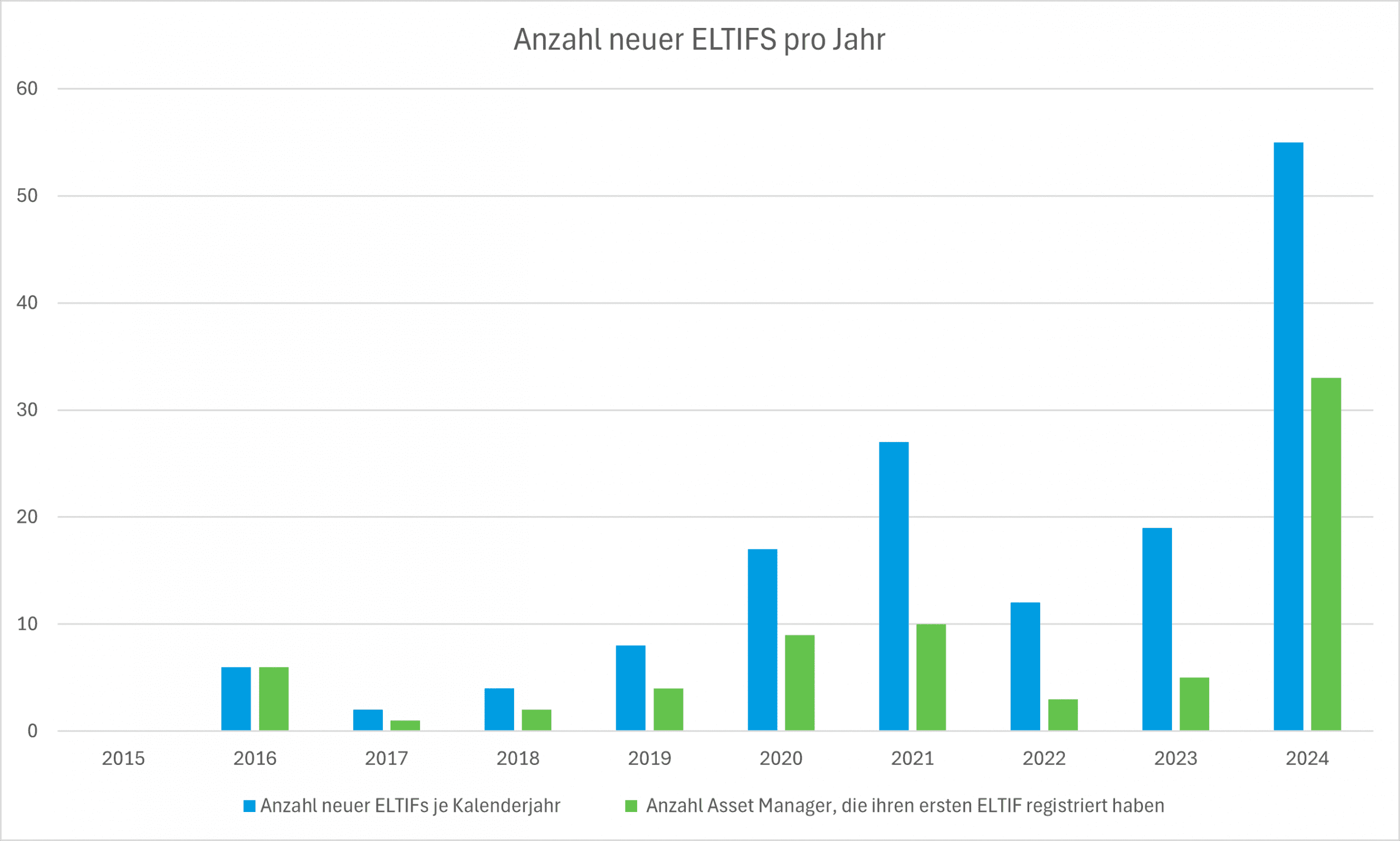
After working through the basics, however, we now want to turn to the study itself. At the end of the ELTIF study period (31.12.2024), there were 150 ELTIFs on the market. The figures of the study speak so clearly for the success of ELTIF 2.0 that a further interpretation seems almost inconsequential:
The first results of this are that the ELTIF market was able to develop a relevant market size, despite the conceptual initial teething problems of the ELTIF 1.0. The ELTIF 2.0 builds on this and was able to increase sales brilliantly in the course of 2024:
And according to this, there are already 192 ELTIFs as of 21.6.2024, so based on this as a connecting fact, the forecast for this year does not seem too ambitious that even more ELTIFs should be launched in 2025 than in the already successful year 2024.
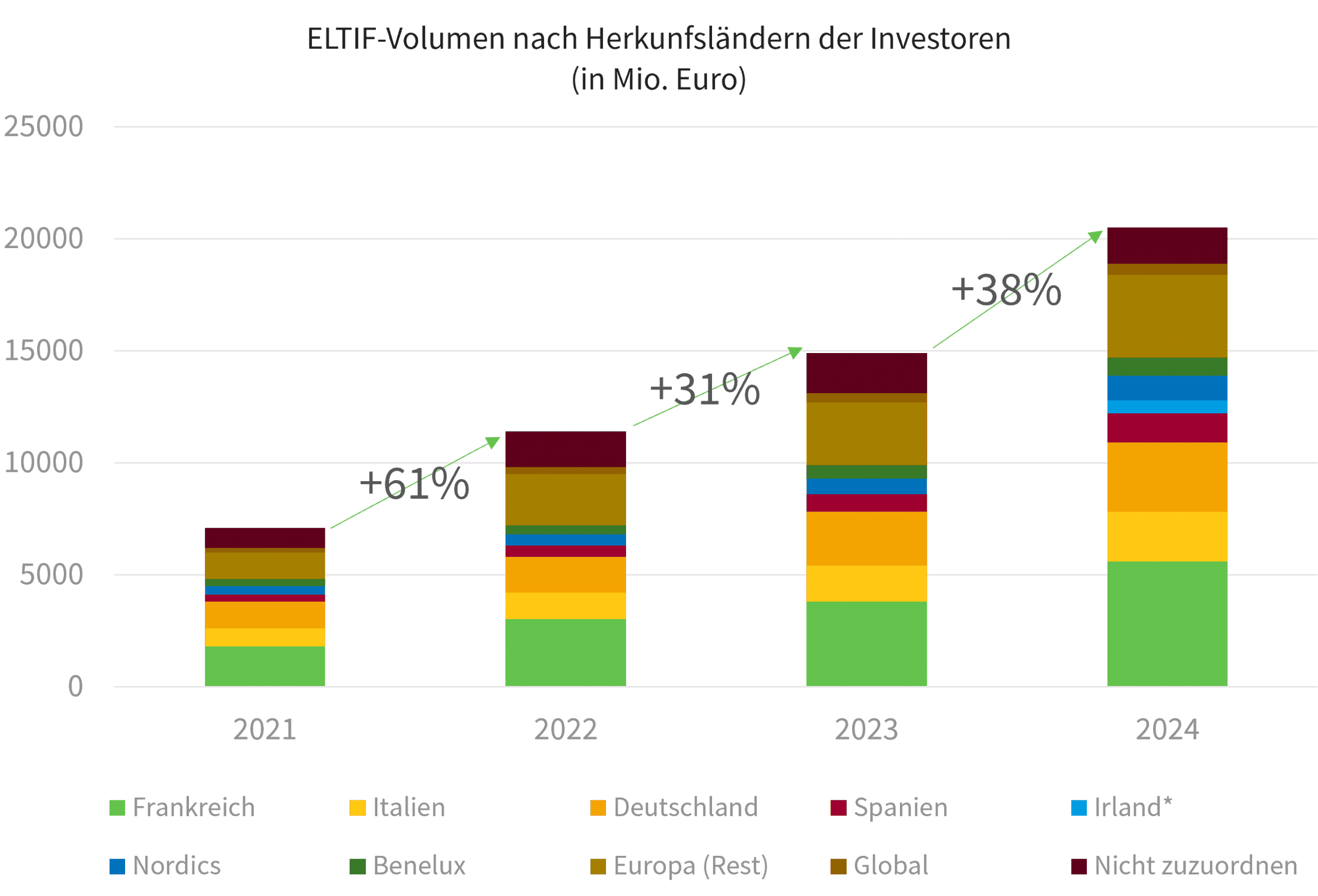
According to the regional distribution of the countries of origin of the acquired capital, the ELTIF study shows the following picture:
Of the German capital market as a whole, klimaVest, registered with the CSSF in Luxembourg, alone accounts for half of the total market with a volume of EUR 1.4 billion at the time of the ELTIF study. The differences in allocation are also interesting: Infrastructure (71%) and private equity (27%) dominate among the products subscribed by Germans. Private debt (1%) is far behind in the German market. Among Italians, infrastructure accounts for only a small share (7%), but private debt dominates (44%), followed by private equity (31%) and other asset classes to a lesser extent. For the French, private debt (37%), infrastructure (33%) and private equity (28%) are more or less evenly distributed. Presumably, the reason for the deviation in the allocation with regard to German investor funds is that German investors had already had suitable fund structures at their disposal for investments in real estate or private markets, which had also been regulated since the introduction of the KAGB in 2013. What they all have in common is that real estate plays no or a very subordinate role for them in ELTIF. One reason for this is certainly at least the past period until the introduction of the ELTIF 2 Regulation. It was not until the ELTIF 2 Regulation that the aim was to remove some narrow definitional hurdles, which had previously made real estate less well included in ELTIFs. It will be interesting to see whether more real estate investments in ELTIF will now be observed under ELTIF 2.0 with a view to the future.
On the one hand, the fact that there are different approaches in the countries on how fund products are integrated into retirement provision certainly plays a role. In addition, Germany has always had regulated real asset funds, so that ELTIFs had to fight their way into distribution in an already well-organized market with diverse legal structures. However, it can also be assumed that the different funding of ELTIFs in the countries also plays a relevant role:
Including all 192 ELTIFs listed in the ESMA Registry, the distribution of invested investor capital – with France in first place and Italy in second place – broadly corresponds to the number of funds domiciled in these countries. According to this, 38 ELTIFs were domiciled in France and 13 ELTIFs in Italy. In view of Germany's placement in 3rd place in terms of acquired investor money, it would have been at least a presumption that a larger number of ELTIFs are domiciled by German KVGs in this country as well. In fact, there are only two of them! At the moment, the CSSF in particular is bringing the PS onto the streets. With 120 domiciled ELTIFs, Luxembourg is the absolute leader. According to the ELTIF study, in 2024 alone, of the 55 ELTIFs launched, 37 of them were registered in Luxembourg.
What might be the reason for this? Regarding the inception process of an ELTIF in Germany, a product provider in the ELTIF study by Scope can be quoted as follows: " The communication with BaFin was very good. BaFin asked many questions to understand the product. In total, the entire process from submission to approval by the ELTIF in October 2024 took seven months. " So this should not have been the reason. In France, for example, "patriotisme économique" is once again coming into play, according to which it is specifically promoting its own fund industry as part of a "buy local" logic. According to this provision, the specific tax incentives for investors require that the ELTIF is issued by a French AIFM. Germany can take this as an example that would help investors in their retirement provision on the one hand, and the German fund industry on the other.

