The Concept of Creative Class by Richard Florida
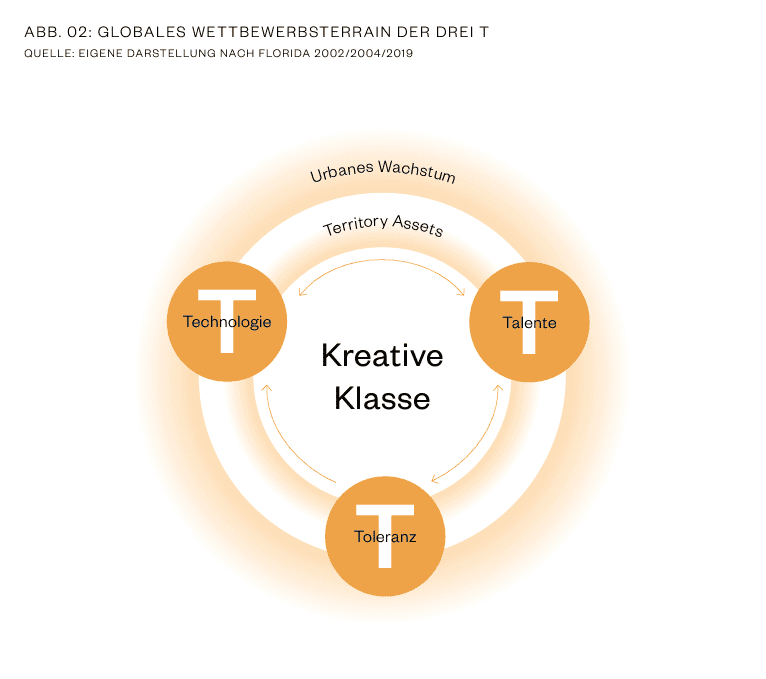
Richard Florida bundles his assumptions into an economic growth theory: "Technology, Talents and Tolerance". These three "T's" mark out the field in which regions and cities compete for a successful economic future. Technology refers in particular to innovations and future technologies. The second T, talents, refers to the existing human capital and tolerance to the diversity and openness of a city or region.
The decisive factor for Florida's thesis is that only regions in which the three T's coincide in a favorable ratio can expect economic growth. Each of the three T's is significant, but none is sufficient on its own. It is the interaction of the three T's that determines the future prospects of regions (Fig. 02).
A tolerant atmosphere, for example, makes a city attractive for highly qualified talent. Where many creative talents live, companies from future technologies or knowledge-based services are settling, attracting further talent with their jobs and thus making the city even more attractive and diverse. In this way, a permanent upward spiral can develop.
"Territory assets", which encompass local and socio-spatial location qualities, are according to Florida one of the decisive factors for the expression of the three T's. On the one hand, this includes the built environment. To attract technology and talent, you need the right residential, industrial and office buildings. On the other hand, so-called "placemaking" is also of particular importance, i.e. the existence of identity-forming places of encounter and experience.