In 2008, Aengevelt Research developed the Aengevelt Residential Investment Index (AWI*) as a reliable scientific guide to the residential investment market. It regularly gathers the assessments of experts from all sectors of the housing industry – who collectively represent a high six-figure number of residential units across all parts of Germany – regarding market sentiment and trends.
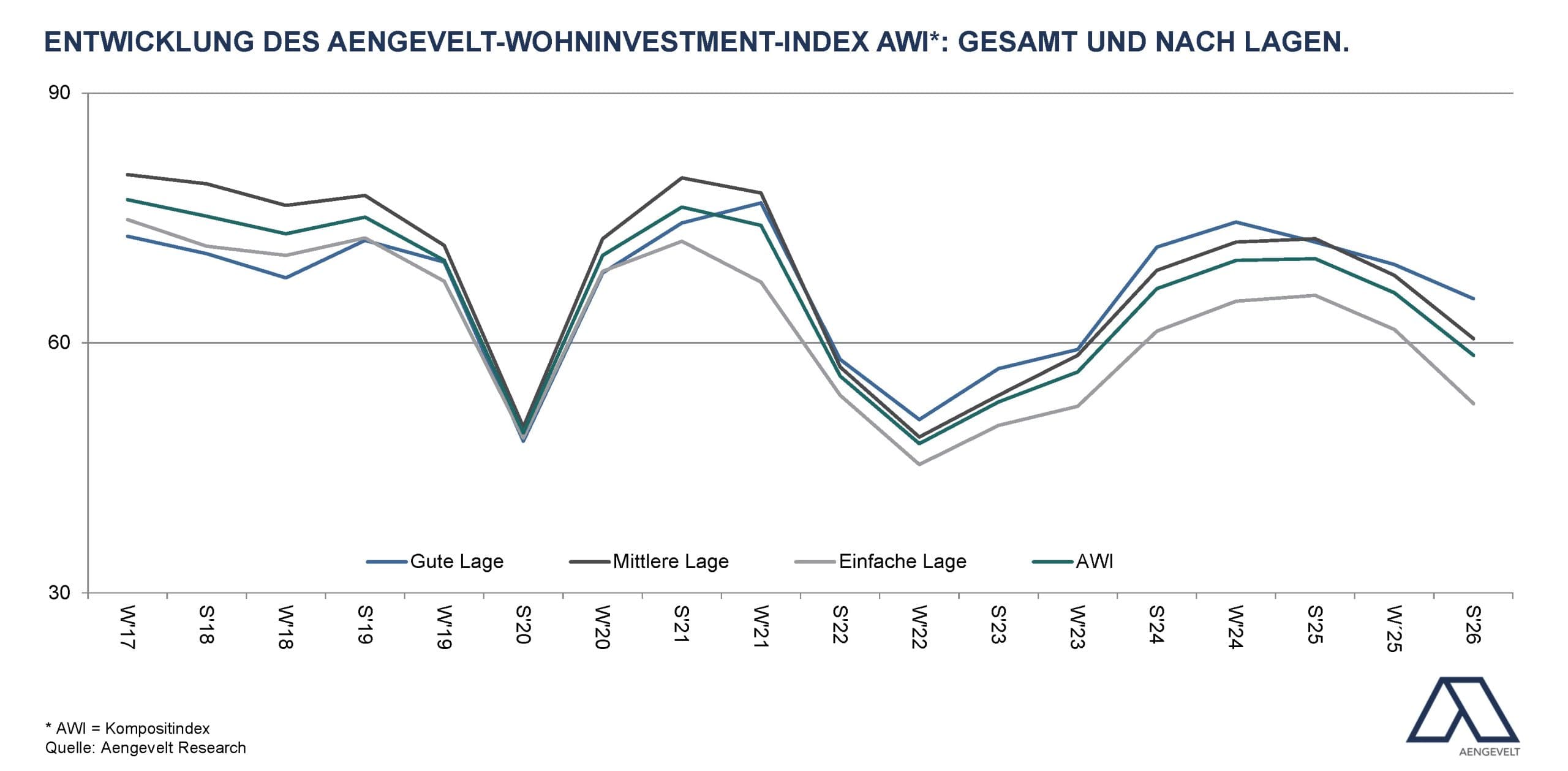
After the AWI recorded its lowest score since the survey began – 47.9 points – in the 2022/2023 winter survey, its value subsequently rose steadily. This trend continued until the 2025 summer survey, when it stood at 70.1 points. In the winter of 2025/2026, the AWI then fell again to 66 points.
This trend continues in the current 2026 summer survey with a further marked decline of 7.5 points to 58.5 points. This development is evident across all residential areas:
- The AWI has fallen by 8.9 points to 53.7 points in basic locations and by 7.6 points to 60.5 points in mid-range locations. Prime locations recorded the smallest decline, falling by 4.1 points to 65.3 points.
- As a result of this decline, the overall AWI and the sub-index for basic areas have returned to market equilibrium (40–60 points) for the first time since the 2023/24 winter survey.
“The turnaround in new housing construction is still a long way off: since 2023, housing completions have been falling, from 294,400 residential units in 2023 to 206,600 in 2025. For 2026, the ifo Institute, amongst others, forecasts a further decline to just 185,000 new homes. This means that the turnaround in new housing construction is still a long way off, and even investment in modernisation is losing momentum. Furthermore, investment conditions – partly due to political intervention – are currently so unfavourable that residential investments are becoming increasingly difficult to justify financially. This shows that the existing government and economic framework conditions are insufficient to stimulate new housing construction significantly and sustainably, and to resolve the existing housing shortage, particularly in growth regions. “That is why significantly more effective incentives for investors and project developers are now needed,” says Dr Wulff Aengevelt, commenting on the AWI findings.
Rental housing market.
The latest survey results confirm this assessment:
- As before, the majority of survey respondents – 69 per cent (Winter 2025/26: 72 per cent) – expect rents to rise.
New housing construction and refurbishment.
- A decline in investment in new rental housing construction is also contributing to this. The majority of respondents do not foresee any change in this regard in the short term. The proportion of respondents expecting an increase in investment has fallen to 4 per cent (Winter 2025/26: 10 per cent), whilst the proportion of those anticipating a decline in investment in new-build housing has risen again, from 51 per cent in the previous survey to the current 58 per cent.
- The survey also reveals declining figures regarding the importance of modernising or refurbishing existing housing stock: only 13 per cent of respondents (Winter 2025/26: 24 per cent) expect investment in modernisation and refurbishment measures to rise. Similarly, only 28 per cent (Winter 2025/26: 34 per cent) expect investment in energy-efficient building refurbishment to rise.
Residential investments: AII falls sharply.
- With regard to expectations regarding the net present value of residential investments, the AII (AENGEVELT Investment Index) reached its highest level to date in the summer 2021 survey, at 77.8 points. It then declined steadily until it reached an all-time low of 23.2 points in the summer of 2023.
In the winter of 2023/24, a slight recovery began, reaching 28.2 points, which continued until the summer of 2025 with a rise to 59.5 points. In the winter of 2025/26, the AII then fell again to 53.9 points. In the latest survey, the AII fell significantly by a further 13 points to 40.9.
- Across all location categories, only around 16 per cent now expect demand for residential property investments to rise. In the winter of 2025/26, this figure stood at 42 per cent. By contrast, more than twice as many – around 37 per cent – expect demand to fall (winter 2025/26: 12 per cent).
- This trend is also reflected in price expectations: at 22 per cent, only one-fifth of respondents now expect rising prices for residential investment properties (winter 2025/26: 37 per cent). Correspondingly, the proportion of those anticipating falling prices has risen to around 30 per cent (winter 2025/26: 21 per cent).
Conclusion.
- For the first time since the 2023/24 winter survey, the AWI has returned to market equilibrium (40–60 points). This is driven by caution on the part of developers – partly due to extensive regulations that make it difficult to make new housing construction economically viable – and also on the part of investors, particularly those from abroad, who are scaling back their involvement not only in the capital but elsewhere too, in view of the threat of expropriation facing major housing stockholders in Berlin.
- At the same time, uncertainties regarding the allocation and availability of funding are holding back housing refurbishments, particularly in the energy efficiency sector, which is reducing the quality of housing and its fittings.
• For tenants, particularly in growth regions, the outlook remains unfavourable or is continuing to deteriorate: given the negative trend, particularly in completion figures, no easing of the housing market is to be expected in the medium term. Accordingly, a further rise in rent levels is to be expected in tight housing markets. Added to this is the burden of rental costs, which is significantly above average, particularly for lower-income households. Here, too, no easing of the situation is to be expected.
_________________________________________________________________________
* The AWI is a composite index that takes into account future trends in demand for rental properties, the supply of rental properties, vacancy rates and rents, as well as assessments of future trends in supply, demand and purchase prices in the residential investment sector.