The inheritance trap of multi-family homes: When the tax burden threatens social harmony – A look back at ‘Münchner Immobilien Fokus’
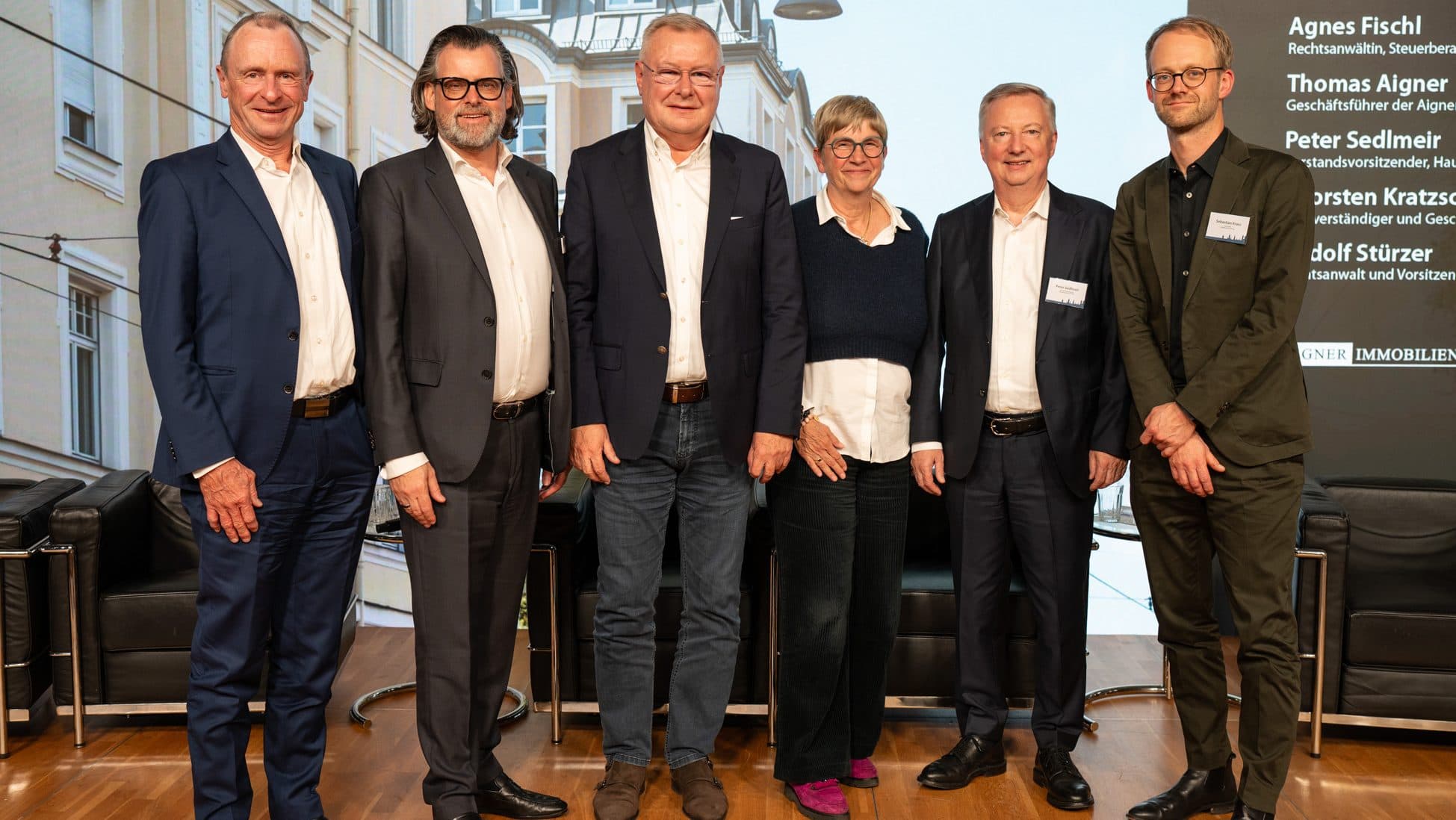
“Inheritance tax value versus market value: How the tax authorities are overtaking the Munich property market from the right!” – that was the topic of this year’s “münchner immobilien fokus”, which took place on 29 October at the Literaturhaus and struck a chord with many property owners. As property prices have fallen, in some cases significantly, as a result of the shift in interest rates, this can lead to overvaluation, inflated tax bases, exceeded tax-free allowances and high inheritance tax rates in the event of inheritance or gifts. The event, which was packed to capacity, was hosted by Aigner Immobilien GmbH, the legal and tax consultancy Schütz & Fischl GbR, and Hausbank München. Journalist Sebastian Krass hosted the evening.
In her opening address, Agnes Fischl, a tax adviser and specialist solicitor in inheritance law at Schütz & Fischl GbR, emphasised that the tax authorities bear no blame for ‘overvaluation’, as they are bound, amongst other things, by the valuations of the expert committees. For the purposes of inheritance and gift tax, the tax office initially values property in a highly simplified manner in accordance with the Valuation Act, based on historical market parameters such as standard land values. This initial standardisation alone often leads to property values that are inflated for tax purposes in the complex reality of the property market, as the Munich Valuation Committee, unlike the market, distinguishes between only four categories of location quality. Since the interest rate turnaround, a further complicating factor is that the tax office’s simplified valuation takes place with a time lag. Until the start of the interest rate turnaround, this time lag had often had a positive effect for taxpayers. Standard land values are published every two years by the valuation committee (most recently as at 1 January 2026) and then remain valid for two years. A gift or inheritance of property taking place in December 2021 was therefore still valued using the lower historical standard land values, which were determined on the basis of actual sales from 2019 to 2020. However, with the interest rate turnaround at the start of 2022, the previous advantage of this time lag has often been reversed. The real problem lies with the legislator, whose highly standardised regulations result in a tax valuation that lags behind the current market, which is generally on a downward trend. Those affected are usually left with no option but to provide costly counter-evidence in the form of a market value report from an expert certified in accordance with DIN EN ISO/IEC 17024 and/or publicly appointed and sworn.
The problem with the ‘one-off’ property
The ensuing discussion initially focused on general market trends. Two members of the Munich Valuation Committee – Thomas Aigner, Managing Director of Aigner Immobilien GmbH, and Thorsten Kratzsch, a publicly appointed and sworn valuer – took to the podium to provide current market insights. Kratzsch pointed out that recent sales are up to ten per cent below the standard land values, which had already fallen. Thomas Aigner added that prices vary greatly depending on the property and its location. Even within a residential complex, prices differ from one unit to another, because, as he emphasised: “Every property is unique.” This, he said, is precisely the dilemma, as generalised reports can only provide rough guidelines for valuing such a unique property. Agnes Fischl strongly condemned this situation: “A highly generalised and simplified property valuation forms the basis for taxation – I vehemently criticise that!” In this context, the valuer emphasised that he could at least make a more realistic adjustment for economic conditions.
A threat to social harmony
Rudolf Stürzer, Chairman of the Munich and Surrounding Area Property Owners’ Association (Haus- und Grundbesitzerverein München und Umgebung e.V.), highlighted the political implications: inheritance tax is now around five times higher than it was 15 years ago. This makes life difficult for private owners of multi-occupancy properties and, consequently, for their tenants as well. Anyone in Munich who inherits a property and wishes to maintain fair rents rather than increase them often has to sell, because the tax burden is unaffordable.
Peter Sedlmeir, CEO of the local bank, calculated that a loan of 1 million euros at an interest rate of 4.5 per cent per annum would incur 45,000 euros in interest. “For many people, the pressure to sell is already high.” Stürzer’s forceful appeal, which was met with applause: “And who will buy the houses then? A commercial investor – and then things will be very different for the tenants! If you drive out private owners, you jeopardise social harmony!”
New solutions are needed
As the discussion progressed, presenter Sebastian Krass deliberately steered the conversation towards the debate on social justice: given that, particularly in Munich, the sale of inherited property often results in capital gains that arise without any personal effort on the part of the seller, many people advocated an inheritance tax as a fair means of redress.
Thomas Aigner agreed with this in principle, but pointed out that property is usually purchased to provide security for the next generation and to build up private savings. “Owners are left to their own devices in this regard. This is, of course, a societal debate about how we fundamentally view retirement provision: should the state, in principle, be responsible for everyone, or do we want to strengthen private provision?”
As a possible solution, he proposed tax incentives – for instance, where heirs comply with certain conditions, such as agreeing not to increase rents for a specified period. A scheme similar to that for business succession would also be conceivable. However, he added: “At present, these tax incentives are the subject of heated debate and are being called into question – we should not expect much in this regard.”
Both on the panel and amongst the audience, the proposal to abolish inheritance tax entirely, following the Austrian model, met with widespread approval. The panellists considered such a move to be entirely plausible, as the tax accounts for just over one per cent of total tax revenue and therefore has little impact anyway.
After the panel discussion, the topic continued to be a talking point for quite some time.
The Munich Property Forum took place on 29 October 2026 at the Literaturhaus under the title ‘Inheritance Tax versus Market Value: How the tax authorities are overtaking the Munich property market!’ Next year, the series of events will enter a new phase. The exact date and topic will be announced in due course.