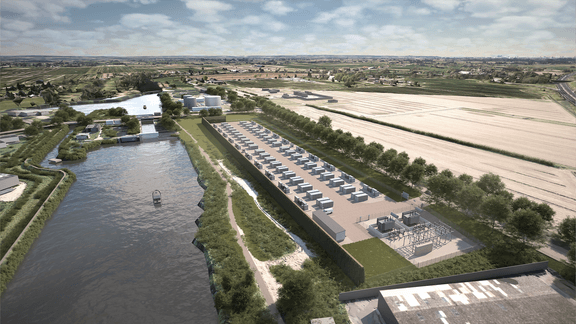

A multi-billion semiconductor deal between Japan and the US shows that the returns on strategic infrastructure investments can extend far beyond the project’s cash flow. For Europe’s fragmented capital and economic markets, this becomes a matter of competitiveness.
Japan provides the funding, America gets the factories, and a private company runs them. This unusual division of labour in a new semiconductor project in the US shows that the economic viability of strategic infrastructure investments can increasingly extend beyond their immediate cash flows.
An unusual deal
In mid-October, GlobalFoundries announced that it would operate two new chip factories in the US state of New York. Total investment: up to 21 billion US dollars. The funding is to come from Japan, whilst GlobalFoundries will take charge of the technology and operations. The US gains industrial production capacity and equity stakes.
What makes this special is that the investment is linked to a US-Japan trade agreement. Under this agreement, Japan has committed to investments totalling 550 billion dollars in the US. In return, US import duties on Japanese goods have been reduced.
Two calculations, one investment
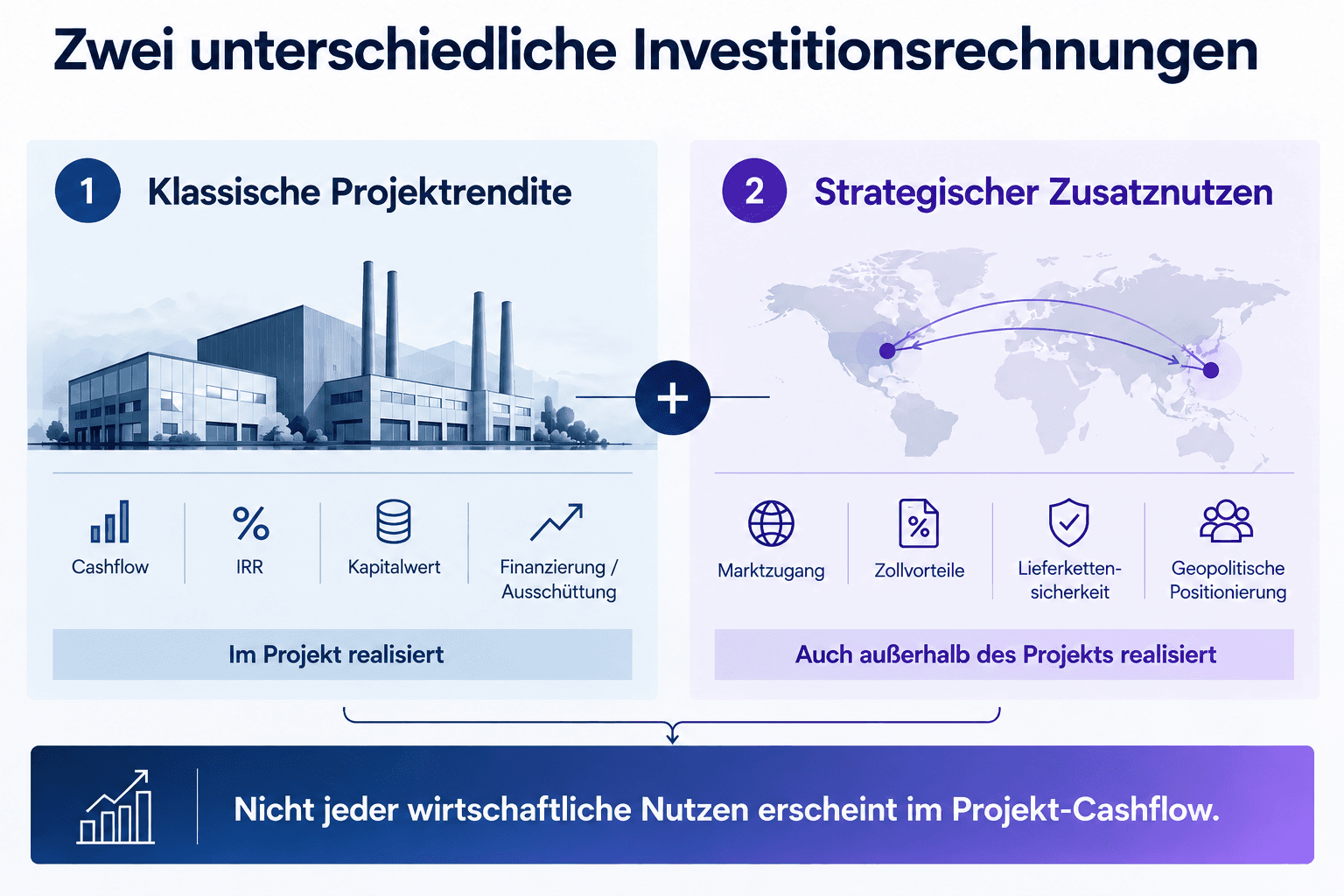
In the world of institutional infrastructure investors, the first step would be to analyse the factories’ financial viability: investment costs, operating cash flows, financing costs and expected return on investment. The project must generate sufficient returns to cover its cost of capital and provide an appropriate return for the risks assumed.
If this calculation yields a negative result, an institutional infrastructure investor is likely to steer clear and deploy its capital elsewhere. However, investments can generate further benefits that do not appear at all in their own cash flows.
This applies in particular to investors who do not base their decisions solely on financial criteria, but who may well compete with institutional investors for the same infrastructure investments.
For Japan, for example, additional economic benefits may arise: improved market access, lower tariffs, more stable supply chains and a closer strategic partnership with the US.
Some of these benefits can certainly be assessed in financial terms. Others, such as security of supply or geopolitical manoeuvrability, are more difficult to quantify.
The crucial point, however, is another: the party making the investment need not be the one that reaps the full economic benefit.
The factories generate their own cash flows. The benefits of the trade agreement, on the other hand, may accrue to Japanese exporters, American industrial customers or the economies involved.
This means that, alongside the traditional project return, there is a second, strategic assessment of benefits.
When returns and benefits diverge
It is nothing new for states to finance infrastructure projects for strategic reasons. What is new is the scale on which investment commitments, property rights and trade policy concessions are linked.
The decision on where to locate a project thus becomes part of a broader economic policy negotiation. It is no longer solely the project’s return on investment that determines the attractiveness of an investment, but possibly also the benefits it generates elsewhere.
This could give rise to a structural problem for Europe. Whilst the European Union has a large single market and a common trade policy, industrial policy, state financing options and capital markets remain largely fragmented. Whilst large economic blocs can bundle market access, investment and strategic concessions into comprehensive agreements, Europe finds it more difficult to translate its economic size into corresponding negotiating power.
📌 Conclusion
Those who compete solely on the basis of the returns from individual projects could find themselves at a disadvantage compared to those who negotiate on the basis of the economic benefits of entire systems.
Sources
GlobalFoundries, 14 October 2026 – Company press release. GlobalFoundries selected to operate two new semiconductor fabs in New York under landmark US-Japan initiative.
Reuters, 14 October 2026 – Stephen Nellis, Makiko Yamazaki and David Shepardson. Japan to invest up to $21 billion in two US chip factories to be run by GlobalFoundries.
GlobalFoundries, 14 October 2026 – Securities and Exchange Commission filing (Form 6-K). Official announcement of the project to the capital markets.
Associated Press, 15 October 2026. GlobalFoundries to open two new chip plants in New York with $21 billion in financing from Japan.