

Rising interest rates are slowing the recovery in the German property investment market
At 23.9 billion euros, transaction volume after three quarters is on a par with the previous year
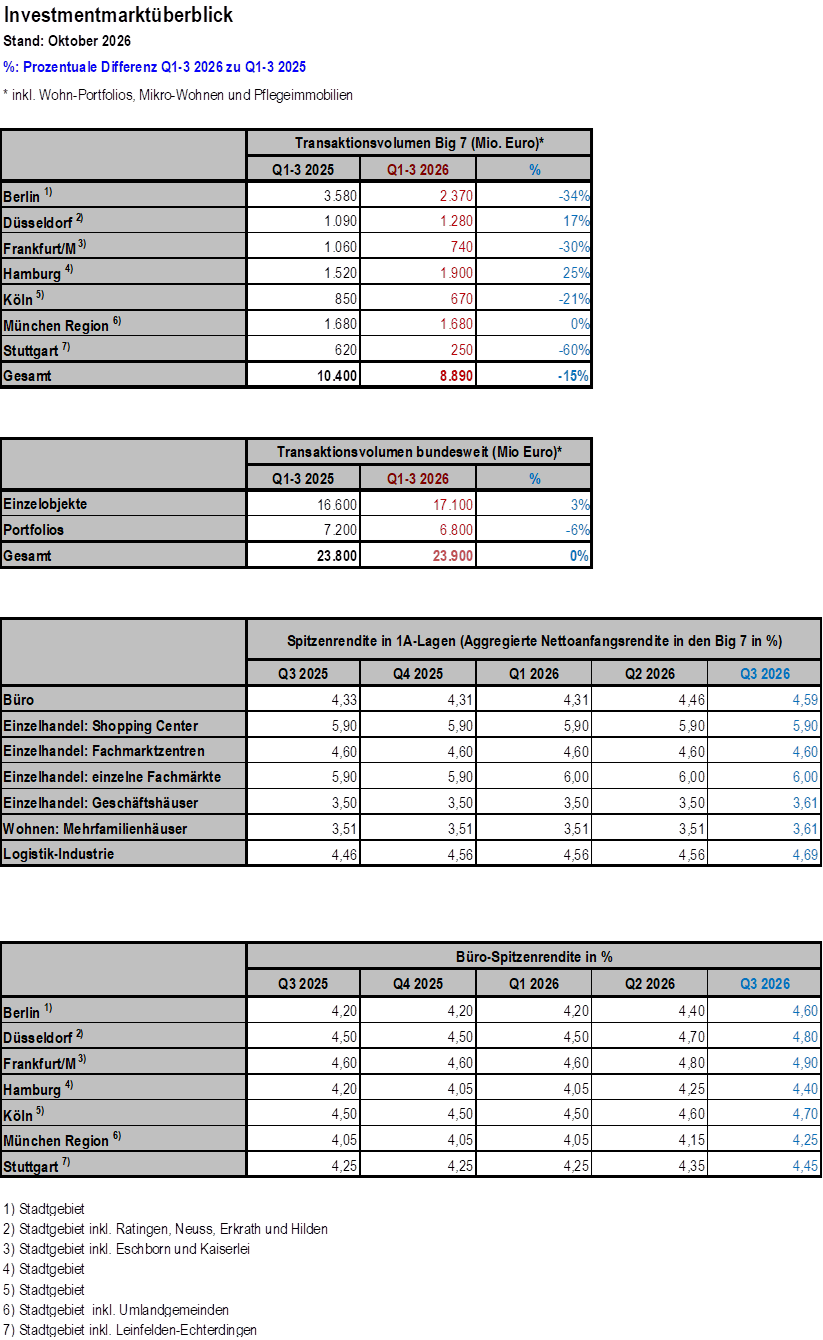
The upward trend in the German investment market, which has been evident since the end of 2025, lost momentum once again in the third quarter. At around 23.9 billion euros, the transaction volume stagnated at the previous year’s level after nine months. By contrast, at the half-year mark, the increase had still stood at 15 per cent. In numerical terms, the third quarter accounted for around 6.3 billion euros, compared with around 8.6 billion euros in the same quarter of the previous year.
In September, the European Central Bank raised its key interest rates by 25 basis points for the second time this year. The deposit rate now stands at 2.50 per cent. This followed a rise in inflation in the eurozone to 3.3 per cent in August, driven primarily by high energy prices resulting from the resurgence of tensions in the Middle East. Yields on the bond markets have also risen. Ten-year German government bonds have since been yielding around 3.5 per cent, whilst the yield on ten-year US Treasury bonds temporarily exceeded the five per cent mark, reaching its highest level since October 2023.
Konstantin Kortmann, CEO of JLL Germany & Head of Capital Markets: “The renewed rise in interest rates is making the operating environment for property investments more challenging, as the spread between property yields and German government bonds – which are considered to carry lower risk – remains narrow in many segments. This particularly benefits well-capitalised players who, given the current high cost of finance, are not reliant on debt. For the vast majority of investors, however, the risk premium for property investments is significantly too low, which is why the ‘pause’ button has been pressed for processes already underway or transactions that had been on the cards.”
This assessment is also reflected in investors’ current perception of risk. According to a recent survey by Bank of America, concerns about developments in the bond markets and rising inflation expectations are coming more into focus, whilst geopolitical risks are becoming less significant.
“There are increasing signs that the ECB will continue to tighten monetary policy. We therefore do not expect a year-end rally in the German property investment market in the final quarter. Our forecast for 2026 as a whole now stands at between 35 billion and 37 billion euros,” adds Kortmann.
Growth in individual transactions is slowing, whilst the decline in portfolio transactions is narrowing
After nine months, the volume of individual transactions reached 17.1 billion euros, which was three per cent higher than the previous year’s figure. At the half-year mark, the increase had still stood at 29 per cent. In contrast, the year-on-year decline in portfolio transactions narrowed from around ten per cent at the mid-year point to just under six per cent. The transaction volume in this area amounted to 6.8 billion euros after nine months.
Helge Scheunemann, Head of Research at JLL Germany: “In both portfolios and individual transactions, the volume continues to be driven by a large number of medium-sized and smaller transactions. Large transactions with a volume of more than 100 million euros, by contrast, have become less frequent. Ten such transactions were recorded in the third quarter, following 16 in the second and 19 in the first quarter. It is noteworthy that eight of the ten large-scale transactions were carried out by investors based outside Germany. This is an indication that foreign investors view the German property market more positively than the general conditions in this country would suggest.”
Transaction volumes down in the seven major cities
After nine months, the total transaction volume across the seven major cities stands at 8.9 billion euros, which is 15 per cent below the previous year’s figure. Their share of the national total fell to 37 per cent.
Trends varied across the individual cities: Hamburg saw its transaction volume rise by 25 per cent compared with the same period last year, whilst Düsseldorf’s increased by 17 per cent. Although Berlin continues to top the rankings with €2.4 billion, it recorded a year-on-year decline of 34 per cent. The decline was even more pronounced in Stuttgart, where the transaction volume fell by around 60 per cent from €620 million to €250 million.
Refinancing gap remains a key issue
Following further insolvencies amongst property developers in recent months, there is debate as to whether the sector is facing the threat of another widespread wave of insolvencies. However, analyses by JLL show that, to date, only 11 per cent of the recorded sales volume since 2024 has been attributable to financial pressure from lenders – for example, because the necessary borrowing was not available in sufficient quantities during refinancing, or because the costs of such borrowing had risen too sharply.
Taking the office market as an example, it is evident that a refinancing gap of four billion euros will still exist in 2026. According to current forecasts, this gap is expected to be closed for office properties – and presumably also for all other asset classes – from 2028 onwards. Despite rising interest rates, a considerable amount of debt capital remains available. In the first half of 2026, for instance, new business in commercial property financing at the twelve major lending institutions analysed by JLL rose by 15 per cent to 17 billion euros.
Nevertheless, global uncertainties are also leading to greater caution amongst lenders in the financial markets. The key factors are considered to be the future course of the Middle East conflict, possible further interest rate rises by the ECB, and the security of energy supplies. Whilst most institutions are sticking to their annual targets, they are monitoring their loan portfolios more closely than before.
The commercial property finance market is undergoing a phase of qualitative consolidation, characterised by a pronounced ‘flight to quality’ trend. Lenders are becoming increasingly selective in their choice of sectors and market segments, whilst financing with high loan-to-value ratios is tending to decline due to limited debt-servicing capacity. The stabilisation of interest rates at a structurally higher level is shaping the new market equilibrium and leading to a sustained increase in refinancing costs.
“The gradual market consolidation we have been observing since 2023 is not yet complete. In large parts of the market, the necessary repricing has yet to take place, whilst equity remains scarce and traditional investors have reduced their volumes or withdrawn. Furthermore, many existing loans are still calibrated to the interest rate and valuation levels of the zero-interest-rate period, meaning that adjustments will only take place upon refinancing,” says Scheunemann.
At the same time, constructive solutions are emerging, and there is a willingness to provide selective refinancing for compelling proposals. Attractive growth niches exist in specialised asset classes such as retail parks, logistics, student accommodation and the hotel sector. Consequently, both demand and transaction activity in these areas remain robust.
Residential leads the way, logistics overtakes offices
After nine months, residential property remains the strongest sector, with a transaction volume of 7.9 billion euros. This represents one-third of the total volume and an increase of three per cent compared with the same period last year. The logistics/industrial asset class grew by four per cent to 4.4 billion euros. It accounted for 18 per cent of the total, putting it ahead of office property once again.
Kortmann explains: “In the office property sector, market trends reflect not only the current economic challenges but also the ongoing structural transformation processes and the question of the role of the office in the age of AI.”
Prime yields are rising across almost all asset classes
Yield trends in the third quarter of 2026 continue to be shaped by the challenging interest rate environment. Compared with the previous quarter, prime yields have risen across almost all asset classes. For office properties in the seven major cities, the prime yield now stands at an average of 4.59 per cent, 13 basis points higher than in the previous quarter. In the logistics/industrial asset class, the prime yield also rose by 13 basis points to 4.69 per cent. In the residential segment, comprising multi-family dwellings, as well as in retail properties and commercial buildings, the prime yield increased by ten basis points in each case to 3.61 per cent. Only the yields on shopping centres and food-anchored retail parks remained stable.
As a result, the spread between property yields and the ten-year German government bond remains narrow in many segments. It should be borne in mind that part of the rise in government bond yields is attributable to a fiscal risk premium and not solely to interest rate or inflation expectations.
For long-term investors holding property with index-linked tenancy agreements, property nevertheless continues to offer a real return advantage over nominal bonds. In the current interest rate environment, however, positive leverage effects from property financing remain virtually non-existent. Value creation is therefore focused on active asset management, potential for rent increases and decarbonisation pathways.
“The market is moving from a recession into a restructuring phase. We will see in the coming weeks whether the signs of a modest recovery seen in the first half of the year will continue. The key factors now remain the future trend in interest rates – the ECB’s next interest rate decision is due on 29 October – and the question of whether and when buyers and sellers will reach a new consensus on prices at the higher yield level,” concludes Kortmann.