New York, Tokyo, London, Seoul and San Francisco are among the most resilient cities in the world, according to the latest Savills Resilient Cities Index . In particular, locations in southern Europe and parts of the USA have recently risen significantly in the ranking. This shows that more and more medium-sized cities are able to react flexibly to macro trends and adapt quickly to changing conditions.
As part of its thought leadership program Impacts, Savills studied the resilience of 490 cities worldwide. Among other things, economic growth, knowledge economy and technology, investments in infrastructure, attractiveness for real estate investors and users, quality of life and measures to adapt to climate change were evaluated. Taken together, these criteria provide information about how well prepared a city is for future challenges.
Savills Resilient Cities 2026: Top 20 by change in rank compared to 2024 and regional distribution
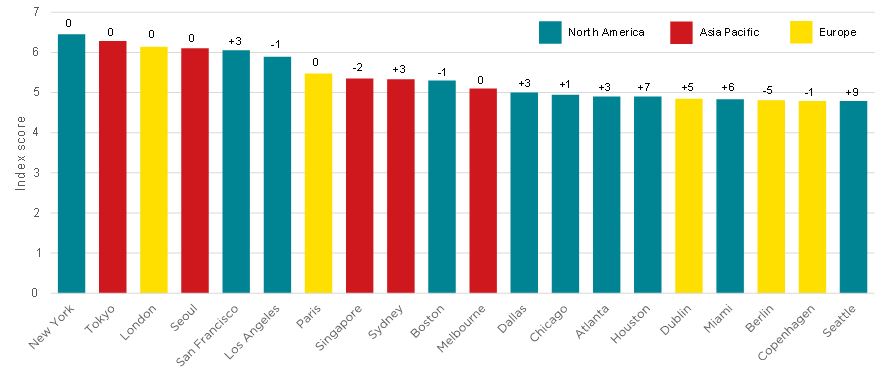
Among the top 100 of the ranking are seven German cities – Berlin, Hamburg, Hanover, Munich, Nuremberg, Stuttgart and Karlsruhe – as well as the Rhine-Ruhr metropolitan region. Berlin performs best within the German group, reaching 18th place, but falls five places compared to the 2024 ranking. This is due in particular to a significant decline in net immigration. Nevertheless, Berlin remains a global top 20 city and the undisputed leader among German locations. Berlin’s consistent performance across the individual valuation dimensions suggests that the city is losing strength rather than being overtaken by dynamically rising competitors – especially US tech hubs and cities in the Asia-Pacific region.
Although the cities in Spain, Italy, Portugal and Greece are predominantly in the middle of the index, they have caught up significantly since the last survey in 2024: on average, they improved by 36 places. The rise of the Spanish metropolises is particularly strong. Madrid is now in 34th place (2024: 77th), Barcelona in 47th place (2024: 85th). Savills attributes this development mainly to Spain’s economic strength, supported by record levels in tourism, the shift to a higher-quality service economy and an unemployment rate below the EU average. In addition, there are high student numbers and robust retail markets in the two cities.
North American cities also rise significantly in the ranking. U.S. cities — from Sunbelt growth hubs to tech-driven hubs — have moved up six places on average compared to 2024. This is mainly due to its above-average economic growth rates and the recovery in transaction volumes in the commercial real estate market. San Francisco is now ranked 5th (2024: No. 8), Dallas is No. 12 (2024: No. 15), Houston is No. 15 (2024: No. 22), Miami is No. 17 (2024: No. 23), Seattle is No. 20 (2024: No. 29) and Phoenix is No. 22 (2024: No. 39).
Paul Tostevin, Head of Savills World Research, comments: “There is little movement at the top of our index. The major economic centres maintain their position, benefit from agglomeration effects and adapt their built environment to the requirements of modern companies. Further down in the ranking, however, there are some interesting developments. Some medium-sized cities have been able to adapt quickly to ecological, technological and economic developments and build up specific strengths or areas of expertise. As a result, they make significant progress, gain growth power and rise in the rankings correspondingly quickly. For real estate investors, the index shows in which cities investments are secured in the long term and where there is future growth potential. For companies, it points to markets where demand for goods and services remains resilient and a robust workforce is available.”