Financing volume of vdp members increases to 39.8 billion euros
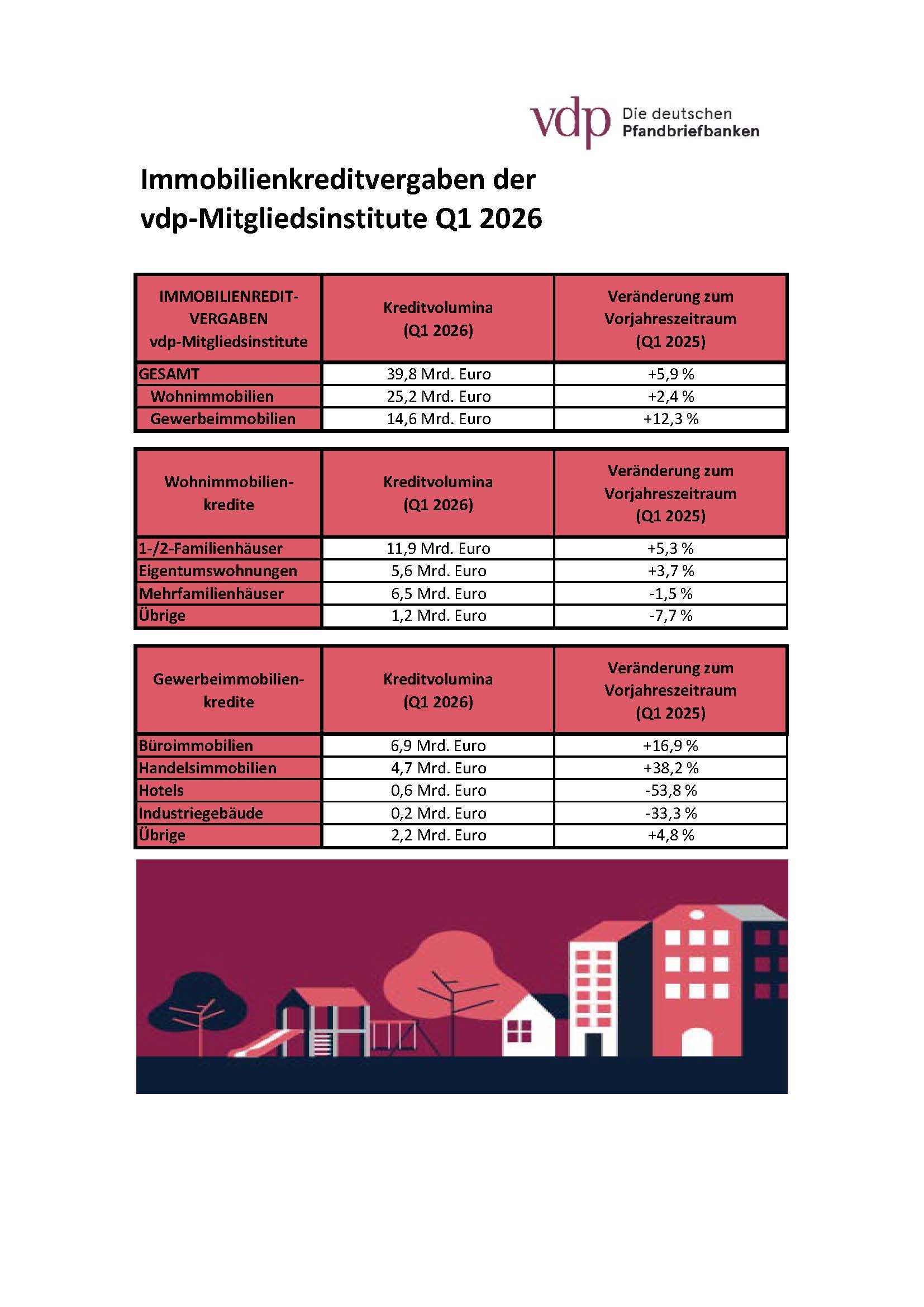
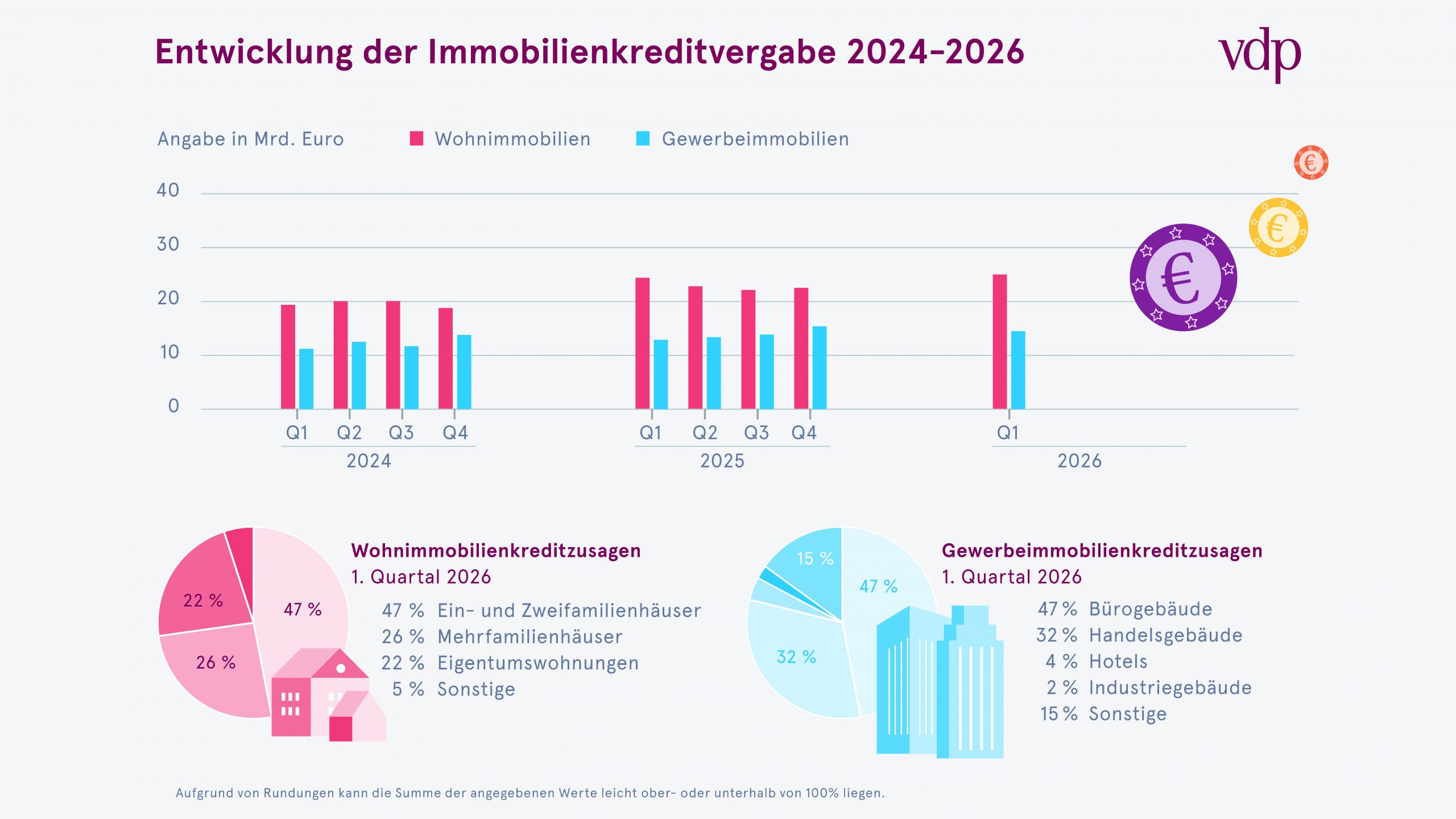
The institutions united in the Association of German Pfandbrief Banks (vdp) extended real estate loans with a volume of 39.8 billion euros from January to March of this year. Compared to the same quarter of 2025, the increase amounted to 5.9% (Q1 2025: EUR 37.6 billion). Compared to the direct previous quarter, there was also an increase of 4.2% (Q4 2025: 38.2 billion euros).
Residential real estate loans once again accounted for the largest share of the real estate financing volume in the reporting quarter: their new business totalled EUR 25.2 billion, an increase of 2.4% compared to the previous year’s figure (Q1 2025: EUR 24.6 billion). The volume of new loans for commercial real estate developed somewhat more dynamically – with a growth rate of 12.3%, but from a low level in a long-term comparison. It reached a value of EUR 14.6 billion (Q1 2025: EUR 13.0 billion).
vdp comments on BaFin’s concern about LTV ratios at WIFSta
“Loan-to-value ratios determined by the Bundesbank for WIFSta exaggerate the actual risk.”
Jens Tolckmitt
“At the beginning of 2026, the real estate financing market continued to experience a slight upswing. However, the possible impact of the Iran war on the financing business will only become apparent in the second quarter,” explained vdp Managing Director Jens Tolckmitt. He also referred to the latest statements by BaFin, which had spoken of increased risks in real estate financing in view of the results of the Bundesbank’s data collection on residential property financing (WIFSta) for the fourth quarter of 2025. “The loan-to-value ratios (LTV) determined at WIFSta exaggerate the actual risk. This is because a WIFSta-LTV only refers to the property to be financed – additional collateral provided by borrowers if the property to be financed is not sufficient as collateral is not taken into account.” In addition, a high LTV would generally go hand in hand with a high creditworthiness of the customer. This means that the probability of default is low in these cases.
“The reasons for the high LTVs lie on the cost side,” Tolckmitt continued: On the one hand, transaction costs in Germany are comparatively high, and on the other hand, construction costs have risen extremely sharply over a long period of time. With the plans for building type E, the federal government is on the right track to counteract further cost increases, but this will not be reflected in a decreasing need for borrowing in the short term.
Commenting on BaFin’s envisaged activation of macroprudential instruments, Tolckmitt noted that this measure would only be justified if a self-reinforcing spiral of rising real estate prices, relaxed lending standards and sharply rising lending were to occur.” However, this is not the case: prices are rising at about the same level as inflation, the financing business is also showing only moderate growth overall, and lending standards are stable, as the Deutsche Bundesbank recently confirmed in its “Bank Lending Survey”, according to Tolckmitt.
Residential real estate financing: detached and semi-detached houses dominate
Of the total residential real estate financing volume of the Pfandbrief banks of EUR 25.2 billion, EUR 11.9 billion or 47.2% was accounted for by loans for detached and semi-detached houses. This was followed by loans for multi-family buildings with a volume of EUR 6.5 billion (25.8%) and for condominiums with a volume of EUR 5.6 billion (22.2%).
Commercial real estate financing: Office loans of EUR 6.9 billion
New business in commercial real estate financing of EUR 14.6 billion in the first quarter of 2026 was mainly attributable to loans for office properties (EUR 6.9 billion) and for commercial buildings (EUR 4.7 billion). Both property classes achieved double-digit growth rates compared to the same quarter of the previous year. From January to March of this year, loans for hotels amounted to EUR 0.6 billion, for industrial buildings to EUR 0.2 billion and for other commercial properties to EUR 2.2 billion.
Sideways movement in the real estate financing portfolio
The real estate loans extended by vdp member institutions reached a total of 1,040.4 billion euros as of 31 March 2026. The real estate financing portfolio was thus at the level of the previous quarter (31/12/2025: EUR 1,040.3 billion). The vast majority of the financing volume (85.4%) was attributable to properties in Germany.
The complete data on the real estate financing business of the vdp member institutions, as well as tables and graphs for free use, are available on the vdp website – under the following LINK.