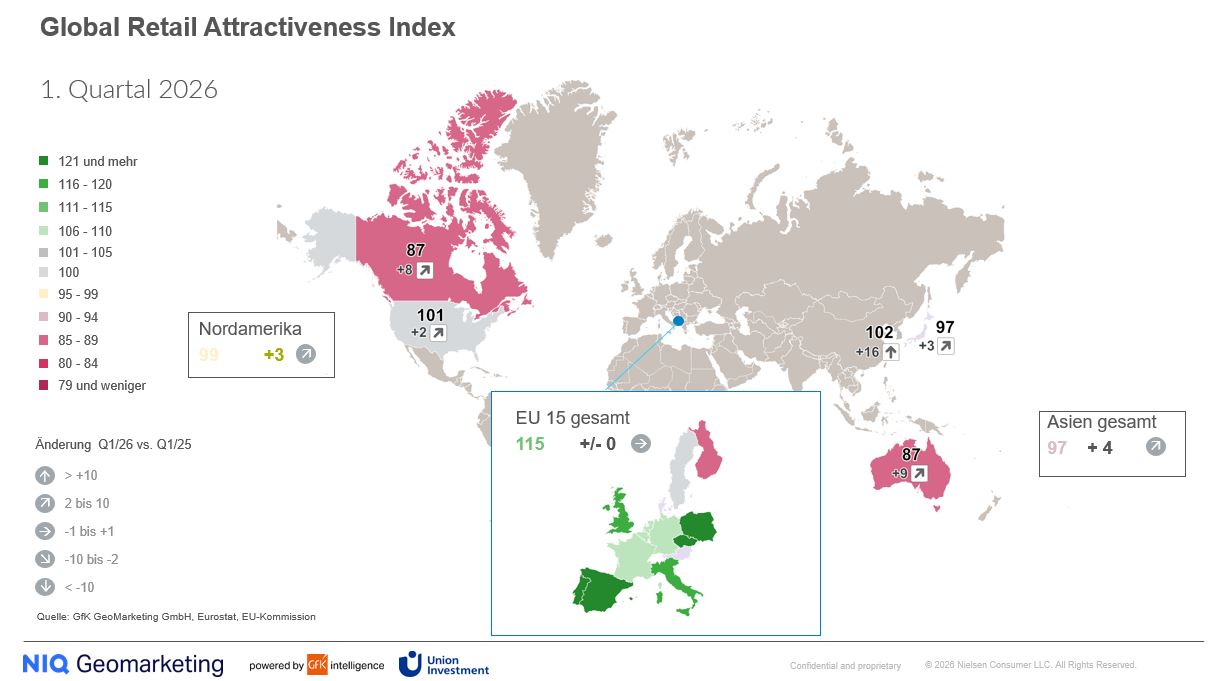
Despite growing geopolitical and economic uncertainty, Europe remains the world’s most attractive retail region. This is the result of the latest Global Retail Attractiveness Index (GRAI), which is compiled by Union Investment and NIQ-GfK. Although the EU-15 retail trade index weakened slightly in the first quarter of 2026 after the strong momentum of 2025, the region still reaches an impressive 115 points, maintaining a significant lead over North America (99 points) and Asia-Pacific (97 points).
Although consumer sentiment and retailer confidence have weakened slightly overall over the past two quarters, driven by higher energy prices, ongoing geopolitical tensions and ongoing economic uncertainty, actual retail activity continues to hold up. Across the EU-15 region, retail remains positive and supports the overall market outlook.
“Accordingly, the European retail market is showing signs of stabilization rather than contraction. The combination of moderate confidence and healthy retail indicates a market that remains active, adaptable and able to absorb external shocks,” says Roman Müller, Head of Investment Management Retail at Union Investment. In an increasingly volatile geopolitical and economic environment, this stability has become Europe’s biggest competitive advantage.
“What distinguishes Europe is not explosive short-term growth, but balance and resilience. Retailers remain healthy, consumers continue to spend, and many retailers maintain their confidence despite difficult macroeconomic conditions,” says Laura Roll, Senior Investment Manager Retail at Union Investment.
Stable consumption despite weaker sentiment
One of the most striking developments in the current GRAI, which combines consumer and retail confidence, unemployment rate and retail sales, comes from the Czech Republic. The country recorded one of the strongest increases in consumer confidence in the whole of Europe (+16.2 points), while at the same time retail confidence fell dramatically (-24.5 points). This unusual divergence reflects a market in which households are increasingly optimistic, while retailers remain cautious about the future economic situation. Despite the weaker sentiment in the retail sector, however, the Czech Republic remains one of the best-performing retail markets in Europe overall: With an index value of 126 points in the first quarter of 2026, the country is well above the EU average and behind Poland (136 points) in 2nd place in the current GRAI. Portugal follows in 3rd place with 123 points.
France is another example of the uneven developments that are currently shaping the European retail landscape: consumer confidence remains weak, labour market indicators continue to deteriorate, and the country recorded a further decline in its overall retail trade index by minus two points to 109 points. Nevertheless, the retail sector itself remains positive, which once again underlines the general European pattern of resilient consumer activity despite weaker sentiment.