Austria to reach 11TWh solar power generation target well before 2030, forecasts GlobalData
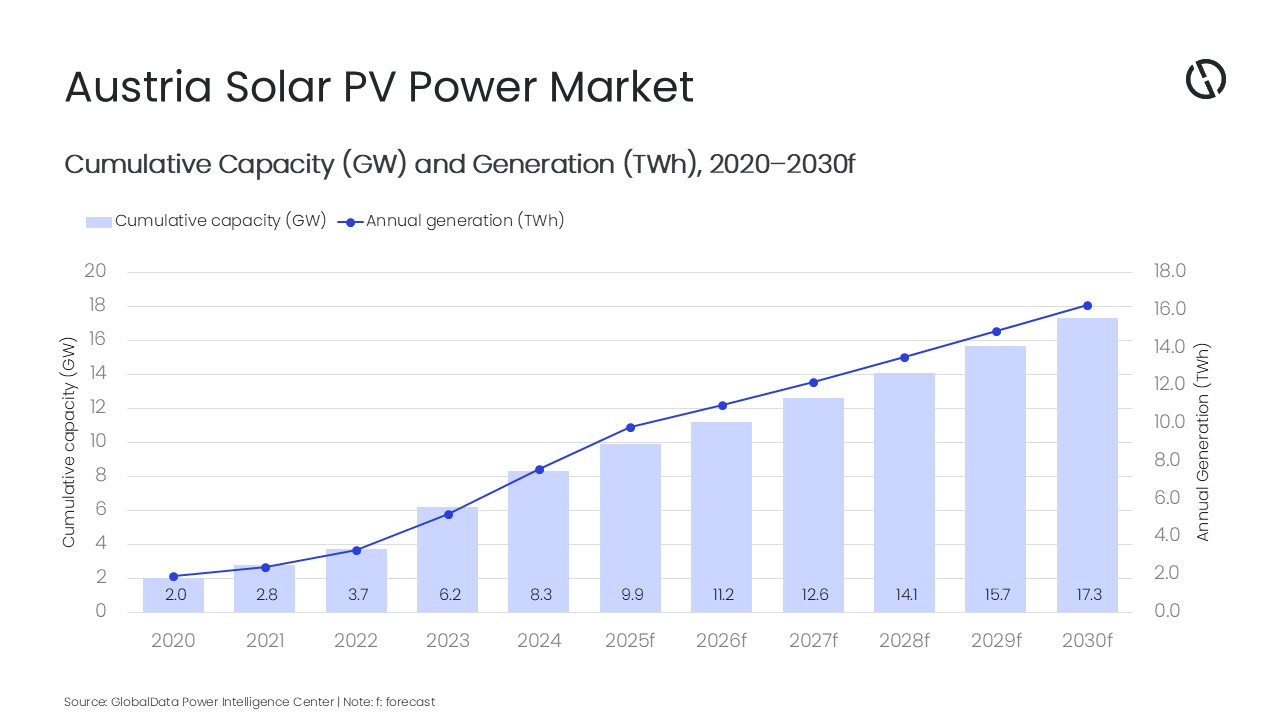
Austria’s solar PV market has recently seen a rapid expansion in capacity. In 2023, the country added about 2.5GW of new solar PV capacity, bringing the cumulative total to approximately 6.2GW. By the end of 2025, that total had grown further to nearly 9.9GW of installed capacity. This places Austria well ahead of linear build‐paths needed to hit the 11TWh target comfortably before 2030, according to GlobalData, a leading intelligence and productivity platform.
GlobalData’s latest report, “Austria Power Market Trends and Analysis by Capacity, Generation, Transmission, Distribution, Regulations, Key Players and Forecast to 2035”, reveals that the country’s solar PV capacity is expected to reach approximately 17.3GW by 2030, while the generation from solar PV is estimated to rise to around 16.3TWh by 2030.
Austria is expected to continue adding around 1.4GW of new solar PV capacity annually from 2026 through 2030, despite delays in permitting, policy uncertainty, and supply chain pressures. Reaching the country’s renewable targets will require accelerating rooftop PV deployment, simplifying regulations, upgrading grids, and pairing solar with sufficient storage and sector coupling to absorb midday peaks and stabilize output.
Sudeshna Sarmah, Power Analyst at GlobalData, comments: “Strong legal mandates especially via the Renewable Energy Expansion Act (EAG) are driving Austria’s solar boom. Generous investment grants, “Made in Europe” bonuses, and support for rooftop/open-space PV bolster financial viability. Meanwhile, falling PV module and system component costs combined with rising electricity demand make solar increasingly attractive. Rooftop and distributed systems are growing fast, benefiting from easier siting and permitting, and when coupled with battery storage, they offer flexibility that aligns well with daytime peak demand.
The OeMAG Marktpreis scheme encourages PV developers to align production and investment with real market signals, thereby rewarding efficient project design, favorable siting, and effective integration. The switch increases predictability for small producers while gradually reducing dependence on fixed feed‐in tariffs, thus integrating solar PV more directly into Austria’s broader electricity market.
The Marktprämie scheme and auctions enhance investor confidence and drive down per‐unit solar costs through competitive pressure, further accelerating PV deployment.
Sarmah adds: “Between 2020 and 2030, Austria’s investment in its power sector is expected to see a clear and sustained realignment toward renewables, with solar PV as the linchpin of that transformation. In the 2020-25 period, solar PV investment witnessed a surge, reaching a peak of nearly $4.4 billion in 2023 before moderating in 2025. Solar PV is expected to remain the dominant renewable investment during 2026-30.
For the period from January 2024 through March 2025, Austria implemented a zero-rate value‐added tax for small PV installations and their associated storage systems, dramatically reducing upfront costs and improving returns on investment. Although it was abolished in early 2025 for new contracts, this temporary fiscal incentive played a critical role in lowering financial barriers during a crucial scaling phase.
Sarmah concludes: “The policy instruments—market-based remuneration (Marktpreis), differentiated operational support (Marktprämie), direct investment subsidies (EAG subsidy calls), regional value incentives (Made-in-Europe bonus), storage integration, and favorable tax treatment create a multi-layered incentive architecture. They reduce both investment and operational risks, align producer behavior with market conditions, and foster local industry. In combination, these policies have been central to Austria’s surge in solar PV investment and its trajectory toward 100 % renewable electricity by 2030.”