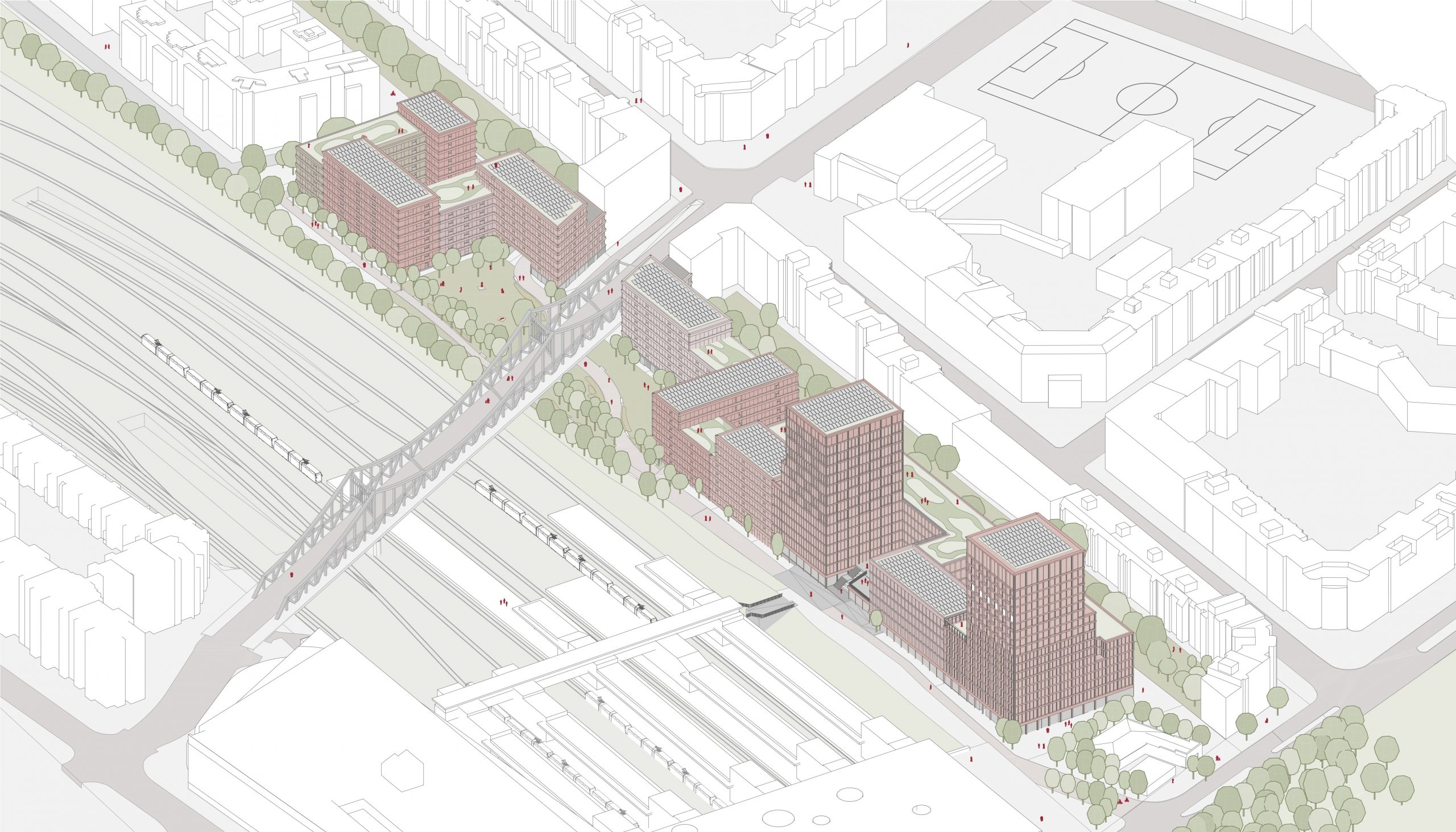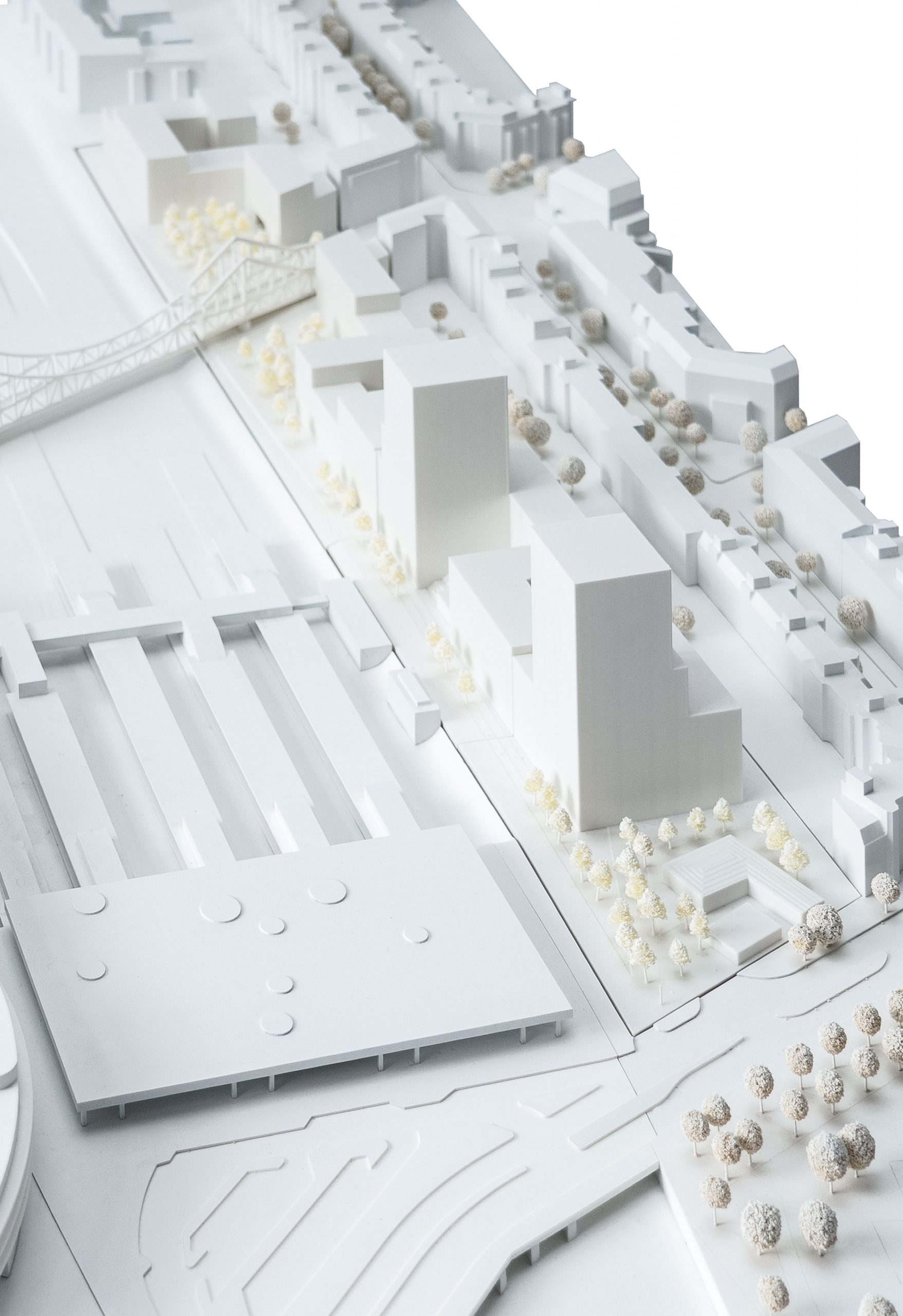
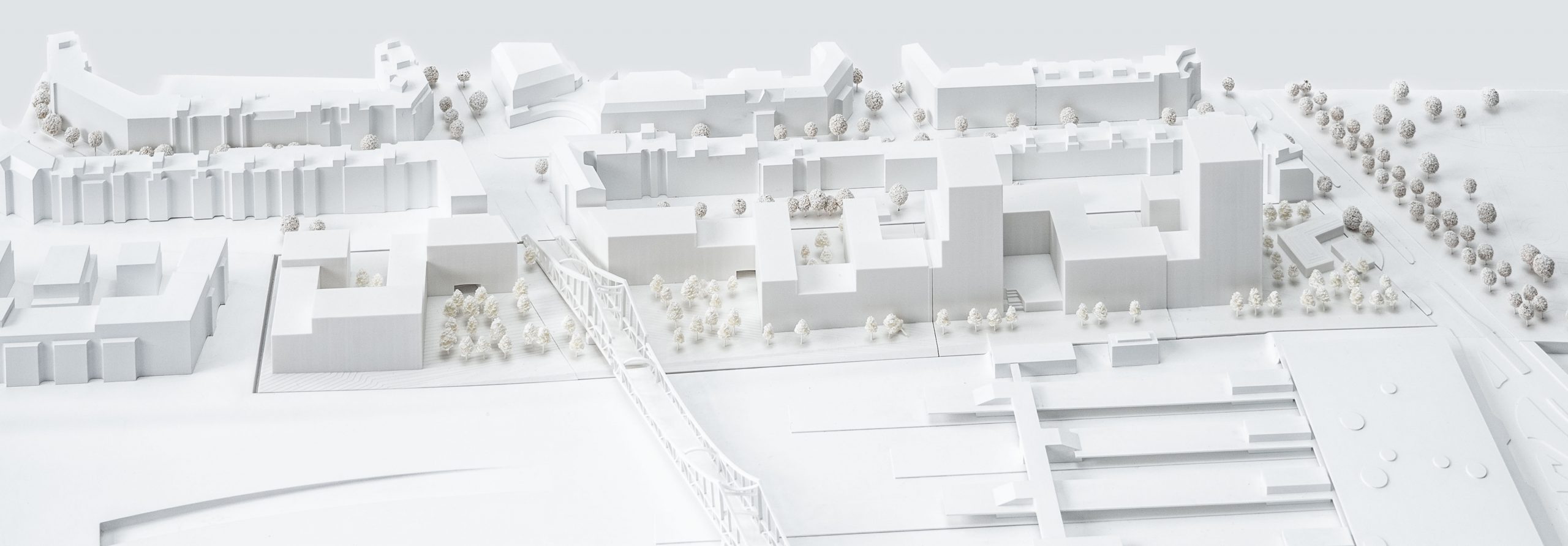
The decision in the two-stage workshop procedure for the “Fountain” district project has been made. The 11-member jury of experts and subject matter unanimously decided in favour of the design by the Berlin architectural firm Max Dudler. A total of six offices from Berlin, Hamburg and Copenhagen took part in the process. The client was the globally active real estate investment manager Hines, who, as the project developer, carried out the procedure in close coordination with the Senate Department for Urban Development, Building and Housing and the Berlin Mitte District Office. The process was accompanied by the Berlin competition office C4C.
The aim of the workshop procedure was to develop an overall urban development concept for the planning area south of the railway line as a basis for the subsequent development plan procedure. The aim is to tap into the previously untapped potential of the site and to design a long-term sustainable district solution that takes into account the central and urban location. The concept envisages high-quality, mixed uses, which complement the existing retail location with urgently needed living space and commercial space. In doing so, the integration of the new construction project into the surrounding buildings, the link with the neighbourhoods and the determination of appropriate building heights for the location must be taken into account.
According to the jury’s assessment, the Max Dudler architectural firm has fully succeeded in developing a consistent morphology across the entire area and all uses. In the jury’s view, this quality makes the design a robust basic framework that can react flexibly to changing requirements and at the same time offers sufficient scope for further elaboration. The outdoor spaces are clearly structured, the version of the public space is concisely worked out.
The jury assessed the qualities of open space as a particular strength. The embedding of the listed Świnoujście Bridge in a newly emerging public green space is also viewed positively from a monument preservation point of view. The jury sees the more than 5,000 square metre open space as a special added value that extends far beyond the neighbourhood. For example, a previously little-used location at Gesundbrunnen is to be developed into a lively urban quarter with public green space, new apartments, workplaces and offers for the neighborhood.
The selected design now provides the basis for the further development of the urban development concept and the subsequent development plan procedure. A quarter with a broad mix of residential uses, including subsidized apartments, daycare facilities, gastronomy, large-scale retail, office and hotel uses is planned. In the future, up to 900 people could live here and about 1,200 employees could work here. A special advantage of the location is the direct location at the Berlin Gesundbrunnen train station. As one of the capital’s most important transport hubs, it connects long-distance and regional traffic with the Ringbahn and the north-south S-Bahn, thus ensuring excellent connections to the future district.
“It is important to us to think ahead about the location with a view to the district and to develop a joint solution in partnership with the district and the senate administrations that creates added value and is in line with the city’s objectives. These aspects are reflected particularly well in Max Dudler’s design,” emphasizes Alexander Möll, Head of Northern & Central Europe at Hines.
“I am very pleased that the Max Dudler architectural firm has presented an excellent overall urban planning and open space planning concept for an urban quarter,” says Senate Building Director Prof. Kahlfeldt. “The absolutely convincing combination of living and working in combination with the corresponding local amenities and social facilities are the right approach for a new, well-designed quarter at Gesundbrunnen station.”
Ephraim Gothe, district councillor from the Mitte district office of Berlin, adds: “It is fantastic that housing for almost 900 people, a third of whom are subsidised, is being created in such a central location. The configuration of the park can also be described as particularly successful: a highly attractive open space is being created around the historic bridge, which presents itself like a sculpture and will shape the quarter.”