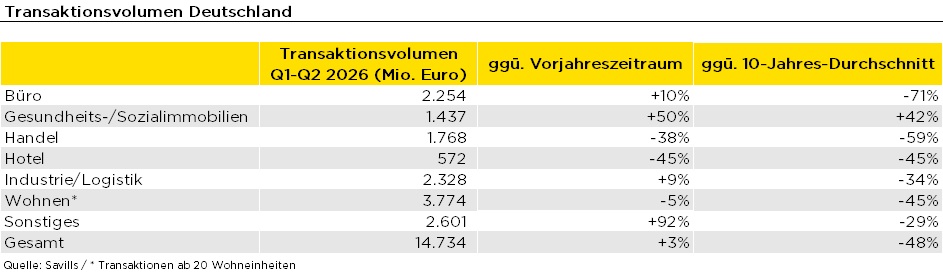
According to Savills, the transaction volume in the German investment market for commercial and residential real estate* amounted to approx. EUR 14.7 billion in the first half of 2026, on a par with the previous year (approx. EUR 14.4 billion). As in the previous year, the 2nd quarter was significantly weaker in sales than the 1st quarter in the current year. While last year it was the US tariff policy that weighed on the market from the spring, the ongoing conflict in the Middle East now slowed down activity.
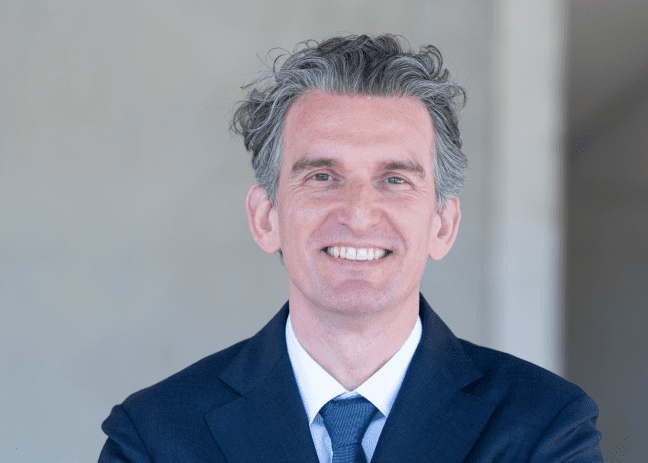
Karsten Nemecek, Deputy CEO Germany at Savills and responsible for Capital Markets, comments on market developments as follows: “Many market participants are looking for orientation in the persistently uncertain environment and are slow to find it. This leads to unusually long decision-making and transaction processes with continued limited market liquidity. Especially in the case of large-volume transactions, many processes are still aborted. At the same time, however, it is becoming increasingly clear which properties fit the current demand. Today, owners can better assess which properties can be sold in the current environment and at what price, and select their properties accordingly in a more targeted manner. In the future, this could lead to more deals.”
Only healthcare and social properties with take-up above the 10-year average
The number of transactions in residential real estate* increased the most – nevertheless, the transaction volume was 5% below the previous year’s figure because the average transactions were noticeably smaller than in the previous year. Nevertheless, the residential segment remained by far the strongest in terms of take-up in the 1st half of the year (approx. 3.8 billion euros). This is followed by industrial and logistics properties as well as offices (2.3 billion euros each), whose turnover was each about a tenth above the previous year’s level. Turnover in retail properties, on the other hand, fell by more than a third to just under EUR 1.8 billion. With an increase of 50%, healthcare/social real estate showed the largest increase in turnover of all uses. It is also the only segment in which the transaction volume was above the average of the last ten years (+42%). The acquisition of Cofinimmo by Aedifica, which accounts for about half of the half-year turnover, made a significant contribution to this.
Few real benchmarks in the large-volume segment
Transactions in the three-digit million range remained rare overall, and often it even took special circumstances for them to take place at all, as Matthias Pink, Head of Research Germany at Savills, explains: “Of the ten largest individual property transactions in the first half of the year, the public sector was on the buyer’s side in five cases. Two further sales were made as a result of insolvencies. This leaves only three transactions that are suitable as real benchmarks for the market – and they are offset by numerous aborted sales processes. Especially in the case of large-volume office properties, the number of potential buyers continues to be very small, regardless of the risk class.” The fact that public sector institutions were on the buyer side in some of the largest transactions of the current year is also reflected in their acquisition volume: In the 1st half of the year, they acquired properties for more than EUR 2 billion, which is already the same as in the whole of 2025. Conversely, institutional investors remained extremely cautious. As direct investors, pension funds (purchase volume of 150 million euros), insurance companies (75 million euros) and the like played almost no role at all in the 1st half of the year. The same applies to open-ended real estate mutual funds as typical buyers of large properties, which have appeared exclusively as sellers in recent months. Family offices and private investors, on the other hand, continued to play a disproportionately large role in a long-term comparison, with a purchase volume of just under EUR 1 billion. However, they appeared much less frequently than last year in purchases of more than EUR 50 million.
Outlook: Stable demand meets growing supply and rising price pressure
Overall, according to Savills, demand is stable, but not increasing. On the other hand, there is a large and growing supply. Together with the rise in interest rates since the beginning of the Middle East conflict, this is increasing the pressure on prices. In particular, initial yields for properties outside the top segment moved upwards in the 2nd quarter. In some cases, however, prime yields also rose. Savills expects a further increase in the coming months. Nemecek outlines the overall outlook for the rest of the year as follows: “Last year, a weak second quarter was followed by a much stronger second half of the year. It remains to be seen whether this pattern will be repeated in 2026. The ongoing uncertainty rather speaks for a continued wait-and-see attitude on the part of many investors. At the same time, the supply and pragmatism on the seller side are increasing. However, we do not see a fundamental change in the dynamics of the market at the moment.” In its baseline scenario, Savills therefore continues to expect a transaction volume of around EUR 35 billion for 2026.
* only transactions from 20 residential units