
Climate change is fundamentally changing the risk landscape for buildings. For the first time, Wüest Partner and CLIMADA Technologies have analysed the future physical climate risks for around 23 million buildings in Germany. The results show that the risks will shift significantly by 2050: Depending on the emission scenario, up to 68 percent of all buildings could be exposed to high to very high heat stress. At the same time, heavy rainfall is developing into one of the greatest climate risks for real estate, while other climate risks are developing significantly differently from region to region. Individual risk analyses are thus becoming significantly more important for investment, valuation and location decisions.
The study analyses the development of heat, heavy rainfall, river and coastal floods, storms and landslides and shows their development up to 2050 under various emission scenarios.
“Climate risks are becoming a key location and value factor. Anyone who invests in real estate or manages portfolios today must take greater account of the future climate resilience of a location than before,” says Dr. Michael Heigl, Director at Wüest Partner.
Heat stress and heavy rainfall as well as regional differences are increasing significantly
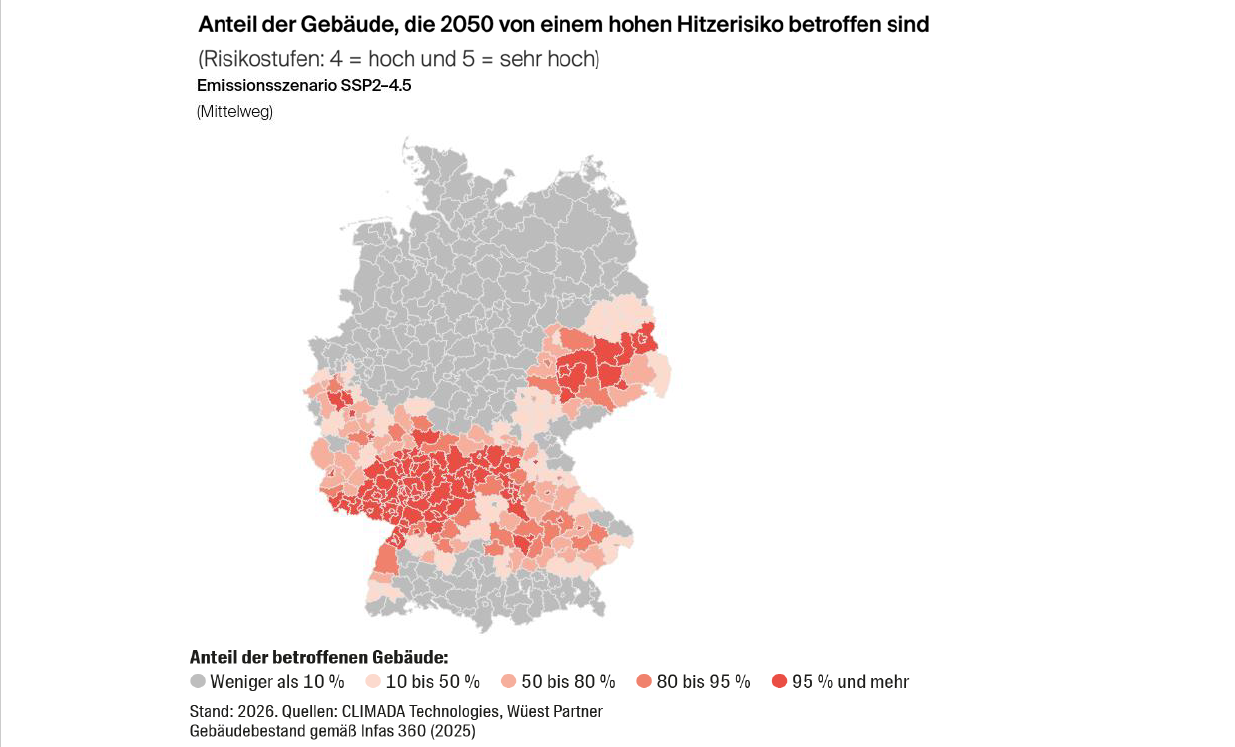
The risk increases particularly significantly due to heat. While hardly any buildings were exposed to high to very high heat stress in the historical reference period, this could be up to two-thirds of all buildings by 2050, depending on the emission scenario. The southern and central parts of Germany as well as densely built-up urban areas are particularly affected. As emissions rise, the risk is increasingly spreading northwards.
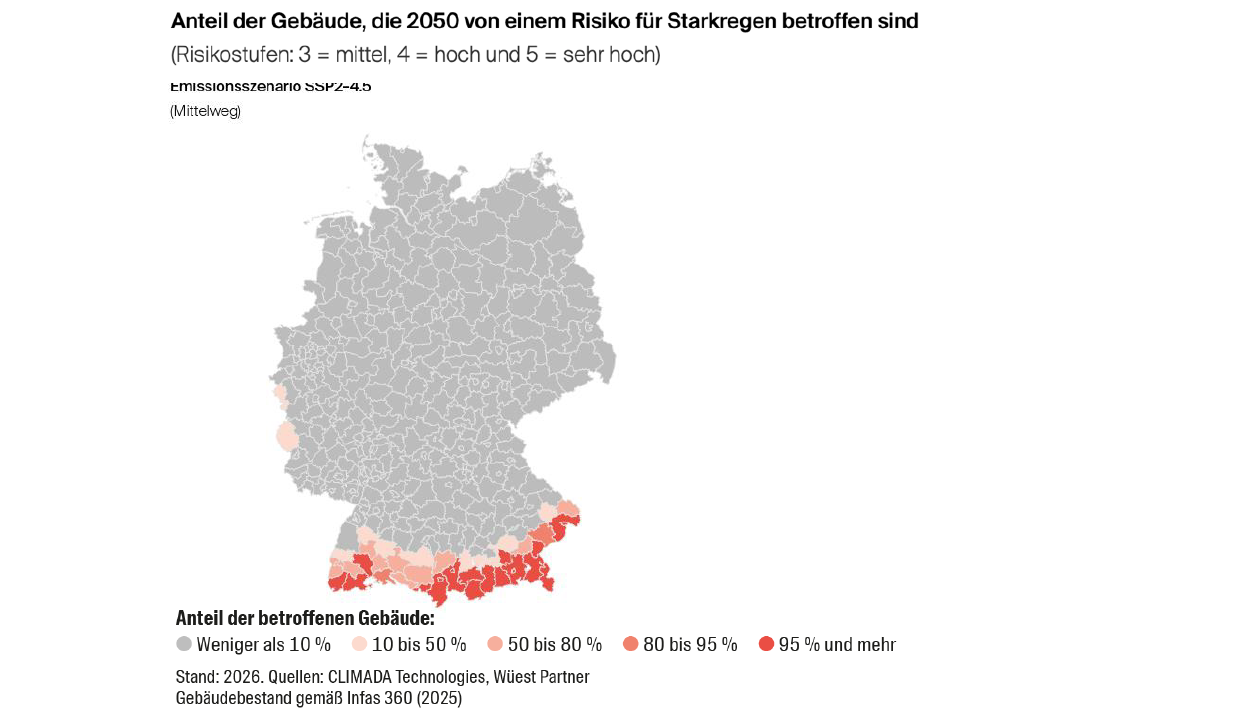
The risk of heavy rain also increases significantly. Since warmer air can absorb more moisture, heavy precipitation becomes more intense. By 2050, the proportion of buildings at risk could rise from around 0.4 percent today to over 10 percent. The risk remains high, especially in southern Germany and the low mountain ranges, while at the same time it is increasingly spreading to the north and west.
In contrast, the risk of classic river floods is partially reduced in some regions. At the same time, heavy rainfall events with local flooding and surface runoff are becoming significantly more important.
Regional changes are also evident in other climate risks. The risk of coastal flooding increases significantly, especially on the North Sea coast, and in some cases also increases on the Baltic Sea. The risk of storms remains high, especially in the north and west of Germany, but its further development is associated with greater uncertainties. The risk of landslides remains low overall, but could double or triple by 2050, depending on the emission scenario, and affects low mountain ranges and alpine peripheral areas in particular.
Consequences for the real estate industry
The results make it clear that climate risks will have to be taken into account even more strongly in investment, valuation, financing and ESG decisions in the future. Site-specific analyses are becoming indispensable because risks develop very differently from region to region.
“For the first time, the analysis creates a Germany-wide database to objectively assess physical climate risks and make informed decisions for portfolios, portfolios and project developments. Those who analyze physical climate risks at an early stage and take appropriate adaptation measures can contribute to the resilience and value retention of the building stock,” says Dr. Michael Heigl.
The full study can be found here: Climate Change and Future Risks