New all-time solar high in Germany: 12 billion kWh of solar power in one month for the first time – IWR explains misunderstandings about EEG subsidies
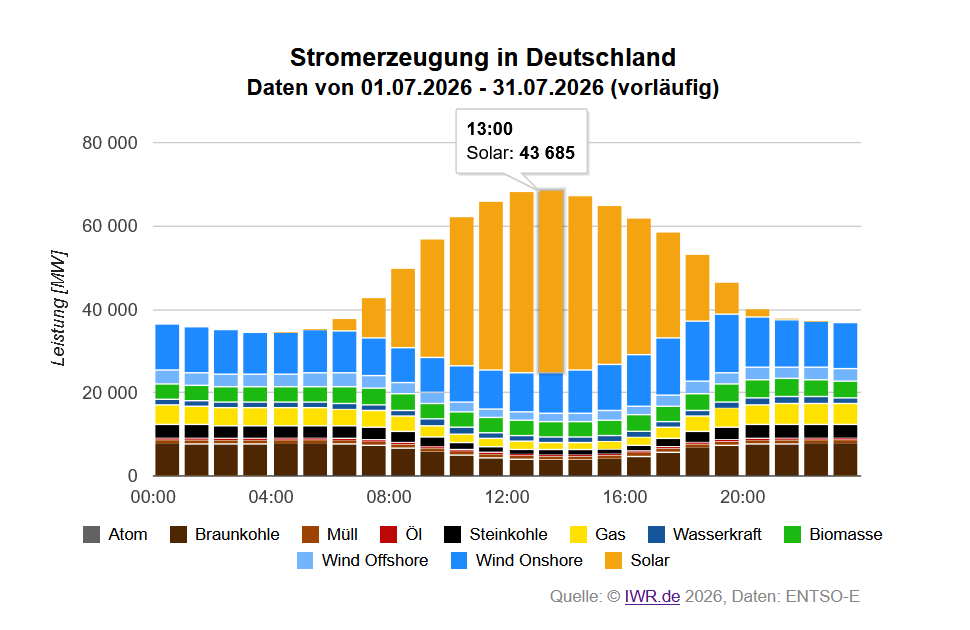
Photovoltaics reached a historic milestone in Germany in July 2026. For the first time, 12 billion kilowatt hours (kWh) of solar power were fed into the public power grid in a single month. This is the result of an evaluation of quarter-hourly feed-in data from the European grid operator platform ENTSO-E by the International Economic Forum for Renewable Energies (IWR) in Münster. In fact, the total solar power generation is even significantly higher, as the solar power consumed directly on site is not recorded in the feed-in statistics.
At the same time, the evaluation illustrates the significantly increased importance of photovoltaics for Germany’s electricity supply. At lunchtime, the monthly average solar power in July was over 40,000 MW. This corresponds to the electrical output of more than 40 nuclear power plants, each with 1,000 MW. Throughout the day, photovoltaics thus displaced a significant part of electricity generation from coal- and gas-fired power plants.
Photovoltaics will become the mainstay of the power supply
The July data mark a structural change in the German electricity system. Photovoltaics has long since ceased to be a complementary technology, but is one of the central building blocks of the power supply. Over the past two decades, this development has been made possible by millions of private homeowners, farmers, commercial enterprises and medium-sized companies that have invested in solar systems.
Against this background, the current legal framework, especially for smaller photovoltaic systems, is changing the economic conditions for precisely the operator group that has made the expansion so far possible.
“Today, photovoltaics is a mainstay of Germany’s electricity supply. This makes it all the more important to have an objective discussion about the actual EEG differential costs. However, the frequently used term solar subsidy is misleading. It gives the impression that every kilowatt hour fed into the grid is paid for entirely from state funds. In fact, the EEG only compensates for the difference between the stock market proceeds and the statutory remuneration claim for new photovoltaic systems. This misunderstanding still shapes the public debate today,” says Dr. Norbert Allnoch, Managing Director of the International Economic Forum for Renewable Energies (IWR).
IWR on EEG solar subsidies: The difference costs are decisive
New photovoltaic systems on residential buildings are currently entitled to a statutory remuneration of around 7 cents per kilowatt hour fed into the grid. This often gives the impression that these 7 cents are the state solar subsidy. However, this is wrong.
In fact, the EEG for new photovoltaic systems is based on a differential cost model. The solar power generated is first sold on the electricity exchange. The entire marketing proceeds flow into the EEG account. The EEG account will then only be used to compensate for the difference between the stock exchange proceeds and the statutory remuneration claim. Only this difference causes EEG differential costs at all.
An example illustrates the mechanism: If the solar power sold on the electricity exchange generates revenue of 5 cents per kilowatt hour and the statutory remuneration entitlement is 7 cents, only 2 cents per kilowatt hour are offset from the EEG account. If, on the other hand, the exchange price rises to 8 cents per kilowatt hour, the entire 8 cents will initially flow into the EEG account. The plant operator receives his statutory remuneration entitlement of 7 cents, 1 cent remains in the EEG account.
The legal remuneration entitlement of new photovoltaic systems of around 7 cents per kilowatt hour is now in a similar order of magnitude to the exchange electricity prices. The actual EEG differential costs of new plants are therefore often significantly lower than the statutory remuneration claim – or even completely eliminated with correspondingly high marketing revenues.
Thus, it is not the statutory remuneration claim that determines the EEG differential costs, but only the difference between the stock exchange proceeds and the statutory remuneration claim.
Contaminated sites: Historical remuneration contracts still determine the EEG differential costs today
Against this background, the public discussion about the costs of photovoltaics often falls short. Today’s EEG differential costs are mainly determined by old PV systems and not by newly installed photovoltaic systems with remuneration claims of around 7 cents per kilowatt hour. The currently planned new regulations do not change the remuneration scheme for older plants, which were built in particular between 2010 and 2013. Due to the significantly higher investment costs at the time, statutory remuneration rates of 30 to over 40 cents per kilowatt hour still apply to these systems.
These remuneration entitlements are valid for 20 years in each case and will only expire gradually between 2030 and 2033. Only with the expiry of these old contracts will the historical EEG differential costs decrease significantly, regardless of the remuneration for new photovoltaic systems.